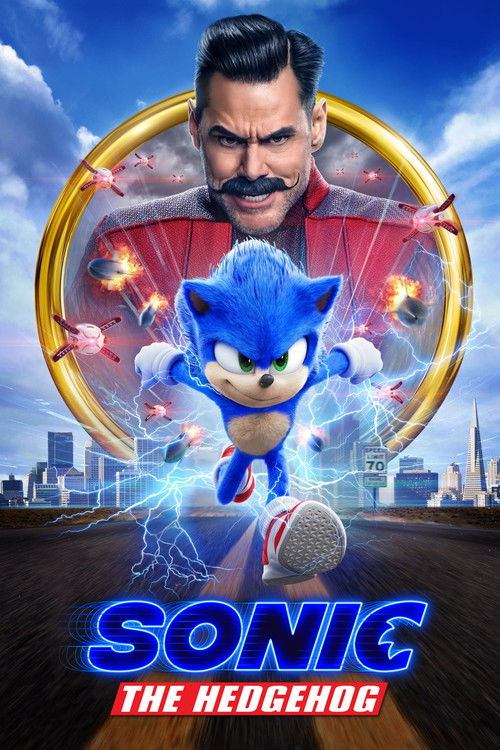
Sonic the
Hedgehog
IMDb Rating
175K+
IMDb Votes
63%
Rotten Tomatoes
$319M
Box Office
Synopsis & Review
Directed by first-time feature filmmaker Jeff Fowler and produced by Paramount Pictures and Sega, Sonic the Hedgehog arrived in February 2020 under circumstances that made its success feel almost improbable. The film had been through a spectacular pre-release crisis — when the original trailer debuted in April 2019, fan reaction to the hyper-realistic, anatomically unsettling design of the title character was so overwhelmingly negative that Paramount made an unprecedented decision: they delayed the film by three months and hired a new visual effects team to redesign Sonic from scratch, at enormous cost and in record time. The gamble paid off. The redesigned Sonic — rounder, more cartoonish, truer to the Sega games — was embraced immediately. The film follows Sonic (Ben Schwartz), a small blue extraterrestrial hedgehog who has been living in secret in the Montana town of Green Hills, befriending the locals from a distance and watching over them. When his presence is detected by the U.S. government, the eccentric and magnificently unhinged Dr. Robotnik (Jim Carrey) is dispatched to capture him. Sonic teams up with a good-natured local sheriff, Tom Wachowski (James Marsden), to retrieve his bag of magical golden rings — his only means of escaping to safety — while staying one step ahead of Robotnik's relentless, gadget-heavy pursuit.
Sonic the Hedgehog is not a film that operates on the level of The Super Mario Bros. Movie in terms of scale or cultural weight, but it does something almost more difficult: it is genuinely likeable in the way of a well-crafted family comedy, the kind that works because its central relationship is warm rather than because its spectacle is overwhelming. Ben Schwartz's voice performance as Sonic is a delight — fast-talking, emotionally transparent, and saddled with the film's most touching undercurrent, which is Sonic's profound loneliness. Jim Carrey's Robotnik, however, is the film's true reason for existing. Carrey plays the villain as a barely contained eruption of ego and genius, a performance rooted entirely in the physical comedy tradition of his 1990s peak but deployed with a gleeful self-awareness that reads as pure pleasure. He is, quite simply, hilarious. The film's $319 million global box office — achieved partially during the early weeks of the COVID-19 pandemic — confirmed that video game adaptations built around charm rather than mythology could succeed on their own terms. The franchise it spawned has continued profitably, a rare achievement in the genre.
Why Watch This Movie?
Jim Carrey's Return to Form — Robotnik as Pure Spectacle
Jim Carrey's Dr. Robotnik is the kind of performance that reminds you what made him a star in the 1990s and what most of his films since have failed to deploy. He plays the character as a manic, narcissistic, physically brilliant buffoon — treating every scene as an opportunity for escalating physical comedy and line delivery that no other actor in Hollywood could or would attempt. The scene in which he discovers Sonic's quill and begins to comprehend its energy, narrated as an internal monologue of mounting scientific ecstasy, is genuinely one of the funniest moments in any recent family film. Carrey committed completely and the result is a villain performance that teenagers and adults will quote long after the film's plot is forgotten.
The Redesign Story — A Hollywood Lesson in Listening to Fans
The decision to scrap and rebuild Sonic's design in response to fan backlash is one of the most remarkable stories in recent blockbuster filmmaking. Paramount spent an estimated additional $5 million and pushed the release date back three months — an enormous financial and logistical risk. But the story behind that decision is ultimately a positive one: a major studio listened, acknowledged the criticism was valid, and fixed the problem. The new design is genuinely excellent, capturing the rounded, expressive warmth of the game character without the uncanny valley horror of the original. The film's success validated the decision and set a precedent for how studios handle IP that comes with a deeply passionate pre-existing community.
A Surprisingly Warm Buddy Comedy at Its Core
Strip away the Sega branding and Sonic the Hedgehog is a road movie about a lonely outsider and a small-town cop who need each other more than they initially admit. The relationship between Sonic and Tom Wachowski (James Marsden, charming and underrated here) has genuine warmth — Sonic's loneliness is played with more emotional weight than the film's marketing suggested, and the pay-off, in which he finally finds a real home and a real family, lands with unexpected sincerity. It is the film's secret strength, and it is what elevates it from a functional game adaptation into something children will return to willingly rather than being dragged back to by younger siblings.
Cast & Crew
Director
Jeff Fowler
Screenplay
Pat Casey & Josh Miller
Based On
Sega's Sonic the Hedgehog
Sonic (Voice)
Ben Schwartz
Dr. Robotnik
Jim Carrey
Tom Wachowski
James Marsden
Maddie Wachowski
Tika Sumpter
Original Score
Tom Holkenborg (Junkie XL)
Studio
Paramount / Sega
Official Trailer
© Paramount Pictures / Sega. Trailer embedded via YouTube.
Frequently Asked Questions
Why did Paramount redesign Sonic after the first trailer, and how expensive was it?
When the first official trailer for Sonic the Hedgehog was released in April 2019, the response was immediate and catastrophic. The original design gave Sonic human-like teeth, small eyes set far apart, and a body that attempted photorealistic musculature — a character who looked profoundly wrong to anyone familiar with the games. The trailer became one of the most mocked in recent Hollywood history within hours, with the phrase "cursed Sonic" spreading across social media. Director Jeff Fowler responded publicly within 24 hours, announcing that the character design would be changed before the film's release — an extraordinary promise given the scale of the visual effects work involved. The redesign required Paramount to push the release date from November 2019 to February 2020 and cost an estimated $5 million in additional visual effects work. The VFX studio Marza Animation Planet was brought in alongside the original effects team to execute the redesign at speed. The new Sonic — with larger eyes, a rounder head, and a design faithful to the game's aesthetic — was universally praised when revealed. The episode is now widely cited as evidence that studios can and should respond to fan feedback before release, rather than after.
Why did Jim Carrey choose to return to broad physical comedy for this role?
Jim Carrey had largely stepped away from the kind of broad, physical, cartoon-villain comedy that defined his early career — films like The Mask, Ace Ventura, and Batman Forever — in favour of more dramatically ambitious projects and an increasingly selective approach to Hollywood roles. His decision to play Dr. Robotnik in Sonic the Hedgehog was driven by the character himself: Carrey has spoken in interviews about being drawn to Robotnik's specific combination of arrogant genius, physical expressiveness, and total lack of self-awareness. The role gave him permission to do something he had not done in years — to use his entire body as a comedic instrument without ironic distance. In interviews, Carrey has described the experience as genuinely liberating, noting that Robotnik's utter conviction in his own superiority made him, paradoxically, the most honest character Carrey had played in some time. His performance was so well-received that the sequel Sonic the Hedgehog 2 expanded his role substantially, allowing him to fully realise the iconic, mustachioed Eggman design from the video games in the film's final scenes.
How did the film perform during the COVID-19 pandemic, and what is its legacy?
Sonic the Hedgehog opened on 14 February 2020 — less than a month before the COVID-19 pandemic forced the mass closure of cinemas across North America and Europe. The film earned $58 million in its opening weekend, making it the highest-grossing opening ever for a video game adaptation at that time, and went on to gross $319 million worldwide before theatres began shutting down. The abrupt end of the theatrical window meant the film was made available on digital platforms and Blu-ray much earlier than planned, where it found a massive additional audience of families in lockdown. That combination of theatrical success and home viewing performance cemented the franchise's viability and led directly to the commission of Sonic the Hedgehog 2 (2022), which earned $405 million, and the announcement of a third film and a Knuckles spin-off series for Paramount+. Its legacy is that of a franchise built from a PR disaster, rebuilt by listening to its audience, and sustained by a warmth that outlasted the chaos of its production.
More Movies Like This
If you loved Sonic the Hedgehog, these game adaptations deserve your attention.