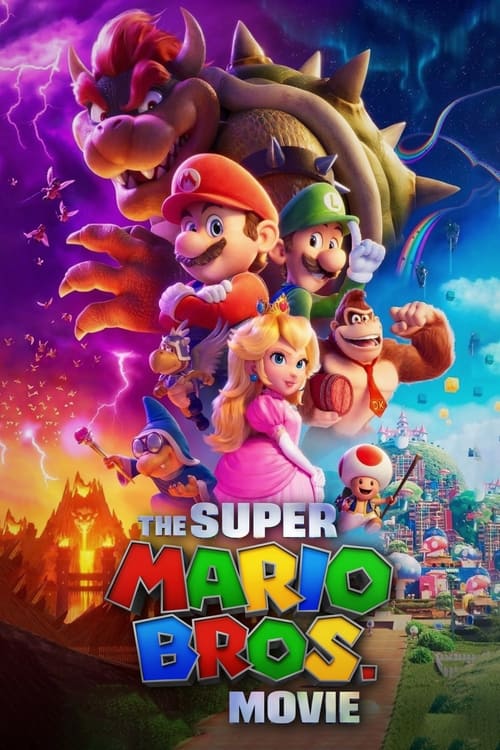
The Super
Mario Bros.
Movie
IMDb Rating
250K+
IMDb Votes
59%
Rotten Tomatoes
$1.36B
Box Office
Synopsis & Review
Directed by Aaron Horvath and Michael Jelenic and produced by Illumination in collaboration with Nintendo, The Super Mario Bros. Movie is the highest-grossing video game adaptation in cinema history — a film that did what dozens of game movies before it had failed to do: capture the pure, uninhibited joy of its source material and deliver it wholesale to the big screen. The story follows Mario (Chris Pratt), a Brooklyn plumber who has staked his savings on a new plumbing business with his brother Luigi (Charlie Day), only to find himself pulled through a pipe into the Mushroom Kingdom. Luigi, separated in the chaos, is captured by the tyrannical Bowser (Jack Black), who is hell-bent on conquering every kingdom in existence — and on marrying Princess Peach (Anya Taylor-Joy) whether she consents or not. Mario must team up with Peach and the Kongs to rescue his brother and stop Bowser before it's too late. The plot is deliberately simple, functioning exactly as a Mario game does: a series of escalating worlds, each with its own visual identity and mechanical logic, building toward a climax of maximalist spectacle.
What makes the film work so comprehensively is its commitment to fan service deployed with genuine craft. Every frame is packed with Nintendo iconography — from the raceway of Mario Kart to the training montage's callback to Donkey Kong arcade — but the references never feel like the point in itself. The animation by Illumination is spectacular: the Mushroom Kingdom has a specific visual texture, warm and chunky and saturated, that feels exactly as the games suggest without being literally photorealistic. Jack Black's Bowser is the film's secret weapon — a hilariously operatic villain who gets his own power ballad and steals every scene he occupies. The film was critically divisive on release, with some reviewers finding it too thin narratively, but audiences were unequivocal: they adored it. The box office — $1.36 billion worldwide — speaks for itself. For a generation raised on Nintendo, this film is an act of love. For children discovering these characters for the first time, it is pure cinematic energy. It is not a deep film. It is a joyful one. Rarely in this genre does that prove to be enough.
Why Watch This Movie?
The Most Faithful Video Game Adaptation Ever Made
Where most game adaptations abandon the source material's tone in pursuit of gritty realism, this film embraces everything that makes Mario Mario. The power-ups, the kingdoms, the kart racing, the music — all of it translated with astonishing care. Nintendo's unprecedented creative control over the production ensured that nothing feels like a corporate approximation. It feels like the games made cinematic, which is an almost impossible thing to pull off and which this film does with seemingly effortless confidence.
Jack Black's Bowser — A Villain for the Ages
Jack Black's performance as Bowser is one of the great animated villain turns in recent memory. He plays the King of the Koopas not as a generic threat but as a magnificent, self-deluding romantic obsessive — a creature of absolute power who is, beneath all the fire and fury, heartbreakingly insecure. His original song "Peaches," delivered with total sincerity at a grand piano, became a genuine cultural phenomenon and a Grammy-nominated moment. It is a comedic performance of extraordinary commitment.
A Film That Proved Video Game Movies Can Be Blockbusters
The industry's assumption for decades was that video game adaptations were inherently B-tier — cursed by the source material's interactivity into producing films that felt hollow by comparison. This film shattered that assumption. With $1.36 billion at the worldwide box office, it became the second-highest-grossing animated film of all time at the time of its release, and set a commercial and creative benchmark that will define the genre for years. It changed what the industry believes is possible with game IP.
Cast & Crew
Directors
Aaron Horvath & Michael Jelenic
Screenplay
Matthew Fogel
Based On
Nintendo's Mario franchise
Mario
Chris Pratt
Bowser
Jack Black
Princess Peach
Anya Taylor-Joy
Luigi
Charlie Day
Original Score
Brian Tyler
Studio
Illumination / Nintendo
Official Trailer
© Universal Pictures / Illumination / Nintendo. Trailer embedded via YouTube.
Frequently Asked Questions
Why did Nintendo insist on creative control over the film, and how did it change the result?
Nintendo was historically protective of its IP, having been deeply burned by the 1993 live-action Super Mario Bros. film — a famously troubled production that took the characters in a dystopian, unrecognizable direction and was widely panned. For this 2023 project, Nintendo co-president Shigeru Miyamoto served as a producer alongside Illumination CEO Chris Meledandri and insisted on final approval over all creative decisions, including character design, tone, and the way the game universe was represented. This unprecedented level of involvement meant the film hewed as closely as possible to the aesthetic and feel of the games. Characters look and behave as they do in the Nintendo catalogue, the music (adapted from the original game composers) is faithful, and the world-building is entirely consistent with established lore. The result was a film that felt designed by people who deeply respected the source material rather than people who wanted to use it as a launching pad for something else — and audiences responded accordingly.
Why was Chris Pratt's casting as Mario so controversial?
When Chris Pratt's casting was announced in 2021, the reaction was overwhelmingly negative from the gaming community, for two primary reasons. First, fans had expected Charles Martinet — the voice actor who has played Mario in virtually every Nintendo game since 1995 — to take the role. His absence felt like a betrayal of the character's established identity. Second, many critics argued that casting a major Hollywood star rather than a voice specialist prioritized commercial recognition over artistic fit. The concern that Pratt would simply use his natural voice, producing a generic "action hero Mario" with no Italian inflection or personality, was widely shared. When the first trailer dropped and confirmed that Pratt's Mario sounded essentially like Peter Quill with slightly more Brooklyn, the backlash intensified. In practice, the voice performance is somewhat better than expected — Pratt makes a genuine effort with the accent — but it remains the element of the film most frequently cited as a disappointment.
How did "Peaches" by Jack Black become a Grammy-nominated cultural moment?
"Peaches" is a scene in which Bowser, seated at a grand piano in his fortress, performs an earnest, sweepingly sincere power ballad about his love for Princess Peach. The song was written and performed by Jack Black, who is also — under the name Tenacious D — a genuinely accomplished rock musician. The genius of the scene is that it is played with complete sincerity: there is no winking at the camera. Bowser means every word. The juxtaposition of this fearsome conqueror being revealed as a lovelorn, self-deluded romantic through the medium of soft rock is one of the best comedic ideas in recent animated cinema. The song was released as a single, charted in multiple countries, went viral on TikTok, and was nominated for a Grammy Award for Best Song Written for Visual Media. Black subsequently performed it live at the Oscars, making it one of the more surreal moments in recent awards history. The film is worth seeing for this scene alone.
More Movies Like This
If you loved The Super Mario Bros. Movie, these game adaptations are worth your time.