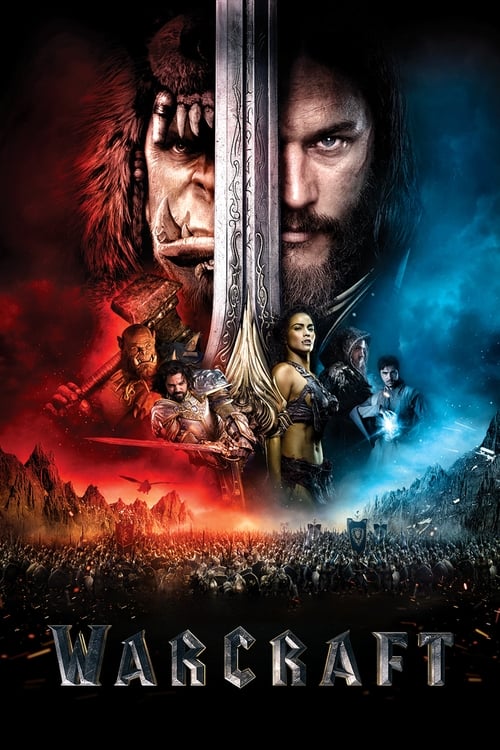
WARCRAFT
IMDb Rating
310K+
IMDb Votes
28%
Rotten Tomatoes
$439M
Box Office
Synopsis & Review
Directed by Duncan Jones — son of David Bowie, director of the acclaimed science fiction films Moon and Source Code — and released in June 2016 after a decade of development at Legendary Pictures and Blizzard Entertainment, Warcraft is simultaneously one of the most ambitious video game adaptations ever attempted and one of the most instructive case studies in the genre's particular difficulties. The film adapts the lore of Blizzard's original 1994 real-time strategy game and the expanded universe of World of Warcraft, the MMORPG that at its peak attracted over twelve million subscribers worldwide. The story is set on the dying world of Draenor, where the Orc shaman Gul'dan (Daniel Wu) has opened a portal to the human realm of Azeroth using the Fel — a dark magic powered by life force — bringing the Orc Horde through to conquer new land. Among the Orcs, the warrior chieftain Durotan (Toby Kebbell, in a motion-capture performance of considerable emotional weight) begins to question Gul'dan's methods when he realises the Fel is corrupting the Horde from within. On the human side, the knight commander Anduin Lothar (Travis Fimmel) and the young mage Khadgar (Ben Schnetzer) investigate the magical threat, allying with the Guardian Medivh (Ben Foster), Azeroth's most powerful sorcerer, whose own relationship with the Fel proves more complicated than expected. The half-Orc Garona (Paula Patton) occupies the space between both worlds, mistrusted by each and serving as the film's nominal emotional bridge across the conflict.
The critical reception to Warcraft was devastating — a 28% on Rotten Tomatoes that placed it among the most poorly reviewed blockbusters of the decade — and centred on two primary objections: that the film was incomprehensible to anyone unfamiliar with the games' lore, and that its human characters were significantly less engaging than its Orc characters. Both criticisms have merit. The screenplay attempts to serve two masters simultaneously — accessible blockbuster entertainment and faithful adaptation of an extraordinarily dense fictional universe — and the compromise pleases neither audience fully. For viewers with no prior knowledge of Warcraft lore, the exposition is relentless and the emotional stakes arrive before the characters have been sufficiently established to earn them. For lore-fluent fans, certain narrative compressions feel like violations of the world's internal logic. And yet the film's audience scores tell a different story: its IMDb rating of 6.8 from over 310,000 voters is substantially higher than its critical score, and its $439 million global box office — driven by a staggering $220 million from China, where it broke multiple opening-week records — suggests that the film connected with an audience that critics were not speaking for. Duncan Jones has stated publicly that Legendary's insistence on cutting approximately forty minutes of character development from his original cut significantly damaged the film's coherence, and that the theatrical release is not the film he made. The existence of a director's cut that has never been released remains one of the more tantalising footnotes in recent blockbuster history.
Why Watch This Movie?
Durotan — The Most Emotionally Compelling CGI Character of Its Era
The film's most universally praised element is Toby Kebbell's motion-capture performance as Durotan, the Frostwolf Orc chieftain who serves as the film's moral centre. Rendered by Industrial Light & Magic with a level of facial expressiveness and physical detail that set a new benchmark for photorealistic CGI characters in 2016, Durotan is a genuinely moving figure — a warrior father whose love for his newborn son and his people places him in direct conflict with the power structure that is destroying both. The scene in which he and his mate Draka release their baby into a river to save him from the Fel — an infant who will eventually become Go'el, the hero known in the games as Thrall — is the film's finest moment and would not be out of place in a serious fantasy drama of considerably higher prestige. The Orc scenes throughout the film have an emotional coherence and visual grandeur that the human scenes consistently struggle to match, which itself tells you something interesting about where the film's creative priorities were most successfully realised.
Industrial Light & Magic's World-Building — Azeroth as a Real Place
Whatever the screenplay's shortcomings, Warcraft's visual realisation of Azeroth is extraordinary. ILM — the visual effects house founded by George Lucas — produced approximately 2,000 visual effects shots for the film, giving the world of the games a physical weight and architectural specificity that franchise fans had imagined for over twenty years. Stormwind's white spires and cobbled streets, Ironforge's forge-lit caverns, Karazhan's gothic towers and moonlit courtyards — each location has a distinct identity rooted in the games' art direction while being expanded to a scale that only cinema can provide. The integration of fully digital Orc characters into practical environments remains technically impressive even by the standards of a decade later. For fans of the World of Warcraft game in particular, seeing these spaces rendered in photorealistic three dimensions is an experience that no amount of critical consensus can diminish.
The China Phenomenon — A Box Office Story Unlike Any Other
Warcraft's performance in China is one of the most remarkable stories in modern blockbuster distribution. The film opened to $156 million in China in its first five days — a record-breaking figure that at the time surpassed the Chinese opening of every Hollywood film that had come before it. Its total Chinese gross of approximately $220 million represented roughly half the film's global box office, effectively turning what would have been a catastrophic financial failure in North America ($47 million domestic) into a modestly profitable international venture. World of Warcraft has always had an enormous, passionate player base in China, and the film's marketing in that market was specifically tailored to that audience. The phenomenon demonstrated that Chinese gaming culture could drive theatrical results for video game adaptations that Western critical consensus would otherwise have buried — a lesson that has since shaped how studios calculate the commercial viability of game IP projects.
Cast & Crew
Director
Duncan Jones
Screenplay
Charles Leavitt & Duncan Jones
Based On
Blizzard Entertainment (1994)
Anduin Lothar
Travis Fimmel
Durotan (MoCap)
Toby Kebbell
Medivh
Ben Foster
Garona
Paula Patton
Original Score
Ramin Djawadi
Studio
Legendary / Universal / Blizzard
Official Trailer
© Universal Pictures / Legendary Pictures / Blizzard Entertainment. Trailer embedded via YouTube.
Frequently Asked Questions
Why does the film have a 28% on Rotten Tomatoes but a 6.8 on IMDb, and which score is more accurate?
The gap between Warcraft's critical score and its audience score is one of the largest in recent blockbuster history, and it illustrates a genuine divide in what the two groups were evaluating. Professional critics judged the film primarily as a standalone cinematic work — and on that basis, found it deficient in narrative clarity, character development, and tonal consistency. They were not wrong on those counts. The film's screenplay, released in a form significantly shorter than Jones' intended cut, rushes through an enormous amount of lore and introduces more characters than it can adequately service in two hours. For an uninitiated viewer, it can be genuinely difficult to follow. The IMDb score, by contrast, reflects the response of a largely self-selected audience that includes a substantial proportion of World of Warcraft players and franchise fans — people who bring two decades of emotional investment in the characters and world to their viewing experience. For that audience, the film's flaws are real but secondary to the experience of seeing Azeroth, Durotan, and Lothar rendered at cinematic scale for the first time. Both scores are accurate for their respective audiences. The honest answer is that the film is somewhere in between.
What happened to Duncan Jones' director's cut, and why has it never been released?
Duncan Jones has been consistently vocal about the fact that the theatrical release of Warcraft does not represent his complete creative vision for the film. He has stated in multiple interviews that Legendary Pictures required significant cuts — approximately forty minutes of footage — prior to release, and that much of what was removed was character development for the human side of the story, particularly the relationships between Lothar, Khadgar, and King Llane. Jones has suggested that this additional material would have made the human characters significantly more sympathetic and the film's emotional architecture more coherent. The director's cut has never been released in any form — not on home video, not through streaming, and not through any other channel — despite considerable fan demand. The reasons appear to be commercial and legal rather than creative: the film's poor domestic performance soured Legendary's enthusiasm for investing further in the property, and without a studio willing to finance the restoration and release of the additional footage, it remains in a vault. Jones has expressed hope that it will eventually surface, but as of 2024 there has been no announcement of any such release.
Why did the film earn $220 million in China specifically, and what did that mean for the franchise's future?
World of Warcraft has had an enormous and deeply passionate player community in China since the game launched there in 2005 — at various points, Chinese players have constituted the largest national player base in the game's global audience. When the film was announced, that community's excitement was immediate and intense, and Legendary — which had been partly acquired by the Chinese conglomerate Wanda Group in 2016 — invested heavily in China-specific marketing campaigns, premiere events in major Chinese cities, and partnerships with Chinese gaming platforms. The result was a theatrical performance that no one in Western distribution had anticipated at that scale: a $156 million opening week that shattered multiple records. The $220 million Chinese total effectively saved the film from being classified as a straightforward financial disaster. However, the lesson Legendary drew from this outcome was complicated: while the Chinese market had validated the IP, the studio concluded that the poor domestic and European performance meant a sequel would require a fundamentally different creative and commercial strategy. That sequel has been announced, delayed, re-announced, and never produced. As of 2024, no Warcraft 2 has materialised, and the film's status as a franchise-launching property remains unfulfilled.
More Movies Like This
If you loved Warcraft, these epic game adaptations deserve your attention.