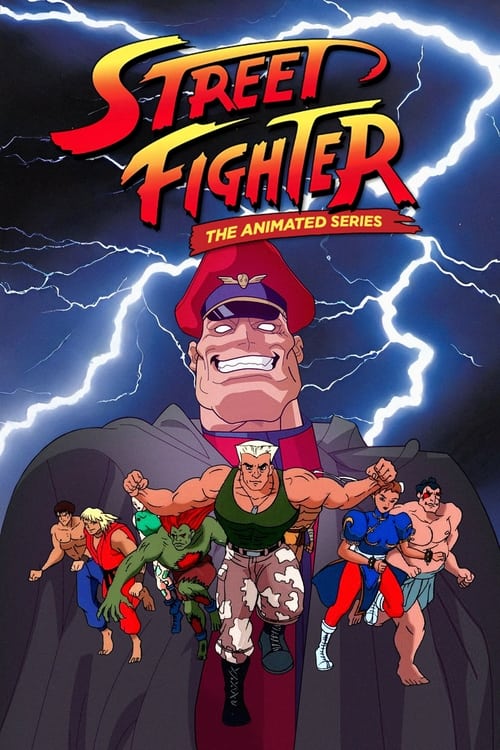
Street
Fighter
IMDb Rating
95K+
IMDb Votes
13%
Rotten Tomatoes
$99M
Box Office
Synopsis & Review
Written and directed by Steven E. de Souza — the screenwriter behind Die Hard and Commando, here making his directorial debut — and produced by Universal Pictures in collaboration with Capcom, Street Fighter (1994) is one of the most magnificently misconceived video game adaptations in Hollywood history, and one of the most beloved. The film is set in the fictional Southeast Asian nation of Shadaloo, where the megalomaniacal General M. Bison (Raul Julia) has taken sixty-three Allied Nations relief workers hostage and is demanding three billion dollars in ransom while constructing a new world order from his underground fortress. Colonel William F. Guile (Jean-Claude Van Damme), Allied Nations military commander and the game's most iconic character, leads a combined strike force — which somehow includes street hustlers Ryu and Ken (Byron Mann and Damian Chapa), Interpol agents Chun-Li (Ming-Na Wen) and Balrog, weapons dealer Sagat, and a genetically enhanced Blanka — toward Bison's compound. What follows is seventy-two minutes of combat choreography, camp set dressing, comic-book plotting, and Raul Julia operating at a level of committed theatricality that the rest of the film does not deserve and cannot contain.
Let us be direct: Street Fighter is not a good film by any conventional measure. Its plot is incoherent even by the standards of 1994 blockbuster action; its characters are reduced to walking costume references; its Van Damme, delivering his lines with the grim efficiency of a man who knows he is in something ridiculous and has decided to get through it, is miscast as the film's nominal hero. And yet the film has something that most of its genre contemporaries entirely lack: Raul Julia as M. Bison. Julia, who was terminally ill during production with stomach cancer and died just weeks before the film's release, chose to appear in Street Fighter as a gift to his children, who adored the game. He plays Bison not as a villain going through the motions but as a performance of Shakespearean grandeur — magnificent, self-aware, operatically committed to every line of dialogue with the full force of his talent. His scenes are the only ones in which the film becomes genuinely, unironically great, and his performance has become one of the most celebrated in cult cinema precisely because of the contrast between the material and the actor's refusal to condescend to it. The film grossed $99 million worldwide. The legend of Raul Julia's Bison is worth considerably more.
Why Watch This Movie?
Raul Julia's M. Bison — One of Cinema's Great Final Performances
Raul Julia was one of the finest stage and screen actors of his generation — a Tony Award winner whose work ranged from Shakespearean tragedy to The Addams Family. By 1994 he was gravely ill, and Street Fighter was his last completed film. He chose it deliberately, for his children, and then performed it with every gram of craft and charisma he possessed. His Bison is a creation of pure theatrical joy: imperious, absurd, utterly convinced of his own magnificence, and delivered with the kind of operatic commitment that makes every line quotable. His speech beginning with the now-legendary line about Tuesday is not just the best scene in the film — it is one of the best villain monologues in 1990s action cinema, achieved through sheer force of performance. Watching it is to watch a great actor make something immortal from something ridiculous, which is the rarest thing in movies.
The Ultimate 90s Camp Experience — Completely Sincere
The 1990s produced a specific genre of big-budget action film that has never been replicated: brash, colourful, deeply earnest about its own silliness, saturated in neon and muscle and practical stunt work, operating entirely outside the ironic self-awareness that would dominate blockbuster cinema after the rise of the MCU. Street Fighter is the purest possible expression of this form. Every costume is a faithful recreation of a game character's design rendered without apparent awareness of how it looks in live action. Every set is gigantic and impractical. Every line is delivered as though it matters. The film does not wink at the audience; it stares directly into their eyes and tells them, with complete sincerity, that Guile is a man of honour. This sincerity is precisely what makes it endure.
Ming-Na Wen's Chun-Li — The Film's Legitimate Highlight
In a film that largely reduces its game characters to walking costume references, Ming-Na Wen's Chun-Li stands apart. Years before she became iconic as Melinda May in Agents of S.H.I.E.L.D., Wen brings a physical presence and dramatic conviction to the role that the film does not earn and does not deserve but gratefully receives. Her fight sequence against Bison's guards in the film's second act is the most technically accomplished action scene in the film, and her delivery of Chun-Li's backstory monologue is the closest the screenplay comes to genuine emotional weight. She is, alongside Julia, the only performer in the film operating at a level higher than the material requires — and it shows.
Cast & Crew
Director / Writer
Steven E. de Souza
Based On
Capcom's Street Fighter II (1991)
Original Score
Graeme Revell
Col. Guile
Jean-Claude Van Damme
General M. Bison
Raul Julia
Chun-Li
Ming-Na Wen
Cammy
Kylie Minogue
Ken Masters
Damian Chapa
Studios
Universal Pictures / Capcom
Official Trailer
© Universal Pictures / Capcom. Trailer embedded via YouTube.
Frequently Asked Questions
Why did Raul Julia — a classically trained dramatic actor — agree to appear in Street Fighter?
The answer is one of the most touching stories in the history of video game cinema. By 1993, Raul Julia had been diagnosed with stomach cancer and knew his prognosis was poor. His children — Raul Sigmund and Benjamin Rafael — were devoted fans of Street Fighter II, and when the film adaptation was offered to him, he accepted it as a final gift to them: a chance to see their father play the greatest villain in the game they loved. He was reportedly weak during production, requiring rest between takes, but he committed to every scene with complete theatrical intensity and refused any accommodation that would reduce his performance. He died on October 24, 1994, eight weeks before the film's release, never having seen it complete. The decision is a perfect encapsulation of his character: a man who understood exactly what he was doing, chose it freely and fully, and brought his absolute best to it regardless of whether the material deserved it. The film is impoverished by everything except him.
Why is Guile, rather than Ryu or Ken, the film's central protagonist?
The decision was driven almost entirely by the casting of Jean-Claude Van Damme. By 1993, Van Damme was one of the biggest action stars in the world — Timecop, released the same year as Street Fighter, was a major hit — and Universal's primary commercial priority was a vehicle for his particular brand of martial arts action stardom. Ryu and Ken, as the game's traditional protagonists, are Japanese and American street fighters with a philosophical martial arts backstory that does not easily accommodate Van Damme's persona or accent. Guile — American military, physically imposing, carrying a personal vendetta against Bison — fit Van Damme's established action hero template precisely. Director de Souza was also attracted to the military ensemble structure that centring on Guile enabled, which allowed him to include more of the game's characters as supporting operatives. The result is a film in which the game's two most iconic characters, Ryu and Ken, are reduced to comic relief, which remains the most consistently criticised creative decision of the entire production.
What happened to the Street Fighter film franchise after 1994, and is a new adaptation in development?
The 1994 film's poor critical reception effectively ended Van Damme's association with the franchise, and Universal did not pursue a direct sequel. A spin-off, Street Fighter: The Legend of Chun-Li (2009), was produced by 20th Century Fox and focused on Kristin Kreuk as a younger Chun-Li, with Neal McDonough as a reimagined Bison. It performed badly at the box office and received even harsher reviews than the original, and the live-action franchise went dormant. Capcom has periodically licensed the property for animated series and shorts. As of the mid-2020s, a new Hollywood adaptation has been discussed in the context of Capcom's growing interest in screen properties — the success of the Street Fighter 6 game in 2023 reinvigorated the brand — but no confirmed production has been announced. The franchise's screen future likely depends on whether a creative team emerges who can solve the same problem that defeated de Souza in 1994: how to make a satisfying film from a fighting game whose characters are archetypes rather than people.
More Movies Like This
If you loved Street Fighter, these game-based action films are worth your time.