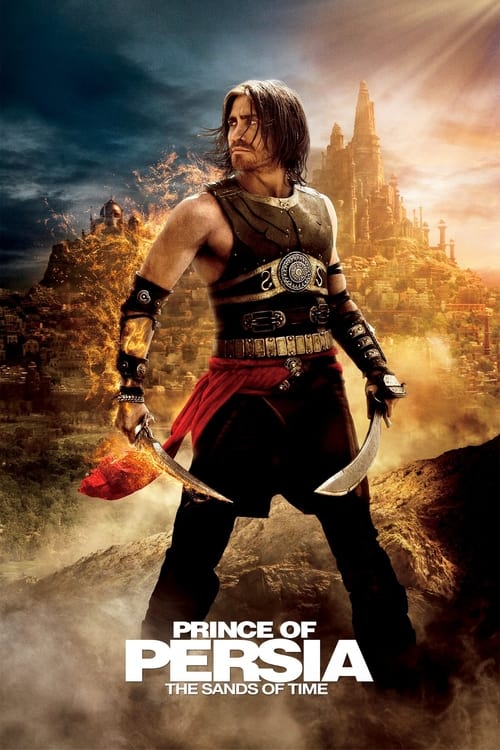
Prince of
Persia
Sands of Time
IMDb Rating
240K+
IMDb Votes
36%
Rotten Tomatoes
$336M
Box Office
Synopsis & Review
Directed by Mike Newell and produced by Jerry Bruckheimer for Walt Disney Pictures, Prince of Persia: The Sands of Time (2010) was the most expensive video game film adaptation ever greenlit at the time — a $200 million gamble that Disney hoped would launch a franchise to rival Pirates of the Caribbean, which Bruckheimer had also produced. The film is set in sixth-century Persia and follows Dastan (Jake Gyllenhaal), a street orphan adopted by the king, who becomes the unlikely custodian of a magical dagger capable of reversing time by releasing the Sands of Time stored within it. When the king is assassinated and Dastan is framed for the murder, he flees with the headstrong Princess Tamina (Gemma Arterton), the dagger's true guardian, as the real conspiracy — orchestrated by the king's treacherous brother Nizam (Ben Kingsley) — begins to unfold. The film follows their cross-desert pursuit, threaded with parkour-inflected action sequences and the gradually deepening relationship between its two leads, toward a climax in which the dagger's power must either be used or destroyed.
The film is, at its best, a thoroughly enjoyable piece of classical adventure filmmaking — the kind of sun-drenched, stunt-driven, wide-screen spectacle that Hollywood stopped making regularly sometime in the early 2000s and has struggled to revive since. Newell, whose previous films included Four Weddings and a Funeral and Harry Potter and the Goblet of Fire, proves a capable handler of large-scale action, and the Moroccan locations give the film a tactile, sand-grained authenticity that studio backlots could never replicate. Gyllenhaal, who underwent an intense physical transformation for the role — adding considerable muscle and mastering parkour movement — is more convincing as an action lead than his casting initially suggested, and he brings a light, self-aware charm to Dastan that recalls the breezy confidence of Harrison Ford's earlier adventure protagonists. Alfred Molina, as the eccentric ostrich-racing tax evader Sheikh Amar, provides the film's most purely entertaining scenes. The Dagger of Time, the game franchise's central mechanic, is translated into the narrative with surprising elegance — it is not a gimmick but a genuine plot device with emotional stakes. Critics found the film formulaic, the romance underdeveloped, and the villain telegraphed from his first appearance. All of these criticisms are fair. None of them prevent the film from being a genuinely pleasurable two hours of old-fashioned adventure cinema that deserved a sequel it never received.
Why Watch This Movie?
The Last Great Old-School Adventure Blockbuster
There is a specific kind of wide-screen, practical-stunt, sun-drenched adventure film that Hollywood produced regularly from the 1980s through the early 2000s — physically grounded, geographically vivid, built around a charming lead and an exotic setting — and Prince of Persia may be the last genuinely successful example of the form. Shot on location in Morocco with an enormous practical crew and real stunt work, the film has a textured physical reality that its contemporaries, increasingly reliant on digital backlots and virtual production, have lost. For audiences who grew up on Raiders of the Lost Ark or The Mummy, it offers the specific pleasure of a film that actually went somewhere and built something real.
The Dagger of Time — A Game Mechanic That Actually Works on Film
The central mechanic of Jordan Mechner's 2003 game — a dagger that can rewind time by a few seconds, allowing the player to undo fatal mistakes — is one of the most beloved innovations in action-adventure game design. Translating a player-controlled mechanic into a narrative device is notoriously difficult, but the film handles it with genuine craft. The dagger is used sparingly, its rules are established clearly, and when it activates — reversing a death, undoing a catastrophe — the visual execution is elegant rather than flashy. It becomes not a superpower but a burden: a responsibility that Dastan carries with increasing weight as the stakes of the conspiracy are revealed.
Alfred Molina's Sheikh Amar — Comic Relief Done Right
In a film of considerable scale and earnest adventure plotting, Alfred Molina arrives as Sheikh Amar — an ostrich-racing, tax-evading, philosophically libertarian desert entrepreneur — and proceeds to steal every scene he inhabits with effortless comic authority. Molina plays the role with complete internal logic: Amar has a fully developed worldview, a set of financial grievances he considers entirely reasonable, and a relationship with his ostriches that the film treats with deadpan seriousness. He is not comic relief imposed upon the adventure; he is a character who happens to be funnier than everyone around him, which is a meaningfully different thing and the reason his scenes hold up on repeated viewing.
Cast & Crew
Director
Mike Newell
Producer
Jerry Bruckheimer
Screenplay
Boaz Yakin, Doug Miro & Carlo Bernard
Prince Dastan
Jake Gyllenhaal
Princess Tamina
Gemma Arterton
Nizam
Ben Kingsley
Sheikh Amar
Alfred Molina
Original Score
Harry Gregson-Williams
Based On
Jordan Mechner's game (Ubisoft, 2003)
Official Trailer
© Walt Disney Pictures / Jerry Bruckheimer Films. Trailer embedded via YouTube.
Frequently Asked Questions
How involved was Jordan Mechner, the original game's creator, in making the film?
Jordan Mechner, who originally created the Prince of Persia franchise in 1989 and designed the acclaimed 2003 reboot that the film adapts, was unusually involved in the production by Hollywood standards — he received a story credit and worked closely with the screenwriting team during development. Mechner had previously sold the rights to Disney but negotiated ongoing creative consultation, and he maintained a public development diary throughout production that gave fans an unusually transparent view of the adaptation process. His involvement ensured that the Dagger of Time was handled with structural fidelity to the game — its rules, its limitations, and its emotional weight were all preserved from his original design. However, Mechner was also candid about the compromises required when a $200 million studio film is assembled by committee, and several of his contributions to early drafts were significantly reworked by the time of the final shooting script. His involvement was genuine but ultimately advisory rather than controlling.
How did Jake Gyllenhaal physically prepare for a role that required parkour and combat?
Gyllenhaal's physical transformation for the role was one of the more dramatic in his career. Over approximately six months of pre-production training, he added roughly eighteen pounds of muscle through a combination of weight training and high-calorie diet, while simultaneously learning parkour — the French discipline of fluid, obstacle-traversing movement that defines the Prince's athletic style in the 2003 game. He trained with practitioners of the discipline for months, learning to run across rooftops, scale walls, and perform the fluid vaulting movement that the film's action sequences required. He also trained in sword fighting and hand-to-hand combat choreography. The commitment was considerable, and the results are visible: Gyllenhaal's physicality in the film is genuinely convincing, particularly in the parkour sequences, where he performs a meaningful proportion of the work himself rather than relying entirely on stunt doubles.
Why did Disney abandon plans for a sequel despite the film grossing $336 million?
The $336 million worldwide gross sounds impressive in isolation, but the economics of the film made it considerably less so. Against a $200 million production budget and a marketing spend estimated at $150 million or more, the film needed to gross approximately $500 million worldwide to break even in theatrical release — a threshold it fell well short of. Disney had been explicit about wanting to replicate the Pirates of the Caribbean model, which had launched with an $80 million production budget and grossed $654 million; Prince of Persia cost two and a half times as much and earned roughly half as much. The domestic performance was particularly disappointing at $90 million, suggesting the brand had not connected with American audiences the way the studio had hoped. Disney's internal assessment was that the franchise had not demonstrated sufficient audience loyalty to justify the investment required for a sequel at the same scale, and the planned follow-up — which would have adapted the second and third games in the Sands of Time trilogy — was quietly shelved within a year of the original's release.
More Movies Like This
If you loved Prince of Persia, these epic adventure films adapted from games are worth your time.