Pokémon
Detective
Pikachu
IMDb Rating
200K+
IMDb Votes
68%
Rotten Tomatoes
$433M
Box Office
Synopsis & Review
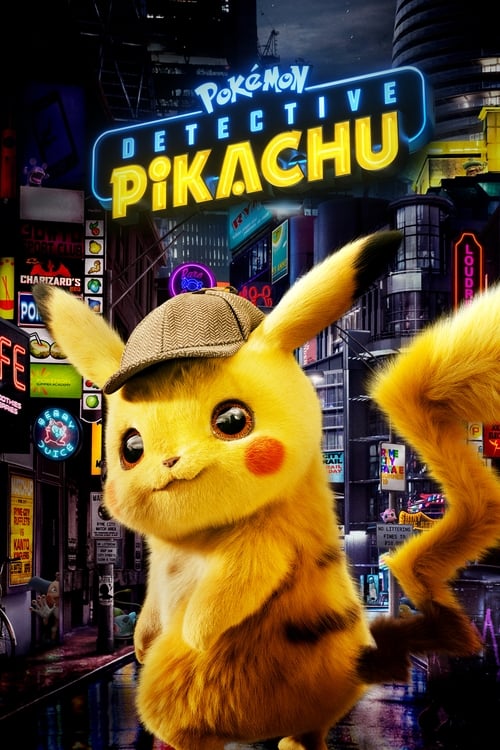
Directed by Rob Letterman and produced by Legendary Pictures and The Pokémon Company, Pokémon Detective Pikachu arrived in May 2019 as the most ambitious live-action attempt to bring the world's most valuable media franchise to the big screen — and, crucially, the first to actually succeed. The film is set in Ryme City, a metropolis built on the radical premise that humans and Pokémon coexist as equals rather than as trainer and battling companion. Into this world arrives Tim Goodman (Justice Smith), a young man who has never connected with Pokémon, summoned by the apparent death of his estranged father, a celebrated detective. In his father's apartment he discovers a small, coffee-addicted Pikachu (voiced by Ryan Reynolds) wearing a deerstalker hat and speaking fluent English — a voice only Tim can hear. Together, they set out to unravel the mystery of what happened to Tim's father, which quickly spirals into a city-wide conspiracy involving a mysterious substance called "R" that causes Pokémon to go berserk, and a secret experiment with consequences for the entire world. The mystery plot, based loosely on the Nintendo 3DS spin-off game of the same name, functions as a serviceable noir framework — not especially surprising in its turns, but competent and well-paced enough to carry the film's real ambitions, which lie almost entirely in its world-building.
What Pokémon Detective Pikachu does that no previous live-action attempt at the franchise came close to achieving is make the Pokémon feel real. The decision to render every creature with photorealistic fur, scale, and weight — Psyduck's rubbery skin, Charizard's firelit scales, Mr. Mime's disconcertingly human eyes — could have been catastrophic. Instead, it produces a sense of genuine wonder. Walking through Ryme City's rain-slicked streets with a Bulbasaur grazing in the background or a Jigglypuff performing in a jazz bar feels less like a digital theme park and more like a world that might actually exist. Ryan Reynolds' voice performance as Pikachu is the film's commercial engine and its emotional centre: he plays the character as a wisecracking, self-deprecating, surprisingly tender presence whose bravado masks a vulnerability that pays off in the film's final act. Justice Smith anchors the human drama with more sincerity than the role strictly requires, and the chemistry between the two carries even the weaker stretches of the screenplay. The film earned $433 million worldwide on a $150 million budget — a strong result that demonstrated the appetite for a thoughtfully realised Pokémon cinematic universe, though a planned sequel has yet to materialise.
Why Watch This Movie?
Ryme City — The Most Convincing Video Game World Ever Put on Screen
The world-building in Detective Pikachu is, without question, the film's greatest achievement and what separates it from virtually every other game adaptation. Ryme City is a fully realised environment — neon-lit, rain-soaked, architecturally eclectic — and it is populated with hundreds of Pokémon rendered with a level of physical detail that makes their presence feel genuinely inhabitable. The film takes the Pokédex seriously as a document of a real ecosystem. Machamp directs traffic. Loudred power a nightclub's sound system. Bulbasaur migrate through the forest in herds. For anyone who grew up with the games, the experience of seeing this world given three-dimensional weight is not merely entertaining — it is emotionally overwhelming in a way that no animated Pokémon film, however excellent, can fully replicate.
Ryan Reynolds' Pikachu — An Inspired Casting Decision
The announcement that Ryan Reynolds would voice Pikachu was met with widespread scepticism — the character's established Japanese voice, performed by Ikue Ōtani since 1997, is one of the most recognisable sounds in global pop culture, and the fear was that Reynolds would simply do Deadpool in a yellow suit. The reality is more interesting. Reynolds plays Pikachu with sardonic humour but also with a genuine undercurrent of sadness and longing that the character's amnesiac backstory demands. The performance works because Reynolds never lets the comedy become armour — the moments in which Pikachu's vulnerability surfaces land with real weight, particularly in the film's final revelation. It is a performance that required more range than the marketing suggested, and Reynolds delivered it.
A Blueprint for How to Adapt a Beloved IP Respectfully
The Pokémon franchise is, by market capitalisation, the most valuable media IP on Earth — worth over $150 billion and beloved by multiple generations across every continent. The pressure to get a live-action adaptation right was therefore enormous, and the potential for catastrophic fan backlash was real. What Letterman and his team did correctly was treat the franchise's internal logic as non-negotiable rather than as a starting point for reinvention. The Pokémon behave as the games and anime establish. The relationships between humans and their Pokémon are portrayed with the same emotional seriousness that fans invest in their own play-throughs. No character is made darkly gritty, edgy, or reimagined for adult audiences at the expense of the source material's warmth. It is a film that respects what made the IP beloved in the first place — a rarer achievement than it sounds.
Cast & Crew
Director
Rob Letterman
Screenplay
Dan Hernandez & Benji Samit
Based On
Nintendo 3DS game (2016)
Pikachu (Voice)
Ryan Reynolds
Tim Goodman
Justice Smith
Lucy Stevens
Kathryn Newton
Howard Clifford
Bill Nighy
Original Score
Henry Jackman
Studio
Legendary / The Pokémon Co.
Official Trailer
© Warner Bros. Pictures / Legendary / The Pokémon Company. Trailer embedded via YouTube.
Frequently Asked Questions
Why was the decision to render Pokémon in photorealistic style so risky, and how did it pay off?
The production team at Moving Picture Company (MPC) faced a genuinely unprecedented challenge: how do you render creatures that exist as two-dimensional drawings and three-dimensional game models in a photorealistic environment without triggering the uncanny valley response that had plagued earlier attempts at realistic animated characters? The approach they chose was to treat each Pokémon as a real animal — researching actual fur, scale, and skin textures and applying them to the existing character designs rather than creating entirely new interpretations. Pikachu received individual strands of soft, rounded fur rather than the smooth yellow surface of the games. Charizard was given scales that reflected light in the manner of a real reptile. Psyduck's rubber-like skin was given subtle translucence. The risk was that fans, highly sensitised to any departure from the canonical designs, would reject the realistic treatment as a violation of the source material. In practice, the opposite occurred — the photorealistic Pokémon were widely praised, and the visual approach is now considered the film's most celebrated accomplishment. MPC won numerous VFX industry awards for the work.
What is the connection between this film and the Nintendo 3DS game it is based on?
Detective Pikachu was originally released as a Nintendo 3DS adventure game in Japan in 2016 and internationally in 2018. The game introduced several concepts that are central to the film: the premise of a talking Pikachu who has lost his memory and partners with a human boy named Tim; the setting of a city where humans and Pokémon live as social equals; and the mystery-solving structure built around the pair uncovering a conspiracy. The film adapts these core elements faithfully while significantly expanding the scale of the conspiracy and the nature of the film's villain, whose identity and motivations differ substantially from the game. The film is therefore neither a direct adaptation — it departs significantly from the game's specific plot — nor entirely original; it is better understood as a creative reimagining of the game's premise, set in the same conceptual universe. The game's sequel, Detective Pikachu Returns, was released for Nintendo Switch in 2023 and was designed with the possibility of a second film in mind.
Why has a sequel never been made despite the film's box office success?
The question of a sequel to Detective Pikachu has been one of Hollywood's more puzzling non-developments. The film earned $433 million worldwide on a $150 million budget — a respectable return that, in any normal circumstance, would trigger immediate production of a follow-up. A sequel was announced shortly after the film's release, with writer Oren Uziel attached to script. However, the project has subsequently stalled without explanation. Several factors are believed to be contributing. First, the COVID-19 pandemic disrupted Legendary's production pipeline and forced a wholesale reassessment of release strategies for all its projects. Second, The Pokémon Company is famously protective of its IP and reputedly difficult to satisfy in development, which may have caused delays in approving a creative direction. Third, the departure of some key creative talent from the project may have required restarting the development process. As of 2024, no production start date has been announced, and the sequel remains officially unconfirmed. Given the release of Detective Pikachu Returns on Switch and the ongoing commercial vitality of the Pokémon brand, industry observers continue to expect a sequel will eventually be made.
More Movies Like This
If you loved Pokémon Detective Pikachu, these game adaptations are worth your time.