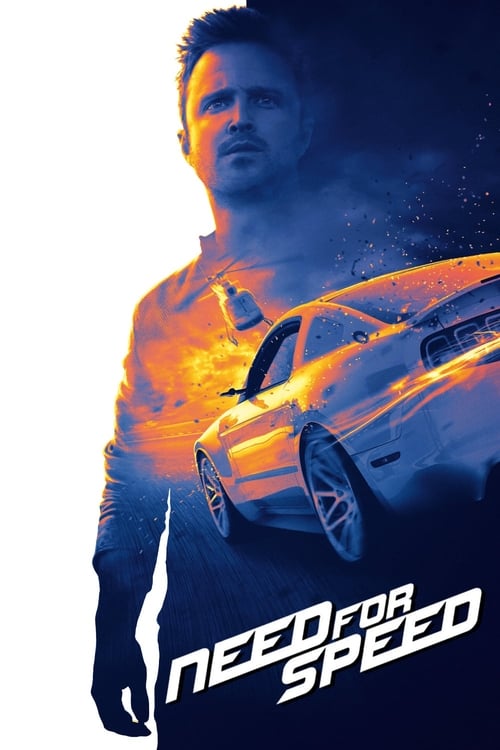
Need for
Speed
IMDb Rating
193K+
IMDb Votes
22%
Rotten Tomatoes
$203M
Box Office
Synopsis & Review
Directed by Scott Waugh — a former stuntman making his second feature — and produced by DreamWorks Pictures in association with Electronic Arts, Need for Speed (2014) arrives with a deceptively simple pitch: a revenge story told entirely through automobiles, at speed, with real cars and real stunt work. Tobey Marshall (Aaron Paul), a gifted street racer and mechanic from upstate New York, is framed for the death of his friend Pete by the wealthy and ruthless Dino Brewster (Dominic Cooper) after a high-stakes street race goes wrong. Tobey serves two years in prison; Dino walks free and builds an empire. Upon release, Tobey has one window to reach the De Leon — an ultra-exclusive underground race in San Francisco, orchestrated by the enigmatic Monarch (Michael Keaton) — the only place where he can confront Dino on his own terms and clear his name. What follows is a cross-country sprint, conducted at illegal speeds across American highways and back roads, with Tobey and a Shelby Mustang GT500 Super Snake against the clock, the law, and a hired convoy of pursuers.
The film's primary virtue — and the thing that separates it meaningfully from the Fast & Furious franchise it inevitably invites comparison to — is its commitment to practical filmmaking. Director Scott Waugh, drawing on his stunt background, made a deliberate decision to use real cars driven by real drivers at real speeds wherever possible, eschewing the digital augmentation that had become standard in the genre. The result is a film with genuine tactile weight: when a car slides, you feel the tyres; when something crashes, it costs something. The Shelby Mustang at the film's centre is not a prop but a character, and the cinematography captures it with the reverence the game franchise always showed its machines. Aaron Paul, fresh from completing Breaking Bad, brings more dramatic credibility to Tobey than the role strictly demands — his watchfulness and intensity suit a character who has learned to wait — and Michael Keaton, delivering all of Monarch's lines in a glass-walled studio overlooking nothing in particular, is extraordinary: eccentric, funny, and oddly moving. Critics dismissed the film as too long, too derivative, and too thin on narrative. They were not wrong on the first count. But as a love letter to driving cinema — to the American highway as a space of freedom and consequence — Need for Speed earns its place in the genre with more integrity than most of its competitors.
Why Watch This Movie?
Real Cars. Real Speed. No CGI Shortcuts.
At a time when Hollywood's car action films had become increasingly dependent on digital effects and green screen, Need for Speed went in the opposite direction. Scott Waugh recruited some of the industry's top stunt drivers and used actual production vehicles — including a bespoke Shelby Mustang GT500 Super Snake built specifically for the film — to execute sequences at genuine speed on real roads. The difference is visible in every chase: the cars move with physical logic, the danger feels consequential, and the sound design has the textured authenticity that only comes from actual machinery under load. For audiences fatigued by weightless digital spectacle, the film is a visceral corrective.
Aaron Paul Brings Genuine Dramatic Weight
This was Aaron Paul's first major film role following the conclusion of Breaking Bad, in which his performance as Jesse Pinkman had been widely regarded as one of the finest in recent American television. He brings that same coiled intensity to Tobey Marshall — a man carrying grief and injustice quietly, who expresses himself most fluently at speed. The role does not ask much of him dramatically, but he gives it more than it asks for, and his presence elevates the film above the standard requirements of the genre. He is a movie star in the classical sense: the camera finds him compelling regardless of what the scene demands.
Michael Keaton's Monarch — Wildly, Perfectly Bizarre
Michael Keaton delivers one of the most entertainingly strange supporting performances in any action film of the 2010s. Monarch — the underground race organiser who exists entirely in a glass broadcast booth, commentating on events he orchestrates from a distance — is written as a genre convenience, but Keaton plays him as a genuine eccentric: restless, funny, oddly philosophical, and wholly committed to a set of values the film never quite explains. His scenes function almost as a different, better film glimpsed through a window. He is the unexpected soul of the movie, and every scene he appears in is the best scene in the film.
Cast & Crew
Director
Scott Waugh
Screenplay
George Gatins
Based On
EA's Need for Speed franchise
Tobey Marshall
Aaron Paul
Dino Brewster
Dominic Cooper
Julia Maddon
Imogen Poots
Monarch
Michael Keaton
Original Score
Nathan Furst
Studios
DreamWorks / Electronic Arts
Official Trailer
© DreamWorks Pictures / Electronic Arts. Trailer embedded via YouTube.
Frequently Asked Questions
How does this differ from the Fast & Furious franchise, and why does the distinction matter?
The comparison is inevitable but the distinction is genuine and meaningful. By 2014, the Fast & Furious franchise had evolved into a globe-spanning superhero action series in which cars were props for increasingly physics-defying spectacle — a franchise about family, loyalty, and elaborate mythology that happened to feature cars. Need for Speed is, by contrast, a film genuinely about driving: about the specific machines, the specific roads, the physical experience of speed and control. Director Scott Waugh's stunt background meant that the film's priority was always the authentic communication of what it feels like to drive very fast — an experience that digital effects, for all their sophistication, consistently fail to replicate. The film is narrower in ambition than the Fast & Furious series, but within that narrowness it achieves something the bigger franchise gave up years ago: the sense that the cars are real, the danger is real, and the driving is the point.
What is the De Leon, and how does the film use it as a narrative device?
The De Leon is the film's central MacGuffin: an invitation-only underground street race held once a year in San Francisco, organised by the mysterious broadcaster Monarch, in which drivers risk their own cars and reputations against the best in the country. It serves several narrative functions simultaneously. First, it gives Tobey a concrete, time-limited objective — he must reach San Francisco within a specific window or the race proceeds without him, which creates the cross-country urgency that structures the entire film. Second, it is the only arena in which Dino Brewster, who has also qualified, can be confronted on neutral ground outside the law. Third, it functions as an aspirational world-building device: the De Leon is a place where the rules of money and status dissolve and only driving ability matters, which is precisely the world the NFS game franchise has always sold. The film uses it to give its revenge story a specific, sporting shape — less a thriller than a race with personal stakes.
Why was no sequel ever made despite the film turning a profit worldwide?
The film grossed $203 million worldwide against a $66 million production budget — a profit, but not a spectacular one by franchise standards. More significantly, its North American performance was modest: roughly $43 million domestically, which was considered disappointing for a wide DreamWorks release. The film's profitability was driven largely by international markets, particularly China, which contributed strongly. DreamWorks and EA were reportedly open to a sequel in the immediate aftermath, and Aaron Paul expressed willingness to return. However, the combination of lukewarm domestic reception, strongly negative critical consensus, and the sheer dominance of the competing Fast & Furious franchise — whose seventh entry, released the following year, grossed $1.5 billion — made it difficult to justify the investment. The sequel never moved beyond early discussions, and by 2016 the window had effectively closed. It remains one of the more commercially plausible video game adaptations that simply ran out of institutional momentum before a second film could materialise.
More Movies Like This
If you loved Need for Speed, these game-based and high-octane action films are worth your time.