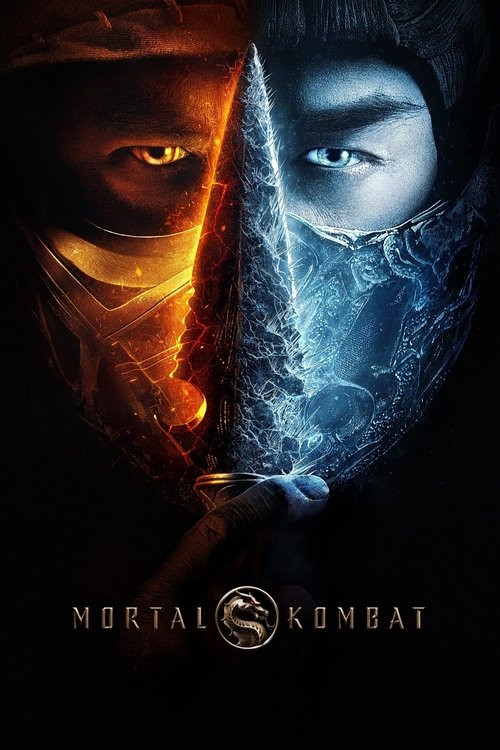
MORTAL
KOMBAT
IMDb Rating
155K+
IMDb Votes
55%
Rotten Tomatoes
$84M
Box Office
Synopsis & Review
Directed by Simon McQuoid in his feature debut and released simultaneously in theatres and on HBO Max in April 2021, Mortal Kombat is a hard-R reboot of a franchise that had not had a major theatrical outing since the mid-1990s, and it arrives with a very clear sense of its own priorities. Those priorities are, in order: spectacular and graphic fight sequences, faithful representation of the games' iconic characters and their signature moves, and enough world-building to sustain the universe it is establishing. The film's plot is, by deliberate design, secondary to all three. The story follows Cole Young (Lewis Tan), an original character created for the film — a washed-up MMA fighter with a dragon-shaped birthmark that marks him as a chosen champion of Earthrealm. He is recruited into a group of Earth's fighters by the thunder god Raiden (Tadanobu Asano) to defend the planet against Outworld's forces in the ancient tournament called Mortal Kombat — a contest that Outworld has now won nine consecutive times, meaning one more victory will give them the right to conquer Earth. Standing against them is an array of fan-favourite fighters: the stoic Special Forces soldier Jackson "Jax" Briggs (Mehcad Brooks) and his partner Sonya Blade (Jessica McNamee); the mercenary Kano (Josh Lawson), spectacularly unpleasant and wildly entertaining; the fire-wielding Liu Kang (Ludi Lin) and his cousin Kung Lao (Max Huang). Opposing them from Outworld are the savage Mileena (Sisi Stringer), the sorcerer Shang Tsung (Chin Han), and at the centre of the film's most compelling storyline, the centuries-spanning blood feud between Scorpion (Hiroyuki Sanada) and Sub-Zero (Joe Taslim).
The criticism most commonly levelled at Mortal Kombat — that its original protagonist Cole Young is a pale, underdeveloped figure relative to the beloved characters surrounding him — is not unfair. Cole exists primarily as an audience surrogate, a point of entry for viewers unfamiliar with the franchise, and his arc follows the familiar template of the reluctant hero discovering his destiny with insufficient variation to make it memorable. The film knows this, which is why it wisely distributes the most engaging character work to the supporting cast. Josh Lawson's Kano is a sustained comic performance of genuine wit, playing the character's obnoxious selfishness with an energy that makes every scene he occupies unpredictable. Joe Taslim's Sub-Zero is a physically imposing, genuinely frightening villain whose ice-based powers are rendered with a specificity and creativity that the games only hint at. And the Scorpion–Sub-Zero prologue — set in feudal Japan, shot with the visual grammar of a samurai film, and anchored by Hiroyuki Sanada's quietly devastating performance — is the finest ten minutes in any video game adaptation of the decade. The film earned $84 million on a $95 million budget during the pandemic's peak theatrical disruption — a modest theatrical result that was substantially supplemented by HBO Max streaming. A sequel has been in development since shortly after release.
Why Watch This Movie?
The Scorpion–Sub-Zero Prologue — Ten Minutes of Pure Cinematic Excellence
The film opens in 17th-century Japan. Hanzo Hasashi — the man who will become Scorpion — is a ninja assassin living peacefully with his wife and daughter when Sub-Zero and the Lin Kuei clan arrive to massacre his family and his entire clan. Hiroyuki Sanada plays Hanzo with a stillness and weight that transforms what could have been a generic revenge-origin prologue into a genuinely moving piece of cinema. The sequence is shot with the visual patience and compositional beauty of a Kurosawa film — bamboo groves, frozen ponds, paper-screen interiors shattered by violence — and when the fight between Hanzo and Sub-Zero finally erupts, it does so with a choreographic ferocity that the rest of the film, for all its competence, never quite matches. The payoff to this prologue, when it arrives in the film's climax, is the most emotionally resonant moment in any Mortal Kombat adaptation, and it earns that resonance because of the ten minutes of groundwork laid at the beginning.
Fatalities on Film — The Franchise's Signature Finally Done Properly
Mortal Kombat's defining feature since its 1992 arcade debut has been its Fatalities — the elaborate, graphic finishing moves that each character performs to end a match. The 1995 film adaptation, rated PG-13, was unable to include them in any meaningful form. This 2021 reboot, rated R, has no such constraint, and it uses that freedom with evident relish. Each major character's Fatality is translated to live-action with a fidelity to the games that fans had been waiting for across twenty-five years: Kung Lao's razor-hat bisection, Sub-Zero's spine rip, Kano's heart extraction — all executed with the combination of practical and digital effects that make them simultaneously viscerally shocking and, in the film's particular register, blackly comedic. For the franchise's long-term fanbase, these moments function as a kind of fulfilment — the proof that a live-action Mortal Kombat film could finally be as uncompromisingly brutal as the games that inspired it.
Josh Lawson's Kano — The Film's Unstoppable Comic Engine
In the games, Kano is a mercenary thug and recurring villain. In the film, Josh Lawson plays him as something more interesting: a magnificently self-serving, foul-mouthed, irredeemably selfish Australian criminal who provides the film's most consistent entertainment by treating the apocalyptic stakes of the plot with the attitude of a man who has been mildly inconvenienced by a long queue. His chemistry with Jessica McNamee's Sonya Blade — who despises him with well-founded completeness — gives the film a comedic relationship that works because Lawson plays Kano's nastiness with absolute commitment rather than winking at the audience. The scene in which he discovers his arcana power and immediately begins experimenting with it while monologuing to himself is the funniest sequence in any fighting-game adaptation, and it belongs entirely to Lawson.
Cast & Crew
Director
Simon McQuoid
Screenplay
Greg Russo & Dave Callaham
Based On
NetherRealm / Midway Games (1992)
Cole Young
Lewis Tan
Kano
Josh Lawson
Sub-Zero
Joe Taslim
Scorpion / Hanzo
Hiroyuki Sanada
Original Score
Benjamin Wallfisch
Studio
Warner Bros. / New Line Cinema
Official Trailer
© Warner Bros. Pictures / New Line Cinema. Trailer embedded via YouTube.
Frequently Asked Questions
Why was Cole Young created as a new character instead of using an established Mortal Kombat fighter as the lead?
The decision to introduce Cole Young — an original character with no counterpart in the Mortal Kombat games — as the film's primary protagonist was one of the most debated creative choices in the project's development. The producers' stated rationale was structural: with an ensemble cast that included over a dozen beloved, established characters, each carrying decades of lore and fan expectation, placing the audience entry point at the centre of a known fighter's story would risk alienating newcomers who have no pre-existing emotional connection to that character. Cole Young, having no established history, could therefore function as a clean surrogate — someone who discovers the world of Mortal Kombat alongside the audience rather than someone the audience is supposed to already care about. The criticism is valid in that the character, as written, lacks the specificity that would make him memorable in his own right. His connection to the Scorpion lineage — revealed in the climax — is an elegant piece of franchise architecture, but it arrives too late to retroactively deepen the character for most viewers. A sequel would almost certainly place him in a more clearly defined role relative to the established roster.
How does the 2021 film compare to the 1995 original and 1997's Mortal Kombat: Annihilation?
The 1995 Mortal Kombat, directed by Paul W.S. Anderson, holds a nostalgic affection among fans of a certain vintage that somewhat exceeds its objective quality. It is an aggressively PG-13 film that captures the games' tournament structure and some of its character energy — Johnny Cage in particular is well-drawn — but is fundamentally unable to deliver the franchise's defining brutality. Its techno score and neon-lit aesthetic are effective in their own right and have aged with a certain campy charm. The 1997 sequel Annihilation is widely considered one of the worst video game films ever made — a chaotic, poorly produced disaster that destroyed the franchise's theatrical viability for nearly three decades. The 2021 reboot is superior to both on virtually every technical and creative metric: its action is more precisely choreographed, its visual effects are more convincing, its handling of the games' cosmology is more faithful, and its willingness to commit to the franchise's R-rated identity gives it an authenticity neither predecessor could achieve. It is not a perfect film, but it is a respectful, seriously produced attempt at the franchise — which, relative to its predecessors, is a significant achievement.
Why was the actual Mortal Kombat tournament not shown in the film, and will the sequel fix this?
One of the most frequently noted structural ironies of the 2021 film is that the Mortal Kombat tournament — the central event around which the entire franchise is organised — does not actually take place in it. The film functions as an origin story and world-building exercise, establishing the stakes, the cosmology, and the characters before the tournament itself commences. Shang Tsung, frustrated by the prospect of a fair contest, dispatches Outworld fighters to assassinate Earth's champions before the tournament can begin — meaning the film's fights are pre-tournament skirmishes rather than the tournament itself. The final scene is an explicit set-up for the sequel, with Cole Young departing to recruit a new fighter (in Hollywood — a clear tease of Johnny Cage, Mortal Kombat's most recognisable face who is conspicuously absent from the first film). The sequel, which has been confirmed to include Johnny Cage as a central character and presumably the full tournament structure, would therefore function as the film that many fans feel the first instalment was building toward. Production details have been slow to materialise, but the creative intent appears clear.
More Movies Like This
If you loved Mortal Kombat, these hard-hitting game adaptations deserve your attention.