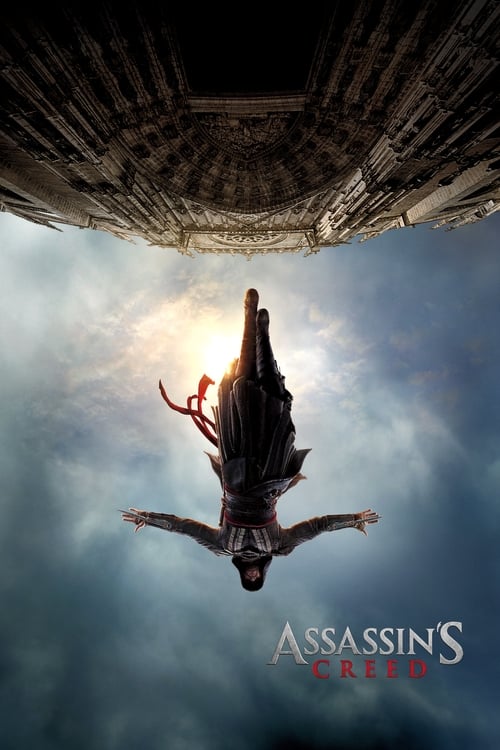
Assassin's
Creed
IMDb Rating
200K+
IMDb Votes
18%
Rotten Tomatoes
$241M
Box Office
Synopsis & Review
Directed by Justin Kurzel and produced through an unprecedented arrangement in which Ubisoft Motion Pictures co-produced the film alongside New Regency and 20th Century Fox, Assassin's Creed (2016) represents perhaps the most artistically serious attempt ever made to adapt a video game franchise into prestige cinema — and simultaneously one of the most instructive case studies in how ambition and execution can catastrophically diverge. The film follows Callum Lynch (Michael Fassbender), a convicted murderer on death row whose execution is faked by the Abstergo Foundation — a pharmaceutical corporation that is, in reality, a front for the Templar Order. Abstergo's director Sofia Rikkin (Marion Cotillard) uses a device called the Animus to connect Callum to the genetic memories of his ancestor Aguilar de Nerha, a Master Assassin operating in 15th-century Granada during the Spanish Inquisition. Aguilar's memories hold the key to the Apple of Eden — a Piece of First Civilisation technology that the Templars have pursued for centuries. As Callum relives Aguilar's missions across the rooftops and alleys of Andalusian Spain, he begins to understand his own heritage and the ancient war between Assassins and Templars — a conflict that has not ended in the present day.
The film assembles an extraordinary cast — Fassbender and Cotillard reunited from Kurzel's Macbeth, supported by Jeremy Irons, Brendan Gleeson, Charlotte Rampling, and Ariane Labed — and shoots the 15th-century sequences in Malta and southern Spain with a visual grandeur that few video game adaptations have matched. The action choreography by Damien Walters and the stunt team is genuinely spectacular: the parkour sequences across Granada's architecture are viscerally exciting, and a leap of faith from a tower crane — shot practically — is as pure a distillation of the franchise's signature move as cinema has managed. And yet the film fails, comprehensively and instructively, because of a fundamental structural miscalculation: it spends more than half its running time in the grey, sterile present-day laboratory scenes rather than in the vivid historical past. The Animus wraparound, intended to give the story intellectual heft through its themes of genetic memory, free will, and corporate conspiracy, instead bleeds the film's momentum dry. Audiences came for the rooftops of Granada; they were given corridors of institutional concrete. It is one of the most frustrating near-misses in modern blockbuster history — a film with the talent, the budget, and the visual ambition to have been genuinely great, undone by a screenplay that privileged mythology over experience.
Why Watch This Movie?
The Historical Action Sequences Are Extraordinary
When Assassin's Creed is set in 15th-century Granada, it is a genuinely exceptional action film. The rooftop chases through Moorish architecture, the sword fights in narrow alleys, the coordination of Assassin movement across crowds and buildings — all of it is choreographed with a physical intelligence and visual clarity that most action films of the era could not match. Stunt coordinator Damien Walters and his team executed sequences of real athleticism on real locations, and Kurzel shoots them with the same austere beauty he brought to his Macbeth. The leap of faith scene in particular — filmed practically with a stunt performer jumping from a working crane — is a moment of pure cinematic exhilaration that the franchise's fans deserved and finally received.
An A-List Cast Committed Beyond What the Script Deserved
The assembly of talent in this film is genuinely remarkable and largely wasted. Fassbender brings his full dramatic intensity to a role that the screenplay never adequately develops; Cotillard navigates the film's most contradictory character — a scientist who is simultaneously a true believer and a moral doubter — with more grace than the writing merits; Jeremy Irons, as her cold, Templar-faithful father, is impeccably commanding. All three are actors who could have anchored a great film with this material. Watching them work against the structural limitations of the script is both frustrating and illuminating — a reminder of how much performance can do and how little it can compensate for when the foundation is compromised.
The Most Faithful Translation of the Game's Visual World
Whatever the film's narrative failures, its visual design is a meticulous and reverential translation of the game franchise's aesthetic. The hidden blade, the eagle vision, the synchronisation points, the Brotherhood's robes and creed — all are rendered with a fidelity that fans of the series will immediately recognise and appreciate. Production designer Andy Nicholson and costume designer Sammy Sheldon constructed a version of Inquisition-era Granada that feels genuinely inhabited rather than assembled on a backlot, and the Abstergo facility's cold architectural severity is a precise visual counterpart to the game's corporate Templar aesthetic. As a piece of franchise world-building, it succeeds completely; it is the story built within that world that collapses.
Cast & Crew
Director
Justin Kurzel
Screenplay
Michael Lesslie, Adam Cooper & Bill Collage
Based On
Ubisoft's Assassin's Creed franchise
Callum / Aguilar
Michael Fassbender
Sofia Rikkin
Marion Cotillard
Alan Rikkin
Jeremy Irons
Joseph Lynch
Brendan Gleeson
Original Score
Jed Kurzel
Studios
New Regency / Ubisoft / 20th Century Fox
Official Trailer
© New Regency / 20th Century Fox / Ubisoft Motion Pictures. Trailer embedded via YouTube.
Frequently Asked Questions
Why did the film spend so much time in the present day rather than in 15th-century Spain?
This was the film's defining creative decision — and its most widely criticised one. Ubisoft's creative leadership, involved in the production through their motion picture subsidiary, reportedly insisted that the present-day Abstergo storyline receive substantial screen time in order to establish the franchise mythology for sequels and to distinguish the film from a straightforward historical action picture. The intention was to signal intellectual ambition: genetic memory, corporate conspiracy, and the long moral war between Assassins and Templars were meant to elevate the film beyond the genre. The result was the opposite. Audiences and critics alike found the laboratory scenes cold, visually monotonous, and narratively inert — scenes that slowed the film's momentum without deepening its characters. Director Justin Kurzel has since acknowledged that the balance between the two timelines was the production's central problem, and that the present-day sequences ran longer than he had originally intended due to franchise-building pressures from the studio and Ubisoft.
What was Ubisoft's level of creative control over the film, and did it help or hinder the production?
Ubisoft's involvement was unusually extensive for a video game licensor. Through Ubisoft Motion Pictures — a production subsidiary established specifically to oversee game-to-film adaptations — the company had a formal co-production role rather than merely a licensing agreement, which gave it meaningful creative consultation throughout development and production. Ubisoft's stated goal was to prevent the kind of unfaithful adaptation that had damaged earlier game-based films, and in terms of visual and world-building fidelity their involvement was largely beneficial: the franchise's iconography, architecture, and mythology are rendered with exceptional accuracy. However, their insistence on establishing the broader Assassin's Creed universe — the Apple of Eden, the First Civilisation, the Templar-Assassin conflict across history — produced a screenplay that was straining to be a franchise engine rather than a self-contained story. The tension between artistic coherence and franchise infrastructure is the film's fundamental wound, and Ubisoft's production influence sits at the centre of it.
Is a new Assassin's Creed film or series still being developed after the 2016 failure?
Despite the 2016 film's poor critical reception and disappointing domestic box office — it grossed $54 million in North America against a $125 million production budget — Ubisoft has not abandoned the franchise's screen ambitions. Netflix announced a live-action Assassin's Creed series in partnership with Ubisoft in 2020, though the project has moved through multiple creative teams and showrunners without a confirmed release date. The streaming format is, in many respects, a better fit for the franchise than a single feature film: the multi-season structure allows the kind of historical world-building and slow mythological development that the 2016 film attempted to compress into under two hours. Whether Netflix's version will succeed where the feature film did not depends on the same fundamental question the franchise has always posed: can the Animus wraparound be made dramatically compelling, or will the historical sequences always be the story that audiences actually want to watch?
More Movies Like This
If you loved Assassin's Creed, these game-based action and adventure films are worth your time.