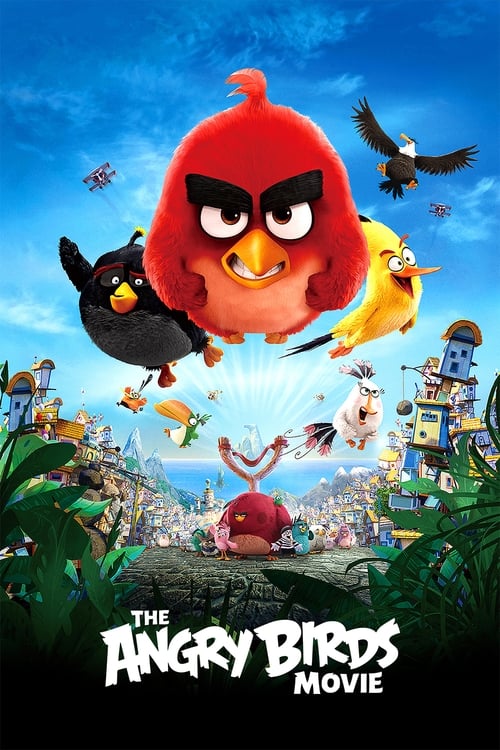
The Angry
Birds
Movie
IMDb Rating
107K+
IMDb Votes
44%
Rotten Tomatoes
$352M
Box Office
Synopsis & Review
Directed by Clay Kaytis and Fergal Reilly and produced by Rovio Animation in partnership with Sony Pictures, The Angry Birds Movie (2016) is the cinematic origin story of the world's most downloaded mobile game franchise — a film that nobody expected to be good, and which turned out to be considerably better than it had any right to be. The story is set on Bird Island, a paradise of flightless, perpetually cheerful birds where Red (Jason Sudeikis), an ill-tempered outsider with a permanently furrowed brow and a talent for making enemies, has been court-ordered to attend anger management classes. There he meets the hyperactive Chuck (Josh Gad) and the explosively volatile Bomb (Danny McBride). When a ship of green pigs — led by the smooth-talking Leonard (Bill Hader) — arrives on the island bearing gifts and goodwill, only Red's instinctive suspicion alerts him to the danger. Sure enough, the pigs steal the birds' eggs and flee. Red, dismissed and ridiculed, must now lead a rescue mission to Piggy Island — and finally has a reason to be as angry as he has always felt.
The film's central joke is both its premise and its thesis: Red's antisocial rage, pathologised and punished by a society that prizes relentless positivity, turns out to be entirely justified. It is a moderately subversive idea for a children's film, and the screenplay by Jon Vitti handles it with enough wit to keep adults genuinely engaged. The animation, produced by Rovio's own studio, is vibrant and inventive — the world of Bird Island is richly detailed, and the climactic catapult-and-destruction sequence translates the game's physics with enormous glee. The vocal cast is well-chosen: Sudeikis's dry, sardonic delivery suits Red perfectly, Gad brings his characteristic manic energy to Chuck, and Peter Dinklage, as the legendary Mighty Eagle, commits to a performance of magnificent self-delusion that steals the film's second act. Critics were lukewarm — the film was seen as a cynical mobile-to-cinema cash-grab — but audiences disagreed: at $352 million worldwide against an $73 million budget, it was one of the surprise hits of 2016, and it demonstrated that a game with essentially no narrative could, with the right creative team, be given a story worth telling.
Why Watch This Movie?
A Genuinely Clever Premise Hidden Inside a Toy Movie
The film's smartest move is making Red's anger not a character flaw to be corrected, but a form of social intelligence that an aggressively cheerful community has suppressed and punished. It is a film about the value of scepticism — about the outsider who sees what the crowd cannot. This is an unusually pointed idea for a family animation, and the screenplay delivers it without losing the comedy or the spectacle. Children will enjoy the chaos; adults will find something more interesting underneath it.
Peter Dinklage as Mighty Eagle — a Comic Masterpiece
The film's greatest single pleasure is Peter Dinklage's Mighty Eagle: a legendary hero of the birds who turns out to be a vain, ageing, deeply insecure recluse living in a mountain cave and wholly unprepared for the expectations placed upon him. Dinklage plays the role with total commitment and zero irony, and the result is one of the funniest animated villain-adjacent performances in years. His lake scene — in which he undresses and swims, announcing himself the freest creature alive — is an extraordinary piece of deadpan physical comedy that lands entirely because of how seriously he takes it.
The Climax Delivers Exactly What the Game Promised
The film's final act — in which the birds storm Piggy Island using a giant catapult to launch themselves at the pigs' fortress — is a joyful translation of the game's core mechanic into animated spectacle. The sequence is fast, funny, and inventively staged, with each bird's ability rendered as a distinct visual payoff: Chuck's speed, Bomb's explosion, Red's determination. It is the moment the film earns its premise in full, and it delivers the visceral satisfaction of the game at a scale a phone screen never could.
Cast & Crew
Directors
Clay Kaytis & Fergal Reilly
Screenplay
Jon Vitti
Based On
Rovio's Angry Birds franchise
Red
Jason Sudeikis
Chuck
Josh Gad
Bomb
Danny McBride
Mighty Eagle
Peter Dinklage
Original Score
Heitor Pereira
Studios
Rovio Animation / Sony Pictures
Official Trailer
© Rovio Entertainment / Sony Pictures Animation. Trailer embedded via YouTube.
Frequently Asked Questions
How do you make a film out of a game with virtually no story?
The original Angry Birds game, released by Rovio in 2009, had essentially no narrative — birds launch at pigs, structures collapse, eggs are recovered. The premise was a physics puzzle, not a story. Screenwriter Jon Vitti's approach was to treat the game's mechanics as the endpoint, not the beginning: rather than adapting what exists, he worked backwards to construct an origin story that would arrive at the game's central conflict — birds versus pigs, eggs at stake — through character and motivation. By asking why the birds are angry and why the pigs have the eggs, he created a film that functions as a prequel to the player's experience, giving emotional weight to a conflict the audience already knows the outcome of. The film does not adapt the game so much as explain it, which is a more interesting creative challenge and one that Vitti handles with genuine wit and economy.
Why was Rovio so desperate to make this film, and what was at stake for the company?
The film's production history is inseparable from Rovio's commercial crisis. The company had been one of the great success stories of the early smartphone era — Angry Birds reached three billion downloads by 2015 — but by the mid-2010s, the mobile gaming market had fragmented dramatically, newer titles had eaten into its dominance, and Rovio was in serious financial difficulty. The company had undergone multiple rounds of layoffs, its revenues had declined sharply, and its attempt to diversify into merchandise, theme parks, and branded content had not compensated for the decline in its core business. The film was conceived as a brand revitalisation strategy: a way to reintroduce Angry Birds to an audience that had largely moved on, generate licensing and merchandise revenue, and position the franchise as an entertainment property rather than just a game. Its $352 million worldwide gross was, by that measure, a genuine rescue — and it provided Rovio with the commercial stability and brand visibility that allowed the company to survive through to its eventual acquisition by Sega in 2023.
Why did the sequel underperform so dramatically compared to the original?
The Angry Birds Movie 2 (2019) received significantly better reviews than the first film — it holds a 73% on Rotten Tomatoes, a remarkable improvement — but grossed only $152 million worldwide, less than half the original's total. The underperformance illustrates a fundamental truth about franchise sequels built on brand recognition rather than character loyalty: the audience that came to the first film was motivated largely by nostalgia for the game and curiosity about the concept. Once that curiosity was satisfied, there was insufficient character investment to drive repeat business. The sequel also arrived in 2019, a full three years after the original, by which point the cultural moment of Angry Birds had passed further. Better critical notices proved entirely unable to compensate for reduced audience appetite — a reminder that in animated family cinema, audience loyalty is built over years through consistent releases, not won back in a single film.
More Movies Like This
If you loved The Angry Birds Movie, these game-based animated films are worth your time.