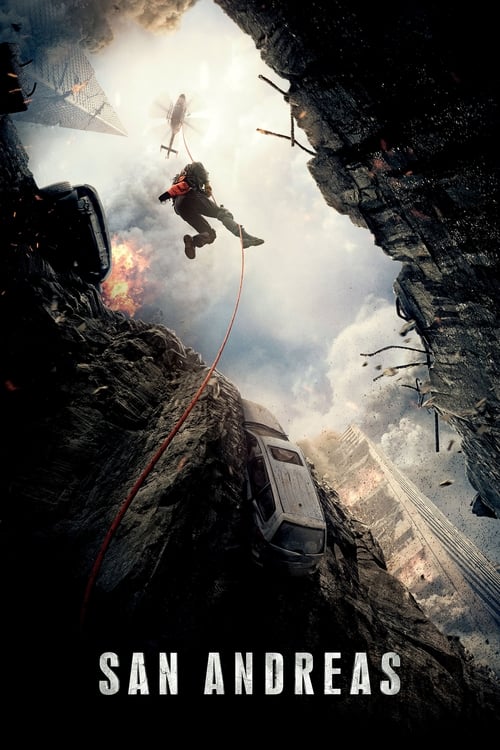
San
Andreas
IMDb Rating
260K
IMDb Votes
49%
Rotten Tomatoes
$474M
Box Office
Synopsis & Review
Directed by Brad Peyton, San Andreas (2015) is the gold standard of modern disaster cinema — a film that embraces its genre's most grandiose traditions with complete, unapologetic commitment. Ray Gaines (Dwayne Johnson) is a Los Angeles Fire Department search-and-rescue helicopter pilot, decorated and decorated again for his work saving lives in impossible situations. His personal life, however, is in free fall: his marriage to Emma (Carla Gugino) is ending, his daughter Blake (Alexandra Daddario) is being absorbed into her mother's new relationship, and Ray is still haunted by a tragic accident years earlier that he blames himself for. When seismologist Dr. Lawrence Hayes (Paul Giamatti) discovers that a catastrophic chain of earthquakes is about to rupture the entire San Andreas fault line — triggering the largest seismic event in recorded history — California begins to tear apart. Los Angeles is devastated. San Francisco is buried. And Blake, stranded in the city with two British brothers she has just met (Hugo Johnstone-Burt and Art Parkinson), must survive long enough for her father to reach her — in a helicopter, a truck, a boat, and ultimately anything he can find to keep moving north.
Critics divided sharply on San Andreas, and the fault lines of that division are easy to understand: the screenplay is functional rather than inspired, the character beats are drawn from the disaster-movie template with little variation, and the film's science is aggressively fictional. But none of that matters if you surrender to what San Andreas actually is — a maximalist spectacle machine operating at the absolute peak of its technical capabilities. The VFX work, particularly the destruction of San Francisco, is some of the most extraordinary large-scale digital destruction ever committed to film. Buildings crumble with genuine physical weight; the tsunami sequence, with a wall of water swallowing the Golden Gate Bridge, is breathtaking in its scale and execution. Johnson anchors it all with the quiet emotional sincerity that distinguishes his best blockbuster work — Ray is not invincible, not unfeeling, not bulletproof. He is a father, terrified and determined, and Johnson plays that with enough vulnerability to make you care about the outcome even when the spectacle threatens to overwhelm everything else. Grossing $474 million worldwide, San Andreas confirmed Johnson as one of the most reliable box-office draws in the world.
Why Watch This Movie?
The Best Large-Scale Destruction in Modern Blockbuster Cinema
Few films in the 2010s matched the sheer physical grandeur of San Andreas's destruction sequences. The Hoover Dam collapse, the levelling of downtown Los Angeles, and above all the obliteration of San Francisco by earthquake and tsunami are rendered with a painstaking attention to physical detail that makes digital destruction feel genuinely weighty and terrifying. The tsunami sequence in particular — shot from multiple perspectives, with the water behaving according to real fluid dynamics — is a landmark of VFX filmmaking. On a large screen or a well-calibrated home setup, it remains jaw-dropping.
Johnson Brings Emotional Weight to a Genre That Usually Ignores It
Disaster films live or die on their human stakes, and San Andreas works better than most of its genre siblings because Johnson plays Ray's grief and guilt with genuine conviction. The backstory — a dead daughter, a failing marriage, a man who saves strangers because he could not save his own child — is not original, but Johnson makes it feel real. There is a moment midway through the film, when Ray finally breaks down, that is more emotionally precise than anything a film of this type is supposed to contain. It is Johnson insisting on being a performer, not just a presence.
Paul Giamatti Playing It Completely Straight
The film's secret weapon is Paul Giamatti as seismologist Dr. Hayes — an Academy Award-calibre actor who treats every line of scientifically dubious exposition as though it were Chekhov. His performance is so committed, so earnestly intelligent, that he single-handedly convinces you that the plot's seismic logic is plausible. Giamatti's work is the film's structural backbone: his scenes ground the spectacle in something that feels like consequence, and watching him deliver disaster warnings with the same intensity he brought to Sideways is one of the film's great pleasures.
Cast & Crew
Director
Brad Peyton
Screenplay
Carlton Cuse
Producer
Beau Flynn
Ray Gaines
Dwayne Johnson
Emma
Carla Gugino
Blake
Alexandra Daddario
Dr. Hayes
Paul Giamatti
Daniel Riddick
Ioan Gruffudd
Ben Taylor
Hugo Johnstone-Burt
Official Trailer
© Warner Bros. Pictures. Trailer embedded via YouTube.
Frequently Asked Questions
Is the science in San Andreas accurate?
Not particularly — and real seismologists have been cheerfully vocal about this. The San Andreas fault is a strike-slip fault, meaning the plates grind horizontally past each other rather than one diving beneath the other. This type of fault does not produce tsunamis, which are generated by vertical displacement of the ocean floor. The magnitude 9.6 earthquake depicted in the film would also be geologically unprecedented along the San Andreas — the fault's geometry caps realistic events somewhat lower. The film's prediction technology (including real-time earthquake forecasting to the precise second) does not yet exist. None of this should stop you from watching: San Andreas is geology fiction, not geology documentary, and it commits to its fictional premises with total conviction.
How much did San Andreas make at the box office?
San Andreas grossed approximately $474 million worldwide against a production budget of around $110 million — a strong commercial result that placed it among the top-grossing films of 2015. It opened to $54.6 million domestically in its first weekend and performed particularly well in international markets, especially China, where the film's spectacular destruction sequences drew enormous audiences. The film demonstrated once again that Dwayne Johnson's global star power could carry a mid-to-large-budget action film to significant profitability regardless of critical reception — a lesson Hollywood has continued to apply across multiple subsequent productions.
How was the tsunami sequence in San Francisco created?
The tsunami sequences were created through a combination of practical photography and extensive digital effects by Method Studios, who built photorealistic digital doubles of San Francisco landmarks including the Golden Gate Bridge, the Transamerica Pyramid, and the Coit Tower. Actors were filmed on practical sets — including a large water tank — with their environments extended digitally in post-production. The water simulation required proprietary fluid dynamics software capable of handling the scale of a city-swallowing wave while maintaining realistic physical behaviour. The production team also studied real tsunami footage and consulted fluid dynamics experts to ensure the water's movement carried physical credibility, even within a dramatically exaggerated scenario.
More The Rock Movies
More films starring Dwayne Johnson you should watch next.