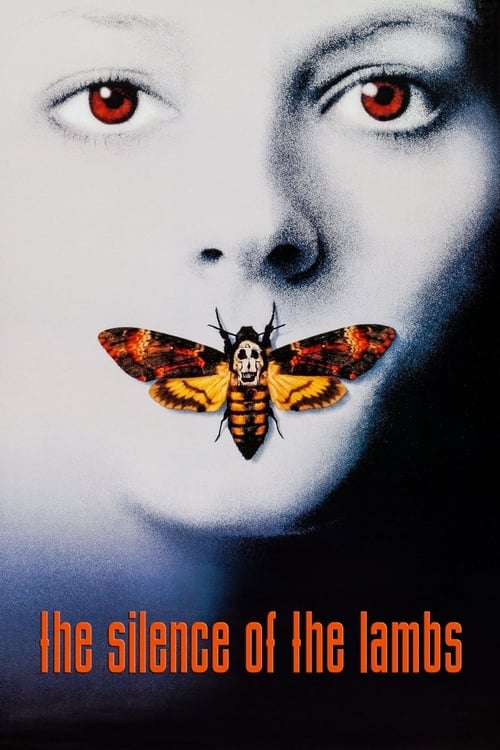
The Silence
of the Lambs
IMDb Rating
1.5M
IMDb Votes
95%
Rotten Tomatoes
$272M
Box Office
Synopsis & Review
Directed by Jonathan Demme and released in 1991, The Silence of the Lambs is one of the most perfectly constructed thriller films in the history of cinema — a work of cold precision and mounting dread that builds its tension not through violence or spectacle but through the far more disturbing mechanism of sustained, intimate psychological pressure. FBI trainee Clarice Starling (Jodie Foster), brilliant and determined but acutely aware of her outsider status within the male-dominated Bureau, is dispatched to a maximum-security psychiatric hospital to interview the incarcerated psychiatrist Dr. Hannibal Lecter (Anthony Hopkins) — a man of extraordinary intellect and refined cultural taste who is also a convicted serial killer and cannibal. The Bureau needs Lecter's criminal profile to help catch a new killer who has been murdering and skinning women: a man nicknamed Buffalo Bill (Ted Levine), who has recently abducted the daughter of a United States senator. What follows is one of cinema's great duels — not a physical one, but a battle of wits, wills, and vulnerabilities conducted through glass and across the negotiated distance of an extraordinary power dynamic — as Lecter agrees to help Clarice solve the case in exchange for glimpses into her own carefully guarded private life.
What makes The Silence of the Lambs so enduringly terrifying is the way it locates its horror not in the monstrous but in the mundane — in the fact that the most frightening person in the film is also the most cultured, the most perceptive, and in a deeply strange way the most honest. Anthony Hopkins appears in the film for fewer than twenty-five minutes, yet his Hannibal Lecter is one of the most indelible presences in cinema history: still, watchful, and utterly, serenely in control, his eyes holding something that cannot be named. Jonathan Demme's signature directorial technique — holding the camera directly on characters' faces as they speak, breaking the fourth wall so subtly that the audience feels personally addressed — creates an intimacy that is profoundly unsettling when applied to Lecter. Jodie Foster's Clarice is the film's moral and emotional center: a woman who must navigate institutional sexism, personal trauma, and the psychological vivisection of a genius predator, and who does so with a quiet, fierce dignity that earned her the Academy Award for Best Actress. The film swept all five major Academy Awards — Best Picture, Best Director, Best Actor, Best Actress, and Best Adapted Screenplay — a feat accomplished by only two other films in Oscar history. It is one of only three horror films ever nominated for Best Picture, and the only one to win. Released on Valentine's Day 1991, it grossed $272 million worldwide on a $19 million budget and has never left the cultural imagination.
Why Watch This Movie?
Anthony Hopkins's 24 Minutes — The Greatest Screen Villain Ever
Anthony Hopkins appears on screen for fewer than twenty-five minutes and won the Academy Award for Best Actor — the shortest screen time of any Best Actor winner in Oscar history. His Hannibal Lecter is not frightening because of what he does but because of what he is: a mind of absolute clarity and total moral absence, who sees into people with clinical precision and finds the exercise faintly amusing. Every scene he is in radiates danger the way a nuclear reactor radiates heat — invisibly, completely, from behind a very thin barrier.
Jodie Foster's Clarice — Cinema's Most Compelling Protagonist
Clarice Starling is one of the great characters in American cinema — a woman who must simultaneously navigate the predatory intelligence of Lecter and the casual condescension of her male colleagues, while carrying the weight of a deeply private childhood trauma that Lecter slowly, expertly excavates. Foster's performance is a masterwork of controlled vulnerability: Clarice is afraid, and she will not show it, and we feel both of those things simultaneously in every frame she occupies.
The Most Perfectly Constructed Thriller Ever Filmed
Every scene in The Silence of the Lambs advances character, tension, and plot simultaneously without a single wasted moment. Demme's direction is a model of economy and precision: the film creates overwhelming dread entirely through tone, performance, and mise-en-scène, using almost no conventional horror movie devices. The night-vision finale — Buffalo Bill stalking Clarice in total darkness — is one of the most technically and psychologically effective suspense sequences ever filmed.
Cast & Crew
Director
Jonathan Demme
Screenplay
Ted Tally
Based On
Novel by Thomas Harris
Clarice Starling
Jodie Foster
Hannibal Lecter
Anthony Hopkins
Buffalo Bill
Ted Levine
Jack Crawford
Scott Glenn
Original Score
Howard Shore
Studio
Orion Pictures
Official Trailer
© Orion Pictures / MGM. Trailer embedded via YouTube.
Frequently Asked Questions
Is Hannibal Lecter based on a real person?
Yes — partially. Thomas Harris, who created the character of Hannibal Lecter in his 1981 novel Red Dragon, has said that Lecter was partly inspired by a real Mexican physician and murderer he encountered while working as a reporter in the 1960s. The man, known as Dr. Salazar, was a surgeon imprisoned for murder who possessed the same unsettling combination of charm, intelligence, and complete moral absence that defines Lecter. Harris has said that Salazar's eyes were what disturbed him most — still and unreadable in a way that seemed to look through rather than at you. Beyond this general inspiration, Lecter is largely a literary invention rather than a direct portrait of any single real individual. The character has since become so embedded in popular culture that he was ranked by the American Film Institute as the greatest movie villain in cinema history.
How many Academy Awards did The Silence of the Lambs win?
The film won all five of the Academy Awards' most prestigious categories — Best Picture, Best Director (Jonathan Demme), Best Actor (Anthony Hopkins), Best Actress (Jodie Foster), and Best Adapted Screenplay (Ted Tally) — at the 64th Academy Awards in 1992. This clean sweep of the "Big Five" has been achieved by only two other films in Oscar history: It Happened One Night (1934) and One Flew Over the Cuckoo's Nest (1975). The achievement is even more remarkable given that The Silence of the Lambs is primarily classified as a horror film — a genre that the Academy has historically shunned. Anthony Hopkins's win is particularly notable: his Lecter appears on screen for fewer than twenty-five minutes, making it the shortest screen time of any Best Actor winner in Oscar history.
Why does Hannibal Lecter make that hissing sound with his lips?
The infamous hissing sound Anthony Hopkins makes after describing eating a census taker's liver "with some fava beans and a nice Chianti" was entirely improvised on set and was not scripted. Hopkins has explained that he developed the gesture to suggest that Lecter is tasting the air — as if the memory of the meal is still present as a sensory impression — while simultaneously performing his own amusement at the effect he is having on Clarice. The sound has since become one of the most quoted and referenced moments in thriller cinema. Hopkins has also noted that the character was inspired in part by HAL 9000 from Kubrick's 2001: A Space Odyssey — another entity of extraordinary intelligence whose politeness and calm make him more frightening rather than less. The hissing was kept in the final cut on the specific request of director Jonathan Demme, who recognized immediately that it was one of those irreproducible moments of instinctive performance genius that cannot be planned.
More Movies Like This
If you loved The Silence of the Lambs, these films will keep you on the edge of your seat.