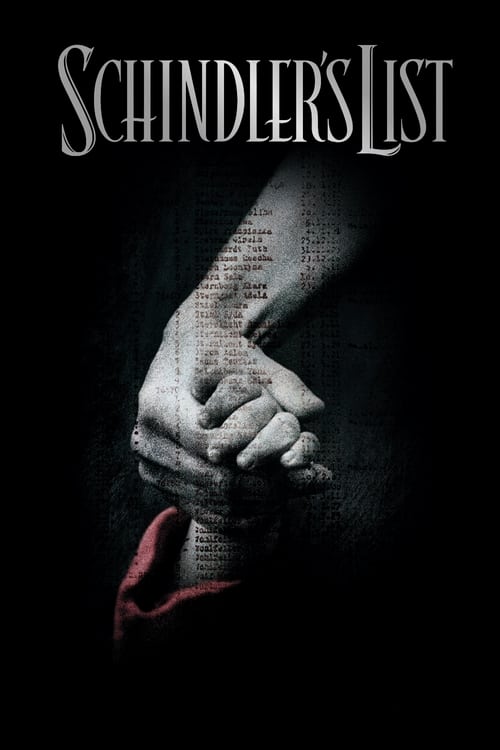
Schindler's
List
IMDb Rating
1.4M
IMDb Votes
98%
Rotten Tomatoes
$322M
Box Office
Synopsis & Review
Directed by Steven Spielberg and released in 1993, Schindler's List tells the extraordinary true story of Oskar Schindler (Liam Neeson), a flamboyant German industrialist and member of the Nazi party who arrives in Kraków during the German occupation of Poland with one ambition: to make money using cheap Jewish labor. Aided by his Jewish accountant Itzhak Stern (Ben Kingsley), Schindler builds a thriving enamelware factory staffed almost entirely by Jewish workers from the Kraków ghetto. As the war progresses and the true horror of the Nazi extermination program becomes impossible to ignore — personified in the sadistic commandant Amon Göth (Ralph Fiennes), who murders prisoners for sport from his villa balcony — something shifts within Schindler. The man who came to profit from suffering begins, at enormous personal risk and financial cost, to protect the very people he had intended to exploit. By the end of the war, Schindler's list of essential workers had grown to over 1,100 names — each one a life saved from the gas chambers of Auschwitz.
Shot almost entirely in black and white by cinematographer Janusz Kamiński, Schindler's List carries the visual weight of a historical document — grainy, immediate, and unsparing. Spielberg made a deliberate choice to strip away the glossy production values of his earlier blockbusters and instead shoot with handheld cameras and natural light, giving the film an intimacy and urgency that makes its horrors feel completely real. John Williams's score, built around a mournful violin solo performed by Itzhak Perlman, is among the most achingly beautiful pieces of film music ever written. The performances are uniformly extraordinary: Neeson brings quiet dignity and complexity to Schindler's moral awakening, Kingsley is warm and watchful as the indispensable Stern, and Ralph Fiennes delivers one of cinema's great villain performances — a man capable of terrifying violence and genuine tenderness in the same breath, whose banality makes him all the more frightening. The film won seven Academy Awards, including Best Picture and Best Director, and is widely taught in schools and universities worldwide as an essential document of the Holocaust. It is not easy viewing. It was never meant to be.
Why Watch This Movie?
A Moral Obligation Disguised as a Masterpiece
There are films you watch for pleasure and films you watch because not watching them would be a kind of blindness. Schindler's List belongs to the second category. It is one of the most rigorously honest accounts of the Holocaust ever committed to film, and its importance only grows as the generation of survivors diminishes. To watch it is to bear witness — and bearing witness is a form of respect that history demands.
Ralph Fiennes's Göth — The Most Terrifying Villain in Cinema
Amon Göth is not a cartoon monster — he is something far more disturbing. Fiennes plays him as a man of ordinary appetites and extraordinary cruelty, who commits atrocities with the casual indifference of a man swatting flies. The scene where he attempts to pardon a Jewish boy and finds he cannot suppress his own violence is among the most chilling pieces of acting in any film. It is a performance that refuses to let you look away.
Spielberg at His Most Uncompromising
This is not the Spielberg of Jaws or Indiana Jones. This is a filmmaker who turned down his salary, donated his profits to Holocaust education, and refused to shoot in color because he felt it would make the film too comfortable to watch. The result is the most personally important work of his career — and arguably the greatest film ever made by one of cinema's greatest directors.
Cast & Crew
Director
Steven Spielberg
Screenplay
Steven Zaillian
Based On
Novel by Thomas Keneally
Oskar Schindler
Liam Neeson
Amon Göth
Ralph Fiennes
Itzhak Stern
Ben Kingsley
Cinematography
Janusz Kamiński
Original Score
John Williams
Studio
Universal Pictures
Official Trailer
© Universal Pictures. Trailer embedded via YouTube.
Frequently Asked Questions
Is Schindler's List based on a true story?
Yes. Schindler's List is based on the true story of Oskar Schindler, a real German industrialist who saved the lives of approximately 1,200 Jewish people during the Holocaust by employing them in his factories in Kraków and Brünnlitz. The film is adapted from Thomas Keneally's 1982 novel Schindler's Ark, which was itself based on extensive interviews with Schindlerjuden — the "Schindler Jews" who survived because of his actions. Amon Göth was a real SS-Hauptsturmführer who commanded the Kraków-Płaszów concentration camp and was executed for war crimes in 1946. The famous scene of the girl in the red coat is based on a real account described by survivors. Spielberg worked closely with Holocaust historians and survivors to ensure the film's authenticity.
Why is the film shot in black and white?
Spielberg chose to shoot in black and white for several deliberate artistic and ethical reasons. First, he wanted the film to feel like a documentary or newsreel footage from the era, grounding it in historical reality rather than the comfortable distance of a period drama. Second, he felt that color would aestheticize the violence and suffering in a way that would be morally inappropriate. Black and white strips away beauty and spectacle, forcing the audience to confront events without the seduction of a gorgeous image. The famous exception — the little girl in the red coat — is a conscious use of the only color in the film to represent the individual human lives being extinguished en masse. Spielberg has said that the red coat represents the moment he understood what the Holocaust meant: politicians and generals saw the statistics; Schindler saw the girl in the red coat.
How many Academy Awards did Schindler's List win?
Schindler's List received twelve Academy Award nominations at the 66th Academy Awards in 1994 and won seven, including Best Picture, Best Director (Steven Spielberg's first competitive Oscar win), Best Adapted Screenplay, Best Cinematography, Best Film Editing, Best Original Score, and Best Art Direction. It was Spielberg's long-overdue recognition from the Academy, which had previously overlooked his direction of Raiders of the Lost Ark, E.T., and The Color Purple. The film is also preserved in the United States National Film Registry by the Library of Congress as being "culturally, historically, or aesthetically significant." Steven Spielberg donated all of his personal profits from the film to Holocaust education and the USC Shoah Foundation, which he founded to record survivor testimonies.
More Movies Like This
If you were moved by Schindler's List, these essential films deserve your attention.