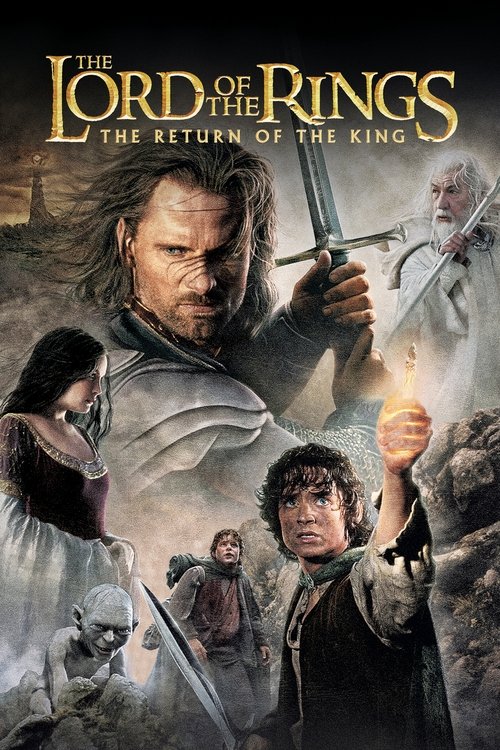
The Lord of the Rings:
The Return of the King
IMDb Rating
1.9M
IMDb Votes
93%
Rotten Tomatoes
$1.14B
Box Office
Synopsis & Review
Directed by Peter Jackson and released in December 2003, The Lord of the Rings: The Return of the King is the thunderous, heartbreaking, and triumphant conclusion to one of the most ambitious filmmaking projects ever undertaken. Based on the final volume of J.R.R. Tolkien's beloved trilogy, the story follows two converging journeys toward a single, world-defining moment: Frodo (Elijah Wood) and Sam (Sean Astin), guided by the treacherous Gollum (Andy Serkis), make their final desperate march across the ravaged wasteland of Mordor toward the fires of Mount Doom, where the One Ring must be destroyed to end Sauron's reign forever. Simultaneously, Aragorn (Viggo Mortensen), Gandalf (Ian McKellen), Legolas (Orlando Bloom), Gimli (John Rhys-Davies), and the remaining Fellowship muster the armies of Men for a suicidal assault on the Black Gate of Mordor — not to win, but to draw Sauron's all-seeing Eye away from Frodo long enough for the hobbit to complete his mission. What results is over three hours of the most emotionally and visually overwhelming epic cinema ever committed to film.
What makes The Return of the King the definitive conclusion to the greatest fantasy saga in cinema history is not its staggering battle sequences — though the Siege of Minas Tirith and the Battle of the Pelennor Fields remain unmatched in scale and execution — but the emotional truth it delivers in the quieter moments. The loyalty between Frodo and Sam, Sam's unforgettable speech about whether there's good in this world worth fighting for, Aragorn's coronation, the hobbits' wordless bow from the entire court — these are the moments that endure. Filmed simultaneously with the other two parts of the trilogy over 15 months in New Zealand, the film was made with a degree of commitment and craft that verges on the miraculous. It swept all eleven of its Academy Award nominations — equaling the all-time record held by Ben-Hur and Titanic — including Best Picture, becoming the first and only fantasy film ever to win the top prize. Howard Shore's score is among the most intricately composed in film history, and Andrew Lesnie's cinematography transforms New Zealand's landscapes into a world that feels simultaneously vast and intimate. It is a film about the end of things — of an age, of a quest, of a fellowship — and it earns every one of its many farewells.
Why Watch This Movie?
The Greatest Fantasy Film Ever Made — Full Stop
No fantasy film before or since has matched the ambition, execution, and emotional resonance of this trilogy's conclusion. Jackson took Tolkien's "unfilmable" masterwork and delivered something that not only honored the source material but transcended it cinematically — creating a world so fully realized that audiences around the world wept at its ending not because of plot, but because they did not want to leave.
Sam Gamgee — Cinema's Greatest Unsung Hero
Sean Astin's performance as Samwise Gamgee is one of the most quietly heroic in film history. Sam has no powers, no destiny, no special ability — just loyalty, love, and stubbornness. His speech on the slopes of Mordor, and his decision to carry Frodo when Frodo can no longer walk, represent the film's deepest moral argument: that ordinary courage is the most extraordinary courage of all.
A Filmmaking Achievement That Will Never Be Repeated
Three films. Shot simultaneously. 15 months of principal photography. 274 sets. Tens of thousands of extras and digital soldiers. A budget that escalated from $281 million across all three films. Peter Jackson's trilogy represents a level of sustained creative ambition that the modern studio system — with its obsession with franchises and safety — will almost certainly never permit again. Watching it is watching something genuinely irreplaceable.
Cast & Crew
Director
Peter Jackson
Screenplay
Jackson, Walsh & Boyens
Based On
Novel by J.R.R. Tolkien
Frodo Baggins
Elijah Wood
Aragorn
Viggo Mortensen
Gandalf
Ian McKellen
Cinematography
Andrew Lesnie
Original Score
Howard Shore
Studio
New Line Cinema
Official Trailer
© New Line Cinema / Warner Bros. Trailer embedded via YouTube.
Frequently Asked Questions
How many Academy Awards did The Return of the King win?
The Return of the King won all eleven of its Academy Award nominations at the 76th Academy Awards in 2004 — the most ever won by a single film without a single loss, a record it shares with Ben-Hur (1959) and Titanic (1997). Its wins included Best Picture, Best Director (Peter Jackson), Best Adapted Screenplay, Best Visual Effects, Best Film Editing, Best Original Score, Best Original Song ("Into the West"), Best Art Direction, Best Costume Design, Best Makeup, and Best Sound Mixing. It also became the first and only fantasy film in history to win the Academy Award for Best Picture — a barrier that many in the industry had long considered unbreakable.
Were all three Lord of the Rings films shot at the same time?
Yes — all three films were shot simultaneously in New Zealand over 15 months of principal photography from October 1999 to December 2000, followed by years of post-production, pick-up shoots, and additional photography. This made the production one of the largest and most complex in cinema history. Peter Jackson and his crew built 274 sets across 150 locations throughout New Zealand. The simultaneous shoot meant actors were constantly switching between scenes from different films on the same day, requiring extraordinary coordination. The three films were then released annually: The Fellowship of the Ring in 2001, The Two Towers in 2002, and The Return of the King in 2003.
Why does the film have so many endings?
The film's extended ending sequence — which many audiences initially found surprising in its length — is entirely faithful to Tolkien's novel, which similarly resolves its many narrative threads gradually and deliberately. Peter Jackson has explained that each "ending" is actually a farewell to a different aspect of the story: the destruction of the Ring, the coronation of Aragorn, the return to the Shire, and finally the departure to the Grey Havens. To cut any of them would be to abandon characters and story threads that the audience had invested in across three films and nine-plus hours. Jackson felt that audiences who had committed that much of their time deserved a conclusion that honored every part of the journey — not just the climactic battle. Most viewers, on reflection, agree completely.
More Movies Like This
If you loved The Return of the King, these epic adventures belong on your watchlist.