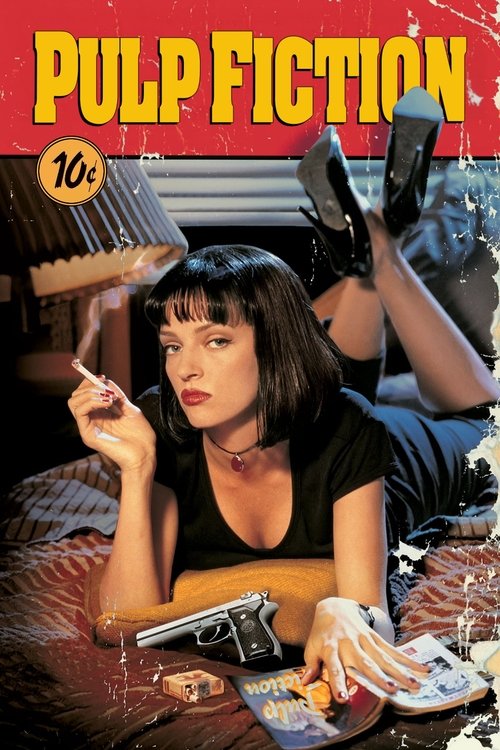
Pulp
Fiction
IMDb Rating
2.1M
IMDb Votes
92%
Rotten Tomatoes
$214M
Box Office
Synopsis & Review
Written and directed by Quentin Tarantino and released in 1994, Pulp Fiction is the film that single-handedly redefined the possibilities of independent American cinema and made Tarantino the most imitated — and least successfully imitated — filmmaker of his generation. The story, told in a deliberately fractured, non-chronological structure, weaves together four interlocking tales set in the criminal underworld of Los Angeles. Vincent Vega (John Travolta) and Jules Winnfield (Samuel L. Jackson) are hitmen for mob boss Marsellus Wallace (Ving Rhames) who spend their morning philosophizing before executing a job. Vincent is later tasked with entertaining Marsellus's wife Mia (Uma Thurman) for an evening — a simple assignment that spirals into catastrophe. A washed-up boxer named Butch (Bruce Willis) double-crosses Marsellus over a fixed fight and finds himself in a situation far stranger and more dangerous than he anticipated. And framing it all, a pair of small-time diner robbers (Tim Roth and Amanda Plummer) discover that the people they have chosen to rob are not quite what they expected. These stories are told out of sequence, with characters from one thread appearing on the fringes of another, creating a mosaic of violence, dark comedy, and unexpected grace.
What makes Pulp Fiction so permanently electrifying is the way Tarantino fuses seemingly irreconcilable elements — the mundane and the murderous, the philosophically elevated and the utterly absurd, the brutally violent and the tenderly human — into something that feels unlike anything that came before it. His dialogue, written with Roger Avary, is the film's greatest achievement: conversations about foot massages, McDonald's, and what they call a Quarter Pounder in Paris are so vividly observed and so perfectly performed that they have entered the permanent vocabulary of cinema. Samuel L. Jackson's Jules Winnfield — a hitman who quotes scripture and has a crisis of faith — is one of the great characters in American film. Travolta's career resurrection, Uma Thurman's iconic cool, the Royale with Cheese, the briefcase, the Gimp, the overdose scene, the twist contest at Jack Rabbit Slim's — every element of Pulp Fiction has been referenced, parodied, and analyzed so many times that it is easy to forget how shocking and original it was when it first arrived. It won the Palme d'Or at Cannes, earned seven Academy Award nominations, and grossed over $214 million on a $8 million budget. It remains the defining film of the 1990s and one of the most influential movies ever made.
Why Watch This Movie?
The Greatest Screenplay Ever Written for the Screen
Tarantino's dialogue is in a category entirely its own. It is simultaneously hyper-realistic — the way people actually talk, drift off topic, argue about trivial things in the middle of serious situations — and completely heightened, poetic almost, with a rhythm and precision that makes even the most casual exchange feel like music. The screenplay won the Academy Award and is studied in every serious screenwriting program on earth.
Samuel L. Jackson's Jules — One of Cinema's Great Characters
Jules Winnfield is the moral and spiritual center of a film that seems, on the surface, to have neither. Jackson plays him with extraordinary intelligence and physicality — terrifying in his violence, hilarious in his pedantry, and genuinely moving in his final scene. His Ezekiel 25:17 monologue is one of the most famous pieces of cinema dialogue in history, and Jackson delivers it differently every time, never quite the same twice.
A Film That Permanently Changed What Cinema Could Sound Like
Before Pulp Fiction, Hollywood films were largely afraid of silence, digression, and irrelevance. Tarantino proved that audiences would not only tolerate but actively love a scene where two hitmen debate tipping etiquette for five minutes before doing their jobs. His influence on the tone, structure, and dialogue of American film for the subsequent thirty years is simply incalculable.
Cast & Crew
Director
Quentin Tarantino
Screenplay
Tarantino & Roger Avary
Producer
Lawrence Bender
Vincent Vega
John Travolta
Jules Winnfield
Samuel L. Jackson
Mia Wallace
Uma Thurman
Butch Coolidge
Bruce Willis
Cinematography
Andrzej Sekula
Studio
Miramax Films
Official Trailer
© Miramax Films. Trailer embedded via YouTube.
Frequently Asked Questions
What is inside the briefcase in Pulp Fiction?
Tarantino has never revealed — and never intends to reveal — what is inside the briefcase, and that ambiguity is entirely deliberate. The briefcase is what screenwriters call a MacGuffin: an object whose only function is to motivate the characters and drive the plot, with no fixed meaning of its own. Whatever is inside glows golden and causes everyone who sees it to react with awe. Popular fan theories have suggested it contains Marsellus Wallace's soul, diamonds, or simply something beautiful. Tarantino has said that audiences can decide for themselves, and that the briefcase represents whatever each viewer finds most valuable. The practical answer on set was that a lightbulb was placed inside to create the golden glow effect.
Why is Pulp Fiction told out of chronological order?
Tarantino structured the film non-chronologically for several interrelated reasons. First, it allows the film to end on a moment of grace and potential redemption — Jules walking away from his life — rather than on Vincent's death, which would give the story an entirely different moral weight. Second, the non-linear structure transforms the film from a plot-driven narrative into a thematic one: we are not watching to find out what happens, but to understand how these lives and choices connect. Third, Tarantino has cited his love of novels — particularly crime pulp fiction — where you can dip in and out of stories in any order. The structure also means that a character can die in one segment and reappear alive in another, subverting the conventional consequences of screen violence in a way that forces the audience to think differently about what they are watching.
Did Pulp Fiction win the Palme d'Or at Cannes?
Yes. Pulp Fiction won the Palme d'Or — the highest prize in world cinema — at the 1994 Cannes Film Festival, from a jury presided over by Clint Eastwood. The win was controversial at the time, with some critics arguing that Krzysztof Kieślowski's Three Colors: Red was the more deserving film, but it has since come to be regarded as one of the most justified Palme d'Or decisions in the festival's history. The film also received seven Academy Award nominations in 1995, including Best Picture and Best Director, winning only Best Original Screenplay — a decision that many film scholars still consider one of the Academy's most puzzling oversights, particularly given that the film lost Best Picture to Robert Zemeckis's Forrest Gump.
More Movies Like This
If you loved Pulp Fiction, these films belong on your watchlist.