Parasite
IMDb Rating
900K
IMDb Votes
99%
Rotten Tomatoes
$263M
Box Office
Synopsis & Review
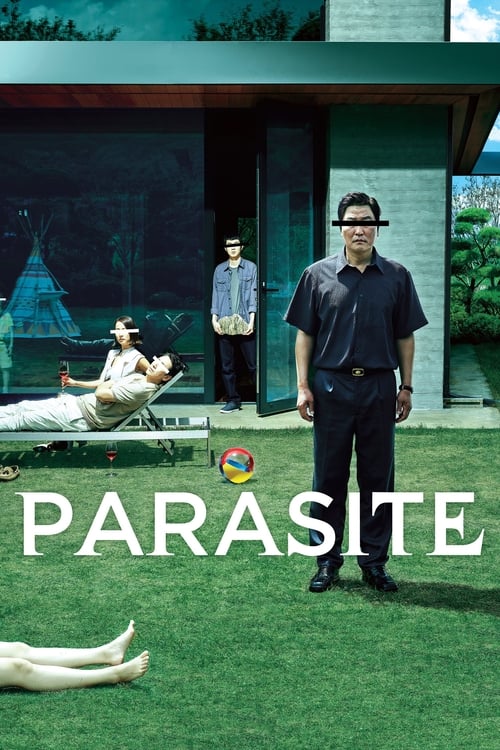
Written and directed by Bong Joon-ho and released in 2019, Parasite is one of the most formally accomplished, tonally daring, and thematically rich films of the 21st century — a work that shifts genres like a conjurer shifts cards, never revealing its next move until it has already made it. The film begins as a dark comedy: the Kim family — father Ki-taek (Song Kang-ho), mother Chung-sook (Chang Hyae-jin), son Ki-woo (Choi Woo-shik), and daughter Ki-jung (Park So-dam) — are four bright, resourceful people living in a damp, cramped semi-basement apartment in Seoul, folding pizza boxes for a living and stealing WiFi from their neighbors. When Ki-woo is offered a job tutoring the daughter of the wealthy Park family — and discovers that the Parks' enormous, architecturally magnificent house is staffed entirely by people who could be replaced — he sees an opportunity. One by one, with elaborate ingenuity and no small amount of moral flexibility, the four Kims insinuate themselves into the Park household: Ki-woo as tutor, Ki-jung as an art therapist, Ki-taek as a chauffeur, and Chung-sook as a housekeeper. The Parks are oblivious and grateful. The scheme is working. And then something is discovered in the house — something hidden far beneath its gleaming surfaces — that changes everything.
What makes Parasite so extraordinary is not just its plotting — which is as precisely constructed as a Swiss watch — but its moral complexity. The film does not ask us to judge either family: the Parks are not villains, merely comfortable and oblivious; the Kims are not heroes, merely desperate and ingenious. Bong Joon-ho's argument is structural rather than individual: the system that produces such extreme inequality produces, inevitably, the desperate behaviour that inequality demands. The film's architecture is itself a metaphor — the Park house rises above ground into light and glass and space, while beneath it, layers of hidden infrastructure descend into darkness — and Bong uses vertical movement through this architecture to track the moral descent of the story with extraordinary precision. Hong Kyung-pyo's cinematography is immaculate. Jung Jae-il's score moves between playful irony and genuine dread with the same effortless fluency that characterizes the film's tonal shifts. Parasite became the first non-English-language film to win the Academy Award for Best Picture at the 92nd ceremony in 2020, after also winning the Palme d'Or at Cannes with a unanimous jury vote — making Bong the first South Korean filmmaker, and the first Asian filmmaker of the modern era, to win both prizes in the same year. It is a film that belongs, definitively, to the canon.
Why Watch This Movie?
A Film That Is Impossible to Categorize — and Perfect Because of It
In the space of two hours and twelve minutes, Parasite moves through black comedy, social satire, domestic thriller, horror, and tragedy — sometimes within a single scene — without ever losing coherence or emotional truth. This is not tonal inconsistency; it is tonal mastery. Bong Joon-ho has described it as "a comedy without clowns, a tragedy without villains," and that description captures exactly what makes the film so uniquely unsettling and moving.
The Most Perfectly Plotted Film of the Decade
Every element introduced in the first act of Parasite — every prop, every character detail, every piece of architecture, every offhand remark — returns in the second and third acts with devastating precision. The film is constructed like a trap that springs on the audience and the characters simultaneously. On a second viewing, the screenplay reveals itself to be even more extraordinary than it appeared on the first — a testament to the craftsmanship of both Bong and his co-writer Han Jin-won.
The Film That Broke the Language Barrier for Global Cinema
Before Parasite, the Academy Award for Best Picture had been won by an English-language film in every single one of its ninety-one previous years. The film's victory was not merely a personal triumph for Bong or a national triumph for South Korea — it was a seismic shift in how global cinema understands itself and its audiences. Bong's acceptance speech remark — "Once you overcome the one-inch-tall barrier of subtitles, you will be introduced to so many more amazing films" — was one of the most eloquent arguments for world cinema ever made from a Hollywood stage.
Cast & Crew
Director
Bong Joon-ho
Screenplay
Bong Joon-ho & Han Jin-won
Producer
Kwak Sin-ae
Ki-taek (Father)
Song Kang-ho
Park Dong-ik
Lee Sun-kyun
Yeon-kyo (Mother)
Cho Yeo-jeong
Ki-woo (Son)
Choi Woo-shik
Cinematography
Hong Kyung-pyo
Original Score
Jung Jae-il
Official Trailer
© CJ ENM / Barunson E&A. Trailer embedded via YouTube.
Frequently Asked Questions
Why is the film called Parasite? Who is the actual parasite?
The title is deliberately ambiguous — and that ambiguity is the film's central argument. On the surface, the Kim family are the parasites: they infiltrate the Park household under false pretenses and live off the Parks' wealth and obliviousness. But Bong Joon-ho has consistently resisted this interpretation as too simple. The Parks are also, in a different sense, parasitic — they depend entirely on an underclass of workers who manage every aspect of their lives while remaining carefully invisible to them. The title also refers to the hidden man living beneath the house, whose existence the film reveals in its most shocking act. Ultimately, Bong argues that the word "parasite" is a moral judgment that the economic system makes about the poor — a label applied to those forced into desperate survival strategies by a structure that benefits the wealthy at the expense of everyone else. The real parasite, if there is one, is the system itself.
How many Academy Awards did Parasite win?
Parasite won four Academy Awards at the 92nd ceremony in February 2020: Best Picture, Best Director (Bong Joon-ho), Best Original Screenplay (Bong Joon-ho and Han Jin-won), and Best International Feature Film. It was nominated for six awards in total. The Best Picture win was historic on multiple levels: it was the first non-English-language film to win in the category's 92-year history, the first South Korean film ever nominated in the category, and the first film in 65 years to win both the Palme d'Or at Cannes and Best Picture at the Academy Awards (the previous being Marty in 1955). Bong Joon-ho's acceptance speech, in which he expressed deep admiration for Martin Scorsese, and his remark about overcoming the "one-inch-tall barrier of subtitles," were among the most celebrated moments of the ceremony.
What is the significance of the smell in Parasite?
The recurring motif of smell in Parasite is one of the film's most carefully constructed and emotionally devastating elements. Bong Joon-ho uses scent — which cannot be disguised by wealth, education, or performance — as the one marker of class that the Kims cannot fake. Park Dong-ik (Lee Sun-kyun) notices that all four of the Kims share a particular smell — the smell of the semi-basement, of poverty, of a life lived below ground — and his private revulsion at it is one of the film's most quietly cruel moments. Ki-taek overhears this observation and it plants a seed of rage that eventually drives the film's catastrophic finale. Bong uses smell to argue that no matter how successfully the poor imitate the rich, no matter how sophisticated the performance, class is an embodied condition that leaves physical traces. The rich can sense it even when they cannot name it — and that sensing, and the contempt it generates, is what makes the system so impenetrable and so violent.
More Movies Like This
If you loved Parasite, these films will challenge your assumptions just as powerfully.
🎬 All 15 Films Complete
You have now explored every entry in CineVault's definitive Top 15 ranking. From Shawshank to Parasite — the greatest films ever made, all in one place.