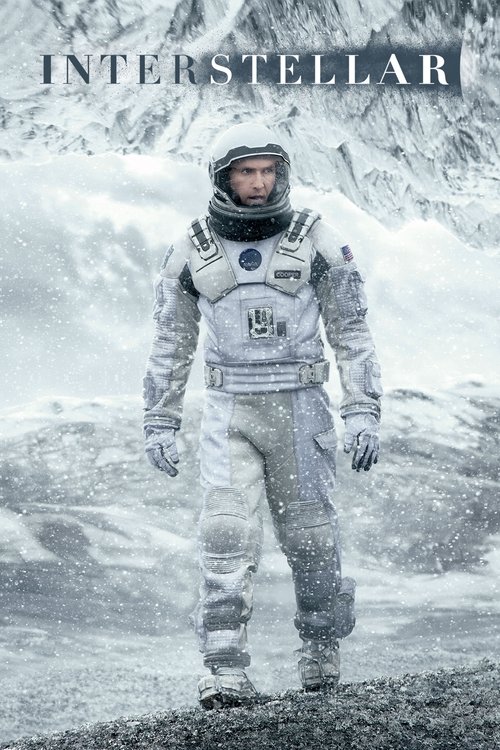
Interstellar
IMDb Rating
2.0M
IMDb Votes
72%
Rotten Tomatoes
$701M
Box Office
Synopsis & Review
Directed by Christopher Nolan and released in 2014, Interstellar is the most emotionally ambitious film of Nolan's career and one of the most awe-inspiring science fiction films ever made — a work that uses the cold, mathematical language of astrophysics as a vehicle for exploring what may be the warmest, most human of all themes: the love between a parent and a child, and what that love can survive. Set in a near-future Earth devastated by crop blight and encroaching dust storms, the film follows Cooper (Matthew McConaughey), a former NASA test pilot and farmer, who is recruited for a desperate last-chance mission: to travel through a newly discovered wormhole near Saturn, explore three potentially habitable planets in another galaxy, and find a world where what remains of humanity can survive. To do so, he must leave behind his daughter Murph (Mackenzie Foy, and later Jessica Chastain) — a child who begs him not to go and who will spend her entire life in his absence working on the equations that might save the human race. The film splits its attention between Cooper's increasingly harrowing journey through space and time — including a planet where one hour equals seven years on Earth — and Murph's parallel life of scientific obsession, grief, and eventual genius on a dying planet.
What makes Interstellar extraordinary, and what separates it from the merely spectacular, is the way it uses genuine theoretical physics — the film was developed with the input of Nobel Prize-winning theoretical physicist Kip Thorne, who served as executive producer and scientific consultant — as the foundation for a story about love as a fundamental force of the universe. The film argues, with mathematical sincerity, that love might be the one thing capable of transcending the dimensions of space and time — and it makes this argument not through sentiment but through a third-act revelation that reframes the entire preceding narrative with an elegance that is genuinely breathtaking. Hoyte van Hoytema's cinematography creates images of space — the wormhole, the black hole Gargantua, the frozen cloudscape of Mann's Planet — that have become among the most iconic visual representations of space travel in cinema history. Hans Zimmer's organ-driven score is the most physically overwhelming piece of film music since the 2001 monolith sequences. Interstellar won the Academy Award for Best Visual Effects and grossed $701 million worldwide. It is a film that demands to be seen on the largest possible screen, at the highest possible volume, with someone you love sitting beside you.
Why Watch This Movie?
The Most Scientifically Accurate Depiction of Space Ever Filmed
With Nobel laureate Kip Thorne as scientific consultant, the film's depictions of black holes, wormholes, and time dilation are grounded in actual theoretical physics. The visual representation of the black hole Gargantua was so scientifically accurate that it led to a peer-reviewed paper published in the American Journal of Physics. Watching Interstellar is the closest most of us will ever come to experiencing what these phenomena might actually look like.
The Most Devastating Use of Time in Cinema
The sequence on Miller's Planet — where one hour equals seven years on Earth — and the scene in which Cooper returns to the ship and watches twenty-three years of recorded video messages from his children while weeping silently, is among the most emotionally devastating sequences in any film. Nolan weaponizes the concept of time dilation, which is usually an abstraction, into something physically felt — a grief so enormous it has no adequate human language.
Hans Zimmer's Score — The Most Overwhelming in Cinema History
Zimmer composed the score without reading the script, working only from a one-page letter Nolan wrote about a parent and child separated by circumstance. The result — built around a church organ that seems to breathe with the weight of the universe — is the most physically immersive piece of film music of the 21st century. Heard in a properly calibrated cinema at proper volume, it is a genuinely transcendent experience.
Cast & Crew
Director
Christopher Nolan
Screenplay
Nolan & Jonathan Nolan
Sci. Consultant
Kip Thorne (Nobel Prize)
Cooper
Matthew McConaughey
Brand
Anne Hathaway
Adult Murph
Jessica Chastain
Cinematography
Hoyte van Hoytema
Original Score
Hans Zimmer
Studio
Paramount / Warner Bros.
Official Trailer
© Paramount Pictures / Warner Bros. Trailer embedded via YouTube.
Frequently Asked Questions
Is the science in Interstellar actually accurate?
Largely, yes — more accurately than almost any other major science fiction film. Nobel Prize-winning theoretical physicist Kip Thorne, who co-originated the idea for the film with director Steven Spielberg (who later passed the project to Nolan), worked as executive producer and scientific consultant throughout production. The depiction of Gargantua — the film's black hole — was generated using a custom rendering pipeline built on Thorne's equations, and it accurately portrays the gravitational lensing effects that would distort light around a rotating black hole. The result was so scientifically significant that it was published as a paper in the journal Classical and Quantum Gravity. The film's treatment of time dilation near a massive gravitational body, wormholes, and the effects of relativity on aging are all grounded in established theoretical physics. The tesseract sequence in the fifth dimension is more speculative but is consistent with theoretical frameworks for higher-dimensional space.
What happens in the tesseract scene? What is the fifth dimension?
After Cooper passes the event horizon of the black hole Gargantua, he is transported into a tesseract — a four-dimensional hypercube — constructed inside the black hole by beings who exist in five dimensions (the three spatial dimensions we experience, plus time as a navigable fourth, plus a fifth dimension that allows movement through time). The film's conceit is that these beings are not aliens but future humans who have evolved the ability to perceive time as a physical dimension rather than a linear progression. Within the tesseract, Cooper can observe any moment in his daughter Murph's bedroom across all of time simultaneously, and — crucially — interact with those moments by manipulating gravity (which can pass through dimensions). Cooper uses binary code tapped in gravitational pulses to send the coordinates of NASA to his past self, and later uses Morse code via the second hand of a watch to transmit the quantum data that Murph needs to solve the equations saving humanity. The film's central thesis is that love — specifically Cooper's love for Murph — is what guided the future humans to build the tesseract where it would be found, making love itself the driving force behind humanity's survival.
Why does Cooper age so much less than his daughter Murph?
The answer lies in Einstein's theory of general relativity, which predicts that time passes more slowly in stronger gravitational fields — a phenomenon known as gravitational time dilation. Miller's Planet, the first planet the crew visits, orbits extremely close to the massive black hole Gargantua, where the gravitational field is enormously powerful. As a result, one hour on Miller's Planet corresponds to approximately seven years on Earth. Cooper and Brand spend roughly three hours on the planet's surface — returning to the Endurance to find that their crewmate Romilly has aged twenty-three years. By the time Cooper eventually returns to the space station near Saturn, Murph is an old woman on her deathbed, while Cooper is still middle-aged. This is not fiction or cinematic shorthand — it is a real and experimentally verified consequence of relativistic physics, demonstrated on smaller scales by the fact that GPS satellites must account for time dilation in their calculations.
More Movies Like This
If you loved Interstellar, these films will take you somewhere beyond the ordinary.