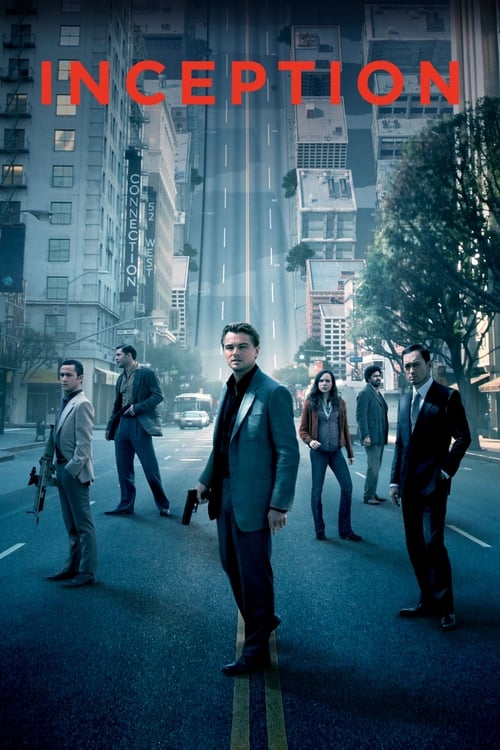
Inception
IMDb Rating
2.4M
IMDb Votes
87%
Rotten Tomatoes
$836M
Box Office
Synopsis & Review
Written and directed by Christopher Nolan and released in 2010, Inception is one of the most genuinely original blockbusters ever produced by a major studio — a film that dares to ask its audience to follow a deeply complex, multi-layered narrative while simultaneously delivering some of the most spectacular action sequences in cinema history. Dom Cobb (Leonardo DiCaprio) is a skilled thief who specializes in a unique and illegal form of corporate espionage: he enters the subconscious minds of his targets while they dream and extracts their most closely guarded secrets. A fugitive from the law, Cobb is offered a chance to have his criminal record erased and return home to his children — but only if he can perform inception: planting an idea so deep within the target's mind that he believes he thought of it himself. The target is Robert Fischer (Cillian Murphy), the heir to a vast energy empire, and the idea Cobb must plant would fundamentally restructure that empire. To do it, he assembles a team of specialists and descends through multiple layers of dreaming — a dream within a dream within a dream — each level governed by different rules of physics, time, and gravity, until the boundaries between reality and imagination become dangerously difficult to distinguish.
What elevates Inception beyond its extraordinary conceptual ambition is the deeply personal story at its heart. Cobb is not simply a thief on a job — he is a grieving husband haunted by the memory of his dead wife Mal (Marion Cotillard), whose projection invades his dreams and threatens to destroy every mission. The film's emotional core is a man who has retreated so deep into constructed realities that he can no longer trust his own perceptions of the world, and DiCaprio carries that exhaustion and longing with remarkable subtlety throughout. Nolan's direction is characteristically precise and relentless — the film's famous rotating corridor fight sequence, in which Joseph Gordon-Levitt battles enemies in a hallway with no fixed gravity, was achieved practically with a built set that actually rotated, making it one of the most astonishing pieces of practical filmmaking in modern cinema. Hans Zimmer's score, built around a slowed-down version of Édith Piaf's "Non, Je Ne Regrette Rien," is as iconic as any film score of the past two decades. Inception won four Academy Awards, grossed $836 million worldwide on a $160 million budget, and ignited a global conversation about its ending that continues to this day. It is the rare Hollywood blockbuster that genuinely respects its audience's intelligence — and the audience responded in kind.
Why Watch This Movie?
The Last Great Original Blockbuster
In an era dominated by sequels, remakes, and franchise adaptations, Inception arrived as a $160 million original idea with no source material, no pre-existing audience, and no safety net — and became a global phenomenon. It proved that audiences hunger for genuine originality when it is offered to them. No film since has matched its combination of scale, ambition, and conceptual daring from a wholly original screenplay.
Practical Filmmaking at Its Most Inventive
Nolan is famously committed to practical effects, and Inception is his most spectacular demonstration of what that commitment produces. The rotating corridor, the Paris folding sequence, the zero-gravity hotel, the collapsing dreamscapes — nearly all of it was achieved in camera, with real sets, real physics, and real ingenuity. Watching the behind-the-scenes footage of how these sequences were constructed is almost as astonishing as watching the film itself.
An Ending That Will Keep You Thinking for Days
The final shot of Inception — a spinning top that may or may not be about to fall — is one of the most discussed and debated endings in modern cinema. Nolan has carefully constructed the film so that both interpretations are equally valid and equally supported by the evidence. The question of whether Cobb is dreaming or awake at the end is not a trick — it is the film's central philosophical argument about the nature of reality and the power of belief, delivered in a single, perfect image.
Cast & Crew
Director
Christopher Nolan
Screenplay
Christopher Nolan
Producer
Emma Thomas
Dom Cobb
Leonardo DiCaprio
Arthur
Joseph Gordon-Levitt
Mal
Marion Cotillard
Ariadne
Elliot Page
Original Score
Hans Zimmer
Studio
Warner Bros. Pictures
Official Trailer
© Warner Bros. Pictures. Trailer embedded via YouTube.
Frequently Asked Questions
Is Cobb dreaming at the end of Inception? Does the top fall?
Nolan has deliberately left this ambiguous and has said he will never definitively answer it — because the ambiguity is the point. However, he has offered a subtle clue: the film's real indicator of whether Cobb is dreaming is not the top, but his wedding ring. In every dream sequence, Cobb wears his wedding ring. In every reality sequence, he does not. In the final scene, he is not wearing his ring — suggesting he is in reality. Additionally, Michael Caine, who plays Cobb's father-in-law, has stated that Nolan told him directly that his scenes always take place in reality, and Caine appears in the final reunion scene. The top, meanwhile, was Mal's totem — not Cobb's. His actual totem is his wedding ring, which the audience may have missed entirely. The film rewards second and third viewings.
How long did it take Christopher Nolan to write Inception?
Christopher Nolan has said that the idea for Inception came to him when he was a teenager, inspired by the concept of lucid dreaming — the ability to control one's own dreams. He spent approximately ten years developing and writing the screenplay, off and on, while working on other films including Memento, Batman Begins, The Dark Knight, and The Prestige. He began the serious, concentrated writing of the final screenplay around 2008, after completing The Dark Knight. The complexity of the dream-logic rules — which had to be internally consistent across multiple levels of reality — required extraordinary structural planning, which is one reason the film took so long to develop. Nolan has described it as the most challenging screenplay he has ever written.
How was the rotating corridor fight scene in Inception filmed?
The iconic rotating corridor fight sequence — in which Arthur (Joseph Gordon-Levitt) battles enemies through a hotel hallway with no fixed gravity — was achieved entirely practically, without CGI. Production designer Guy Hendrix Dyas built a full-scale hotel corridor set inside a massive steel gimbal that could rotate a full 360 degrees. The set weighed 100 tons and took six weeks to construct. Gordon-Levitt and the stunt team trained for weeks on the rotating set and performed most of their own stunts. The cameras were mounted directly on the rotating set, moving with it, so that the audience experienced the disorientation exactly as the actors did. The sequence took three weeks to film. It is widely considered one of the greatest achievements in practical filmmaking of the 21st century, and it was accomplished without a single frame of CGI.
More Movies Like This
If you loved Inception, these mind-bending films belong on your watchlist.