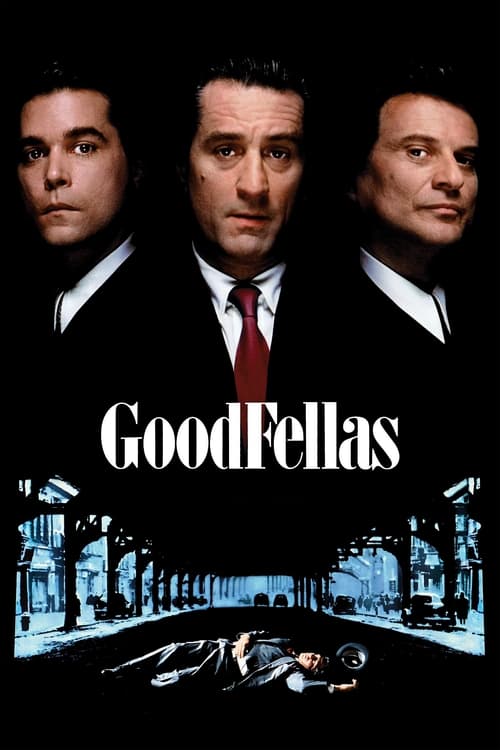
Goodfellas
IMDb Rating
1.2M
IMDb Votes
96%
Rotten Tomatoes
$47M
Box Office
Synopsis & Review
Directed by Martin Scorsese and released in 1990, Goodfellas is the definitive portrait of organized crime in American cinema — a film that does what no mob movie before or since has managed with quite such blistering precision: it makes you understand, at a visceral and seductive level, exactly why someone would choose this life, and then shows you, with equal clarity and without a moment's sentimentality, what that choice costs. Based on Nicholas Pileggi's 1985 nonfiction book Wiseguy, the film follows Henry Hill (Ray Liotta) from his childhood in a working-class Brooklyn neighborhood, where he falls in love with the power and glamour of the local mob, through his rise within the Lucchese crime family alongside the volatile Tommy DeVito (Joe Pesci) and the cool, calculating Jimmy Conway (Robert De Niro), through decades of murders, heists, cocaine addiction, FBI surveillance, and the slow, paranoid collapse of everything he has built. Narrated in Henry's own voice — a voice of cheerful, amoral pragmatism that never entirely condemns what it describes — the film covers roughly thirty years at a pace that feels simultaneously exhausting and exhilarating, Scorsese's camera restless and propulsive, his editing rhythm as tight and intoxicating as the lifestyle it depicts.
What separates Goodfellas from every other crime film is its total refusal to romanticize the Mafia in the way that even The Godfather — a greater film by most metrics — cannot entirely resist. There are no codes of honor in Scorsese's mob, no tragic dignity, no operatic nobility. There is only money, power, paranoia, and the constant possibility of sudden, senseless death. The film's most celebrated sequence — a nearly three-minute, unbroken tracking shot following Henry and Karen through the back entrance of the Copacabana nightclub — is a masterclass in seduction as filmmaking technique: it makes us feel exactly what Karen feels, exactly what Henry feels, the breathless exhilaration of being special, of being known, of moving through a world that parts for you. And then Scorsese spends the next two hours showing us what lies beneath that feeling. Joe Pesci's Tommy DeVito — violent, unpredictable, terrifyingly funny — won the Academy Award for Best Supporting Actor and remains one of the most frightening characters in American cinema. Goodfellas earned six Academy Award nominations, was selected for preservation in the National Film Registry in 2000, and is consistently ranked among the ten greatest films ever made by critics, filmmakers, and audiences worldwide.
Why Watch This Movie?
Scorsese's Direction — The Most Kinetic Camera in Cinema History
No director uses the camera as a storytelling instrument with more physical intelligence than Scorsese at his peak, and Goodfellas is his peak. The Copacabana tracking shot. The cocaine-fueled third-act paranoia, shot with a handheld camera that makes the audience feel Henry's fragmentation. Thelma Schoonmaker's editing, which can compress a decade into three minutes or stretch a murder across an entire sequence. Every formal choice serves the story's emotional logic with extraordinary precision.
Joe Pesci's Tommy — The Most Terrifying Comic Performance Ever
"Funny how? Like I'm a clown, I amuse you?" Tommy DeVito is simultaneously the funniest and most terrifying character in crime cinema. Pesci built the role partly from his own memories of growing up around dangerous men — men who used humor as a weapon — and the result is a performance of extraordinary unpredictability. You never know when the laughter will stop and the violence will start. That uncertainty is the source of the film's deepest dread.
The Greatest Soundtrack in Cinema History
Scorsese deployed over forty songs — from Tony Bennett to the Rolling Stones to Cream to the Shangri-Las — not as background music but as a precise emotional and chronological instrument, charting the decades and moods of Henry's life with unerring accuracy. "Layla" over the discovery of the bodies. "Sunshine of Your Love" as Jimmy plots his betrayals. "Jump Into the Fire" during the cocaine paranoia sequence. Each song is so perfectly chosen it seems inevitable — which is the mark of genius.
Cast & Crew
Director
Martin Scorsese
Screenplay
Scorsese & Nicholas Pileggi
Based On
Wiseguy by Nicholas Pileggi
Henry Hill
Ray Liotta
Jimmy Conway
Robert De Niro
Tommy DeVito
Joe Pesci
Karen Hill
Lorraine Bracco
Film Editor
Thelma Schoonmaker
Studio
Warner Bros. Pictures
Official Trailer
© Warner Bros. Pictures. Trailer embedded via YouTube.
Frequently Asked Questions
Is Goodfellas based on a true story?
Yes, Goodfellas is based almost entirely on the true story of Henry Hill, a real-life associate of the Lucchese crime family in New York who became an FBI informant in 1980 and entered the Witness Protection Program. The film is adapted from Nicholas Pileggi's 1985 nonfiction book Wiseguy, which was itself based on extensive interviews with Hill conducted over several years. Most of the major characters — Jimmy Burke (fictionalized as Jimmy Conway), Tommy DeSimone (fictionalized as Tommy DeVito), Paul Vario (fictionalized as Paulie Cicero) — were real people, and the film's major events, including the 1978 Lufthansa heist at JFK Airport (the largest cash robbery in American history at the time), the murder of Billy Batts, and Henry's eventual cooperation with the FBI, all occurred. Henry Hill died in 2012, having lived openly under his own name after his Witness Protection cover was blown.
How was the Copacabana tracking shot filmed?
The famous three-minute unbroken tracking shot that follows Henry and Karen through the back entrance, kitchen, and corridors of the Copacabana nightclub was shot in a single continuous take using a Steadicam operated by cinematographer Michael Ballhaus. The sequence required extraordinary logistical coordination: the entire path through the club had to be pre-lit, the dozens of extras and staff along the route were choreographed with precision, and Ray Liotta and Lorraine Bracco had to walk at exactly the right pace to keep their conversation natural while hitting their marks. The sequence was filmed over the course of a full day and required multiple takes. Scorsese chose to shoot it as a single unbroken take specifically to replicate the seductive, uninterrupted momentum of Henry's life at this point — the feeling that everything is moving effortlessly, nothing can stop you, doors open before you've even reached them. It is widely considered one of the ten greatest single shots in the history of cinema.
Did Goodfellas win Best Picture at the Oscars?
No — and this is widely considered one of the most egregious oversights in Oscar history. Goodfellas received six Academy Award nominations at the 63rd Academy Awards in 1991, including Best Picture and Best Director. It won only one: Best Supporting Actor for Joe Pesci. The Best Picture award went to Kevin Costner's Dances with Wolves, which also beat Scorsese for Best Director — a decision that provoked widespread disbelief and remains a source of intense critical debate. Many film scholars argue that Goodfellas is not only a greater film than Dances with Wolves but one of the greatest films in the history of American cinema, and Scorsese himself — who had previously been overlooked for Raging Bull, another film many consider superior to its Best Picture winner — would not receive the Academy Award for Best Director until 2007, for The Departed.
More Movies Like This
If you loved Goodfellas, these essential crime films belong on your watchlist.