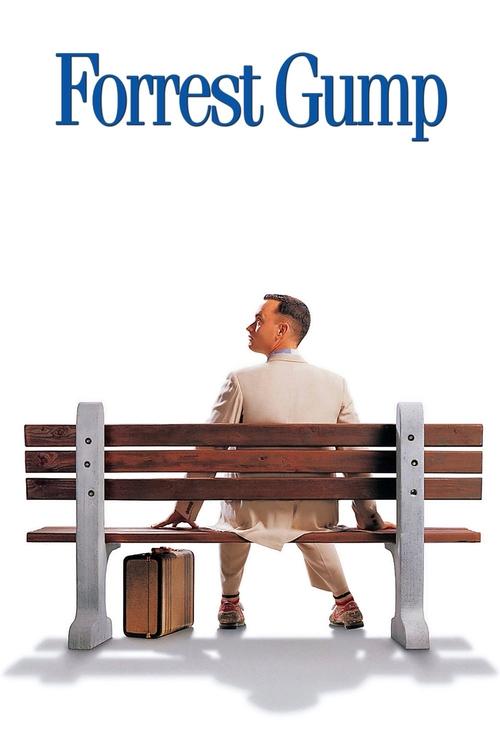
Forrest
Gump
IMDb Rating
2.1M
IMDb Votes
71%
Rotten Tomatoes
$678M
Box Office
Synopsis & Review
Directed by Robert Zemeckis and released in 1994, Forrest Gump is one of the most beloved and unusual films in American cinema — a work of remarkable tonal daring that is simultaneously a slapstick comedy, a sweeping historical epic, a tender romance, and a deeply moving meditation on destiny, love, and the random cruelty of life. The film is told in a single extended flashback by Forrest Gump (Tom Hanks) himself, a man from Greenbow, Alabama, with an IQ of 75 and an extraordinary capacity for kindness, loyalty, and inadvertent heroism. Sitting on a bench at a bus stop, he tells his life story to a succession of strangers — and what a story it is. Through a combination of blind luck, genuine decency, and a gift for running very fast, Forrest teaches Elvis Presley to dance, serves as a decorated Vietnam War hero, inspires the Watergate break-in, invents the smiley face, popularizes the bumper sticker "Shit Happens," and builds a shrimping empire — all while remaining entirely, gloriously unaware of how extraordinary any of it is. Threading through every chapter of his remarkable life is Jenny (Robin Wright), the girl he has loved since childhood, whose parallel journey through the counterculture of the 1960s and 70s takes her down a far darker and more painful road.
What makes Forrest Gump a genuine masterwork rather than merely an entertaining fantasy is the emotional intelligence it brings to the gap between Forrest's simplicity and the world's complexity. Tom Hanks delivers one of the greatest performances of his career — and of American cinema — finding in Forrest not a figure of mockery or sentimentality, but a man of genuine moral clarity whose very inability to understand cynicism, calculation, or cruelty makes him a kind of secular saint. The film's groundbreaking visual effects — digitally inserting Forrest into archival footage of historical events — were revolutionary for 1994, winning the Academy Award for Best Visual Effects. Alan Silvestri's score is among the most recognizable and emotionally precise in cinema history. Forrest Gump won six Academy Awards, including Best Picture and Best Director, and grossed $678 million on a $55 million budget — making it one of the highest-grossing films of all time to that point. It is a film that divides critics but unites audiences: dismissed by some as manipulative nostalgia, and adored by hundreds of millions as one of the warmest, funniest, and most emotionally devastating films ever made. Both reactions are defensible. But the people who love it love it with a depth that is very hard to argue with.
Why Watch This Movie?
Tom Hanks at the Absolute Peak of His Powers
Hanks won his second consecutive Academy Award for this role — a feat accomplished only once before, by Spencer Tracy. His performance as Forrest is a staggering technical and emotional achievement: physically specific, linguistically precise, and yet somehow completely transparent, so that we never watch Hanks acting but always watch Forrest living. It is one of the ten greatest performances in American film history, and it carries every one of the movie's 142 minutes entirely on its own.
A Love Story That Earns Every Tear It Demands
The relationship between Forrest and Jenny is one of cinema's great love stories — but it is not a simple or comfortable one. Jenny is damaged, self-destructive, and repeatedly unable to accept the love she is offered. The film never judges her for this. It simply shows us, with heartbreaking honesty, what it costs both of them — and the final scenes between Forrest and his son represent some of the most quietly devastating emotional filmmaking of the 1990s.
An Entire American Century Seen Through Innocent Eyes
By filtering thirty years of turbulent American history — Vietnam, Watergate, the civil rights movement, the AIDS epidemic, the counterculture — through Forrest's uncomplicated perspective, the film achieves something remarkable: it allows audiences to see familiar events with fresh eyes, stripped of ideology and political noise, and simply feel their human weight. It is history as emotional experience rather than argument, and very few films have managed it as well.
Cast & Crew
Director
Robert Zemeckis
Screenplay
Eric Roth
Based On
Novel by Winston Groom
Forrest Gump
Tom Hanks
Jenny Curran
Robin Wright
Lt. Dan Taylor
Gary Sinise
Bubba Blue
Mykelti Williamson
Original Score
Alan Silvestri
Studio
Paramount Pictures
Official Trailer
© Paramount Pictures. Trailer embedded via YouTube.
Frequently Asked Questions
Is Forrest Gump based on a true story?
No, Forrest Gump is not based on a true story. It is adapted from Winston Groom's 1986 satirical novel of the same name. The character of Forrest Gump is entirely fictional, though the historical events he witnesses — the civil rights movement, the Vietnam War, the Watergate break-in, John Lennon's appearance on The Dick Cavett Show — are all real. The film takes considerable creative liberties with Groom's novel, which is darker, stranger, and more satirical in tone. In the book, for example, Forrest becomes an astronaut and travels to space, and his character is written with a deliberately absurdist edge that the film softens considerably. Eric Roth's screenplay preserves the novel's central conceit — a simple man accidentally shaping history — while creating an entirely original emotional journey for the characters.
How did the film put Forrest into real historical footage?
The seamless integration of Tom Hanks into archival footage of Presidents Kennedy, Johnson, Nixon, and John Lennon was achieved through groundbreaking digital compositing technology — techniques that were genuinely revolutionary in 1994 and earned the film the Academy Award for Best Visual Effects. The process involved carefully matching the lighting, grain, and color palette of the original archival footage, then digitally removing the mouths of the historical figures and replacing them with new lip movements to match rewritten dialogue. Tom Hanks filmed his scenes against a blue screen, which were then composited into the archival footage frame by frame. For the scenes with President Kennedy, the production also used a body double with a digitally replaced face. The technology used was so new that the team had to develop many of the tools themselves. Industrial Light & Magic, George Lucas's effects company, handled all the compositing.
Why did Forrest Gump beat Pulp Fiction and The Shawshank Redemption for Best Picture?
The 67th Academy Awards in 1995 are now widely regarded as one of the most debated Best Picture decisions in Oscar history. Forrest Gump won over Pulp Fiction, The Shawshank Redemption, Four Weddings and a Funeral, and Quiz Show — a lineup that many film scholars consider the strongest in Academy history. At the time, Forrest Gump was the highest-grossing film of the year, had enormous popular goodwill, and represented the kind of feel-good Americana that the Academy historically favored. Pulp Fiction was considered too transgressive and violent for many voters, and The Shawshank Redemption had underperformed at the box office and was less well known. In retrospect, the critical consensus has shifted dramatically: both Pulp Fiction and The Shawshank Redemption now rank above Forrest Gump on virtually every critical and audience list, while Forrest Gump itself remains one of the most beloved popular films ever made — suggesting that "best" and "most beloved" are not always the same thing.
More Movies Like This
If you loved Forrest Gump, these films will stay with you long after the credits roll.