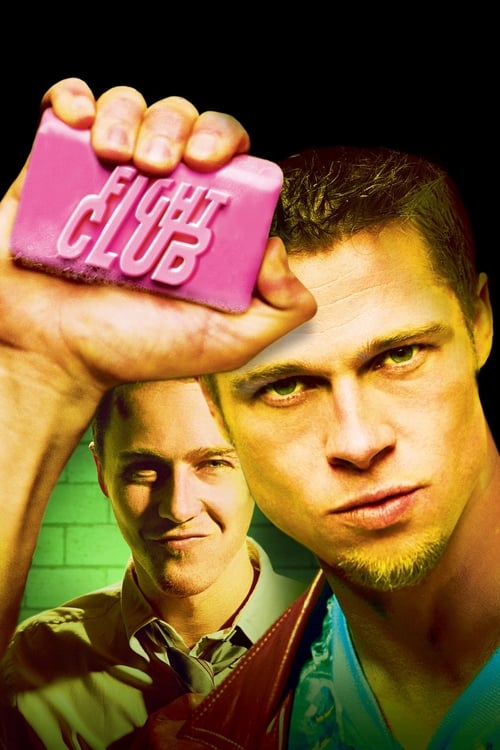
Fight
Club
IMDb Rating
2.2M
IMDb Votes
79%
Rotten Tomatoes
$101M
Box Office
Synopsis & Review
Directed by David Fincher and adapted from Chuck Palahniuk's 1996 novel, Fight Club is one of the most daring, formally inventive, and genuinely subversive films ever produced by a major Hollywood studio — a film that was largely dismissed on release, bombed at the box office, and has since been recognized as one of the defining works of American cinema. The story is narrated by an unnamed insomniac office worker (Edward Norton), a man so numb from the IKEA-catalog emptiness of his corporate life that he has begun attending support groups for diseases he doesn't have, just to feel something. On a business flight, he meets Tyler Durden (Brad Pitt) — a soap salesman who is everything the Narrator is not: charismatic, fearless, contemptuous of social convention, and magnificently, dangerously alive. After the Narrator's apartment explodes under mysterious circumstances, he moves into Tyler's collapsing house and the two men begin sparring in a parking lot — discovering that the physical reality of pain is the only thing that makes either of them feel real. That parking-lot fight becomes Fight Club: an underground network of men who gather to beat each other bloody, not out of rage but out of a desperate need to feel present in their own lives. Fight Club expands, metastasizes, and becomes something far darker and more political — a revolutionary organization called Project Mayhem — and the Narrator begins to realize that he understands Tyler Durden far less than he thought.
What makes Fight Club so remarkable — and so persistently misunderstood — is the precision with which Fincher and screenwriter Jim Uhls deploy the film's anarchist energy as satire rather than endorsement. The film is not a manifesto for nihilism; it is a diagnosis of it. Tyler Durden is not a hero but a symptom — the seductive, destructive fantasy of a man who has confused the absence of feeling with the absence of meaning. Fincher's direction is extraordinary in its technical bravado: the film's visual grammar, shot by Jeff Cronenweth, is deliberately cheap and unstable, as if the world itself is coming apart at the seams. The performances are uniformly exceptional — Brad Pitt has never been more charismatic or more frightening, Edward Norton has never been more precisely calibrated, and Helena Bonham Carter's Marla Singer is one of the great underappreciated supporting performances of the decade. The film's twist ending — which reframes everything the audience has seen — is one of the most perfectly constructed reveals in cinema history, executed not as a cheap trick but as a tragic and inevitable truth about the cost of dissociation. Fight Club lost money in theaters, was condemned by several critics as irresponsible, and is now consistently ranked among the greatest films ever made. Few films have been more right about being wrong.
Why Watch This Movie?
David Fincher's Direction — A Masterclass in Visual Storytelling
Every frame of Fight Club is doing work. Fincher hides clues to the film's twist in plain sight from the first scene — dozens of subliminal single frames, visual inconsistencies, and symbolic details that reward multiple viewings. His camera is restless, oppressive, and deeply intelligent, creating a visual world that feels simultaneously hyper-real and dreamlike. It is the most technically sophisticated American film of the 1990s.
Brad Pitt's Most Dangerous Performance
Tyler Durden is one of the great cinematic characters — a figure so perfectly constructed to appeal to the male id that his philosophy sounds seductive even as it reveals itself to be catastrophically wrong. Pitt understood this completely and plays Tyler not as a villain but as a charismatic ideal, making the film's moral argument land with maximum force. It is a performance that requires the audience to question their own attraction to the character, which is precisely the point.
The Most Perfectly Executed Twist in Film History
Unlike lesser twist films, Fight Club's revelation does not simply recontextualize plot — it recontextualizes character, theme, and meaning. Every single scene plays differently on a second viewing, not because the film cheated, but because it was scrupulously honest about everything and trusted the audience not to see it. Watching the film a second time is a completely different and arguably more rewarding experience than watching it the first.
Cast & Crew
Director
David Fincher
Screenplay
Jim Uhls
Based On
Novel by Chuck Palahniuk
The Narrator
Edward Norton
Tyler Durden
Brad Pitt
Marla Singer
Helena Bonham Carter
Cinematography
Jeff Cronenweth
Original Score
The Dust Brothers
Studio
20th Century Fox
Official Trailer
© 20th Century Fox. Trailer embedded via YouTube.
Frequently Asked Questions
What is the twist in Fight Club and were there clues?
The twist — that Tyler Durden is not a real person but a dissociated alter ego of the Narrator — is seeded throughout the film with extraordinary care. Clues include: Tyler and the Narrator are never seen by other characters simultaneously; the Narrator's boss never addresses Tyler directly in the office scene; when the Narrator calls Tyler from the phone booth, the phone has a sign saying it cannot receive incoming calls; Tyler appears in single subliminal frames long before the Narrator meets him; and the Narrator's apartment is never shown as genuinely destroyed until the reveal. Fincher also inserted Tyler's face into four brief single frames in the first act — frames too fast to consciously register — mirroring the film's own argument that the unconscious mind sees what the conscious mind denies. The film is entirely honest. It simply trusted the audience to see Tyler the way the Narrator sees him.
Why was Fight Club so controversial on release?
When Fight Club opened in October 1999, it was met with a deeply divided critical response and significant moral alarm. Many critics condemned the film for what they saw as a glorification of violence and anarchism — arguing that audiences might miss the satire and take Tyler Durden's philosophy at face value. The film's graphic depictions of bare-knuckle fighting and the explicit instructions Tyler gives for making explosives from household materials drew particular concern. News Corporation chairman Rupert Murdoch was reportedly furious that his own studio, Fox, had made the film. The timing was also fraught — the Columbine High School massacre had occurred just months earlier. In retrospect, most critics who initially dismissed the film have reconsidered, recognizing that the controversy itself proved the film's point: that the line between satire and endorsement is exactly as blurry as the film suggests, and that audiences willing to mistake Tyler for a hero are precisely the audience the film is warning about.
Did Brad Pitt or Edward Norton actually learn to make soap and fight?
Both actors committed extensively to their physical preparation for the film, but in deliberately contrasting ways that mirror their characters. Brad Pitt trained obsessively for months to achieve Tyler Durden's physique — widely considered one of the most iconic bodies in Hollywood history — working with a personal trainer to drop to roughly 5% body fat. Edward Norton, by contrast, was instructed by Fincher to avoid the gym entirely so the Narrator would look genuinely soft and deskbound compared to Tyler. For the fight choreography, both actors trained in boxing and taekwondo with professional fighters. Pitt and Norton also genuinely learned soap-making from a professional soap maker and practiced together between takes, partly to build real chemistry and partly because, as Norton has noted, they genuinely found it satisfying. The two actors also reportedly genuinely hit each other in several scenes at reduced force to maintain authenticity.
More Movies Like This
If you loved Fight Club, these films will challenge and disturb you in equal measure.