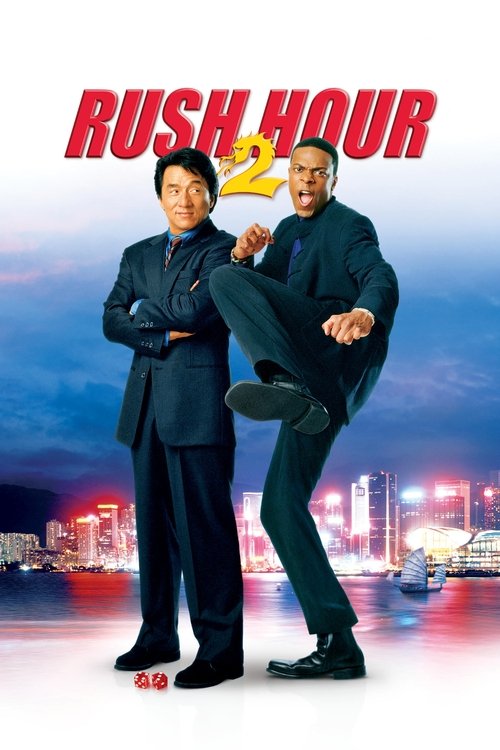
Rush
Hour 2
IMDb Rating
200K
IMDb Votes
53%
Rotten Tomatoes
$347M
Box Office
Synopsis & Review
Set shortly after the events of the first film, Rush Hour 2 opens with Inspector Lee (Jackie Chan) and Detective Carter (Chris Tucker) on holiday in Hong Kong — or rather, Lee is working and Carter is eating. When two US Secret Service agents are killed in a bomb blast at the American Consulate, Lee is assigned to investigate the Triads, specifically the organisation led by Ricky Tan (John Lone), a former partner of Lee's murdered father. The investigation reveals that Tan is running a sophisticated counterfeit US currency operation — the bills are so perfect that they are called "Superbills" — in partnership with a ruthless Triad enforcer named Hu Li (Zhang Ziyi) and an American businessman named Steven Reign (Alan King). The trail leads from the neon-lit streets and bamboo-scaffolded skyscrapers of Hong Kong to the casinos and backstage corridors of Las Vegas, culminating in a spectacular sequence set at a brand-new casino hotel on the Strip.
Directed again by Brett Ratner and written by Jeff Nathanson, Rush Hour 2 operates on a simple and effective principle: take everything that worked in the first film, move it to a more visually interesting location, increase the scale, and give Chan and Tucker more room to breathe. The reversal of the fish-out-of-water dynamic — now Carter is the foreign visitor navigating an unfamiliar city while Lee is on home ground — generates new comic energy from the established dynamic without straining for novelty. Zhang Ziyi, fresh from her international breakthrough in Crouching Tiger, Hidden Dragon (2000), makes a formidable villain whose physical skills give the film's action sequences genuine edge. The film grossed $347 million worldwide — significantly more than the original's $244 million — making it one of the highest-grossing comedies of 2001 and cementing the franchise as one of the most commercially successful buddy-cop series in Hollywood history. Critics were cooler than audiences, but the film delivers exactly what it promises: ninety minutes of Chan-Tucker chemistry at full power.
Why Watch This Movie?
Chan and Tucker at Their Most Comfortable — and Funniest
The first Rush Hour was the film where Chan and Tucker discovered their chemistry. The sequel is the film where they know exactly what they have and use it with complete confidence. Every scene between them — Carter's bewildered hunger tour of Hong Kong, Lee's increasingly exasperated attempts to keep Carter out of the investigation, the pair's shared escalation through every situation — plays with the relaxed timing of a double act that has found its rhythm. The reversal of the dynamic, with Carter now as the tourist and Lee as the local, gives Tucker material that draws on genuine culture-shock comedy while letting Chan be the one who knows what he is doing for once.
Zhang Ziyi Is a Genuinely Dangerous Villain
Hu Li is one of the strongest antagonists in the Rush Hour franchise, and Zhang Ziyi brings both physical credibility and icy menace to the role. Her training under Yuen Woo-ping for Crouching Tiger, Hidden Dragon is visible in every action sequence: her striking is precise, her screen presence is authoritative, and she manages the specific challenge of being both a credible physical threat to Jackie Chan and a compelling dramatic character simultaneously. The film's most kinetically exciting sequence — Hu Li and a casino full of hostages, Jackie Chan working through the building to reach her — is built around making her genuinely difficult to beat. She succeeds in that regard completely.
Hong Kong on Screen Is a Visual Treat
The first act of Rush Hour 2 — set across Hong Kong's harbour, markets, massage parlours, and bamboo-scaffolded construction sites — gives the film a visual energy the original's Los Angeles setting could not match. Chan's knowledge of Hong Kong action cinema's spatial vocabulary is fully deployed: the bamboo scaffolding fight sequence, in which Chan uses the construction materials themselves as weapons and obstacles with characteristic ingenuity, is a genuine highlight of his Hollywood period. For audiences who knew Chan only from Rush Hour, the Hong Kong sequences function as an introduction to the visual world of his Hong Kong films — a taster that sent many viewers directly to Police Story and Drunken Master II.
Cast & Crew
Director
Brett Ratner
Screenplay
Jeff Nathanson
Producer
Arthur Sarkissian / New Line
Inspector Lee
Jackie Chan
Det. James Carter
Chris Tucker
Hu Li
Zhang Ziyi
Ricky Tan
John Lone
Isabella Molina
Roselyn Sanchez
Music
Lalo Schifrin
Official Trailer
© New Line Cinema / Warner Bros. Trailer embedded via YouTube.
Frequently Asked Questions
How much did Rush Hour 2 gross compared to the original?
Rush Hour 2 grossed approximately $347 million worldwide — a significant increase over the original's $244 million and one of the strongest sequel performances of the early 2000s. Its North American opening weekend of $67.4 million in August 2001 was the highest-ever opening weekend for a Jackie Chan film and one of the biggest comedy openings in Hollywood history at the time. The film was made on a budget of approximately $90 million (significantly more than the first film's $33 million) and returned a substantial profit. Its commercial performance made the franchise one of New Line Cinema's most valuable assets and established Chris Tucker as one of the highest-paid actors in Hollywood — his reported $20 million salary for the sequel becoming widely discussed in the entertainment press.
How was Zhang Ziyi cast as Hu Li?
Zhang Ziyi came to Hollywood's attention through her performance in Crouching Tiger, Hidden Dragon (2000), which premiered at Cannes and went on to win the Academy Award for Best Foreign Language Film, grossing over $213 million worldwide. Brett Ratner cast her directly off the success of that film, recognising that her combination of genuine martial arts training, striking screen presence, and international recognition made her the ideal counterpart to Jackie Chan's action sequences. The casting was significant as part of a broader Hollywood interest in Chinese-language action stars following Crouching Tiger's success. Zhang Ziyi has spoken about the experience positively in interviews, noting that working with Chan gave her insight into a different tradition of action filmmaking from what she had experienced under Ang Lee.
Which is better — Rush Hour or Rush Hour 2?
This is genuinely contested among fans of the franchise. The original Rush Hour has the advantage of novelty — the discovery of Chan-Tucker chemistry, the surprise of how well the pairing works, and the freshness of the fish-out-of-water setup — and it has the stronger cultural impact as the film that cracked America for Jackie Chan. Rush Hour 2 has the advantage of confidence: Chan and Tucker know exactly what they are doing, the action sequences are more ambitious (particularly the bamboo scaffolding fight and the casino climax), Zhang Ziyi is a more compelling villain than Tom Wilkinson's Griffin, and the reversal of the culture-clash dynamic generates different but equally effective comedy. Many fans consider the sequel the funnier film precisely because the chemistry has had time to deepen. Both are essential viewing; neither is a replacement for the other.
Was any of Rush Hour 2 filmed in the real Hong Kong?
Yes — unlike Rumble in the Bronx, which famously faked New York in Vancouver, Rush Hour 2 shot substantial footage on location in Hong Kong itself. The production filmed across Tsim Sha Tsui, Kowloon's market streets, the harbour waterfront, and several of the city's distinctive architectural environments. The bamboo scaffolding fight sequence was filmed in a purpose-built set constructed to replicate a Hong Kong construction site — authentic bamboo scaffolding being a distinctive visual element of the city — but the surrounding establishing shots and street-level scenes are genuinely Hong Kong. The Las Vegas sequences were filmed at various Las Vegas Strip locations including the exterior of a major hotel that served as the film's climactic casino setting. The dual-city production gave the film its distinctive visual split between the compressed density of Hong Kong and the expansive neon of Las Vegas.
More Jackie Chan Movies
More films starring Jackie Chan you should watch next.