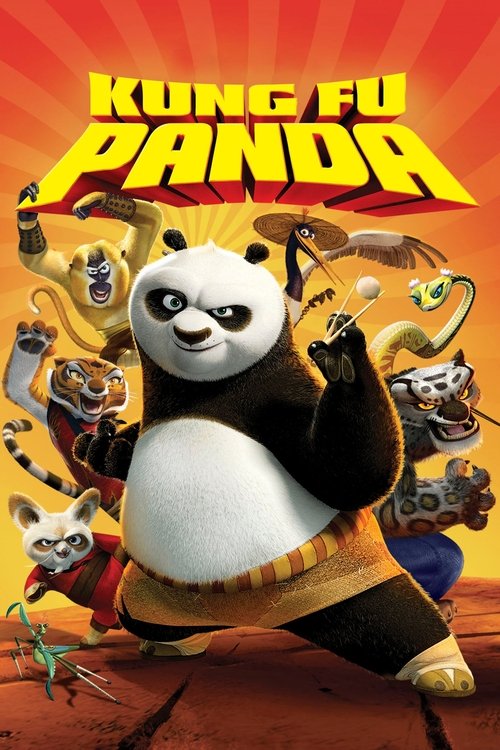
Kung Fu
Panda
IMDb Rating
475K
IMDb Votes
88%
Rotten Tomatoes
$631M
Box Office
Synopsis & Review
In the Valley of Peace — a richly realised ancient China populated entirely by anthropomorphic animals — Po (Jack Black) is a clumsy, noodle-obsessed giant panda who dreams of becoming a kung fu master like the legendary Furious Five: Tigress (Angelina Jolie), Crane (David Cross), Mantis (Seth Rogen), Viper (Lucy Liu), and Monkey (Jackie Chan). When the great tortoise Master Oogway (Randall Duk Kim) announces that the Dragon Warrior — the one destined to receive the ultimate Dragon Scroll and defend the Valley — must be chosen, Po accidentally crashes the ceremony and is selected to everyone's astonishment, including his own. Under the reluctant tutelage of Master Shifu (Dustin Hoffman), Po must somehow become the Dragon Warrior in time to confront Tai Lung (Ian McShane), a fearsome snow leopard and former student of Shifu's who has escaped from an inescapable prison and is marching on the Valley to claim the Dragon Scroll for himself.
Directed by Mark Osborne and John Stevenson and produced by DreamWorks Animation, Kung Fu Panda arrived in 2008 as a film that surprised everyone — including, reportedly, DreamWorks itself, which had expected a passable family comedy and received instead one of the most accomplished animated films of the decade. The secret is the film's complete sincerity: it is not a parody of kung fu cinema but a genuine love letter to it, made with deep knowledge and real affection for the genre's aesthetics, philosophy, and visual vocabulary. The opening sequence — an ink-brush animated fantasy of Po's dream — is one of the most beautiful pieces of animation DreamWorks ever produced, and the action sequences throughout are choreographed with the same principles of environmental creativity and physical comedy that define Jackie Chan's live-action work. Chan voices Monkey with characteristic warmth and physicality, and the film clearly benefits from having a cast member who understands kung fu cinema from the inside. Kung Fu Panda grossed $631 million worldwide, spawned two equally excellent sequels and a third, and launched one of animation's most beloved franchises. The first film remains the purest and most emotionally resonant entry in the series. Skadoosh.
Why Watch This Movie?
A Genuine Love Letter to Kung Fu Cinema, Not a Parody
Most Hollywood animated films that reference martial arts treat the genre as comedy material — a source of poses and sound effects. Kung Fu Panda does something genuinely rare: it takes kung fu seriously. The film's action sequences are choreographed with real knowledge of how martial arts styles differ — Tigress's aggressive power, Viper's fluid evasiveness, Crane's aerial grace, Mantis's speed and precision, Monkey's acrobatic improvisation. The philosophy embedded in the story — the concept of the Dragon Scroll, Oogway's teaching about the present moment, Shifu's understanding of Po's unique relationship with food as a motivational tool — reflects genuine engagement with Chinese martial philosophy. Jackie Chan's presence in the cast gives the film a direct connection to the tradition it is celebrating.
The Animation Is Among DreamWorks' Finest Work
The visual design of Kung Fu Panda draws deeply from classical Chinese painting, architecture, and decorative art — the Jade Palace's rooflines, the Valley of Peace's landscape, and the colour palette all reflect genuine research into Tang and Song dynasty aesthetics. The opening ink-brush dream sequence is a masterclass in hand-drawn animation integrated with CG, and the fight sequences — particularly the Furious Five's prison convoy battle and the final confrontation between Po and Tai Lung — are animated with the spatial intelligence and physical specificity of the best live-action choreography. The film is consistently beautiful to look at in a way that holds up fully sixteen years after release.
The "There Is No Secret Ingredient" Message Actually Lands
Many family films carry an inspirational message that the film itself does not quite earn — the lesson arrives before the audience feels it. Kung Fu Panda earns its central message with unusual care. The revelation of the Dragon Scroll's secret — that it is blank, that there is no secret ingredient, that the power was always within Po himself — lands as a genuine emotional moment because the film has spent its entire running time making Po's self-doubt feel real. The parallel with Po's father's noodle soup secret ingredient works perfectly. It is one of the most cleanly executed thematic payoffs in DreamWorks' entire catalogue.
Cast & Crew
Directors
Mark Osborne & John Stevenson
Screenplay
Jonathan Aibel & Glenn Berger
Studio
DreamWorks Animation
Po
Jack Black
Monkey
Jackie Chan
Master Shifu
Dustin Hoffman
Tigress
Angelina Jolie
Tai Lung
Ian McShane
Master Oogway
Randall Duk Kim
Official Trailer
© DreamWorks Animation / Paramount Pictures. Trailer embedded via YouTube.
Frequently Asked Questions
Why did DreamWorks cast Jackie Chan specifically as Monkey?
The casting was deliberate on multiple levels. Monkey — acrobatic, improvisational, playful and dangerous in equal measure — maps directly onto Jackie Chan's real-world martial arts persona and the type of character he has played throughout his career. DreamWorks wanted the Furious Five to be voiced by performers who brought genuine cultural and martial arts authenticity to the project, and Chan's decades of real kung fu training and his status as the world's most recognisable Asian action star made him the natural choice. Chan has spoken positively about the role in interviews, noting that Monkey's movement style in the film reflects elements of the acrobatic and physical comedy traditions he trained in as a child at the China Drama Academy — making the casting a quiet full-circle moment in his career.
How many Kung Fu Panda films are there and are they all worth watching?
As of 2024 there are four films in the main series. Kung Fu Panda (2008) is the original and widely considered the finest. Kung Fu Panda 2 (2011) — directed by Jennifer Yuh Nelson, the first woman to solely direct a major Hollywood animated feature — is an emotionally deeper sequel that deals with Po's adoption and the genocide of the pandas, and many critics consider it equally strong. Kung Fu Panda 3 (2016) is a visually spectacular if slightly less focused third entry that reunites Po with his biological father. Kung Fu Panda 4 (2024) marks a creative pivot, introducing a new character as Po's successor while Po ascends to the role of Spiritual Leader of the Valley — a solid if less essential entry. All four films feature Jackie Chan returning as Monkey.
What does "Skadoosh" mean?
"Skadoosh" is the exclamation Po uses when he deploys the legendary Wuxi Finger Hold — the ultimate technique described by Master Shifu as a move so powerful it can destroy an opponent entirely. The word itself is invented; it was created by the film's writers and voice director as an expression of maximum impact and finality. Po delivers it just before using the Wuxi Finger Hold on Tai Lung in the film's climax. The word entered popular culture immediately after the film's release in 2008 and has been used widely as a general exclamation of triumph or closure. It appears in all subsequent Kung Fu Panda films and has become one of DreamWorks Animation's most recognisable signature phrases.
How was the film received in China?
Kung Fu Panda was a massive commercial success in China and sparked a significant cultural conversation. The film was widely praised by Chinese audiences for its respectful and knowledgeable portrayal of Chinese culture, kung fu traditions, and classical aesthetics — a reception that some Chinese filmmakers found uncomfortable. Several prominent Chinese directors and critics publicly questioned why an American studio had managed to make such a culturally resonant film about Chinese tradition while Chinese studios had not. This conversation is credited with influencing a wave of Chinese films that took traditional cultural material more seriously. The franchise has performed strongly in China across all four films, with Kung Fu Panda 3 (2016) co-produced with Pearl Studio (formerly Oriental DreamWorks) specifically to deepen the China connection.
More Jackie Chan Movies
More films starring Jackie Chan you should watch next.