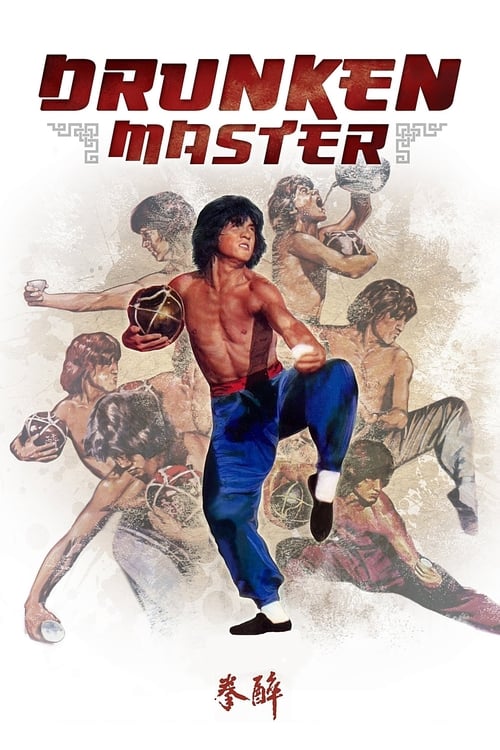
Drunken
Master
IMDb Rating
30K
IMDb Votes
96%
Rotten Tomatoes
1978
Chan's Breakthrough
Synopsis & Review
Set in late Qing Dynasty China, Drunken Master (1978) follows the young Wong Fei-hung (Jackie Chan) — a real-life folk hero reimagined here as an incorrigible troublemaker who brings shame upon his father's martial arts school through a combination of arrogance, laziness, and a talent for provoking the wrong people. After a series of humiliating confrontations, Wong's exasperated father sends him to train under his eccentric uncle, the beggar and wine-soaked kung fu master Beggar So (Yuen Siu-tien), also known as Sam Seed. Beggar So's training regimen is brutal, repetitive, and apparently designed to destroy his students before building them back up — but his style, the Eight Drunken Immortals, is the most powerful and unpredictable form of kung fu in existence. The film builds toward an inevitable confrontation between a newly skilled Wong Fei-hung and Thunderleg (Hwang Jang-lee), a feared assassin whose lightning-fast leg techniques have made him effectively unbeatable.
Directed by Yuen Woo-ping — who would later choreograph The Matrix (1999) and Crouching Tiger, Hidden Dragon (2000) — Drunken Master is the film that established Jackie Chan's screen identity as completely distinct from Bruce Lee's: where Lee was stoic, powerful, and tragic, Chan was comic, fallible, and ultimately triumphant through cleverness as much as skill. The film's comedy sequences — particularly the running gag of Beggar So's sadistic training and Wong Fei-hung's various failed attempts to escape it — are genuinely funny in ways that hold up perfectly across forty-five years. Hwang Jang-lee, a real-life taekwondo champion, provides a final opponent whose speed and power make him a credible threat to everything Chan has learned. The film was a massive commercial success across Asia, grossing approximately HK$6 million in Hong Kong alone — enormous for 1978 — and made Chan one of the colony's biggest stars overnight. It remains the clearest origin point of everything Jackie Chan became.
Why Watch This Movie?
The Film That Invented the Jackie Chan Formula
Before Drunken Master, Chan had made several attempts at serious Bruce Lee-style action — films that played to his martial arts training but suppressed his natural comedic instincts. Drunken Master was the first film to let both exist simultaneously, and the result was something Hong Kong cinema had not seen before: an action star who could make you laugh and hold your breath in the same sequence. Every Jackie Chan film that followed — Police Story, Project A, Rush Hour — is built on the template established here. Understanding where the formula came from makes every subsequent Chan film richer.
Yuen Siu-tien's Beggar So Is One of Cinema's Great Comic Performances
Yuen Siu-tien — Yuen Woo-ping's father, known as Simon Yuen — gives one of the great supporting performances of Hong Kong cinema as the dissolute, wine-addicted, infuriating, and ultimately magnificent Beggar So. His timing is impeccable, his physical comedy is as accomplished as anything in the film, and the relationship between his character and Chan's Wong Fei-hung generates the warmth that gives the film its emotional spine. Yuen Siu-tien died in 1979, a year after the film's release, making this one of his final and finest performances. His work here is irreplaceable.
Hwang Jang-lee Is the Most Dangerous Villain Chan Ever Faced on Screen
Hwang Jang-lee is a genuine taekwondo champion with a competition record that gives his screen villainy complete physical credibility. His leg speed in the finale is extraordinary — kicks that arrive faster than the eye can track — and Chan's defensive choreography against him is visibly strained in ways that feel authentic. The final fight between Wong Fei-hung deploying the Miss Ho style of drunken boxing — the most powerful and embarrassing of the Eight Immortals, played as pure comedy — against Thunderleg's devastating kicks is one of the great extended combat sequences of the 1970s: funny, technically remarkable, and genuinely tense.
Cast & Crew
Director
Yuen Woo-ping
Screenplay
Ng See-yuen & Yuen Woo-ping
Producer
Ng See-yuen / Seasonal Film
Wong Fei-hung
Jackie Chan
Beggar So (Sam Seed)
Yuen Siu-tien (Simon Yuen)
Thunderleg
Hwang Jang-lee
Wong's Father
Yuen Tak
Action Director
Yuen Woo-ping
Studio
Seasonal Film Corporation
Official Trailer
© Seasonal Film Corporation. Trailer embedded via YouTube.
Frequently Asked Questions
Who is the real Wong Fei-hung and why is he important?
Wong Fei-hung (1847–1924) was a real Cantonese martial artist, physician, and folk hero from Foshan, Guangdong Province. He was a master of Hung Ga kung fu and the lion dance, and operated a medical clinic called Po Chi Lam in Canton. In his lifetime he was respected as both a healer and a fighter, but his legendary status grew enormously in the decades after his death — first through novels and radio dramas, then through film. The character of Wong Fei-hung has appeared in well over a hundred films since the 1940s, played by more than two dozen actors. Jackie Chan's interpretation in Drunken Master is deliberately irreverent — the real Wong Fei-hung was a serious, dignified figure, not a reckless young troublemaker — and was controversial among older Hong Kong audiences for that reason. Jet Li's more reverential portrayal in the Once Upon a Time in China series (1991–1997) is a corrective to Chan's version.
Who is Yuen Woo-ping and what else has he directed or choreographed?
Yuen Woo-ping is arguably the most influential action choreographer in cinema history. Born in 1945 into a martial arts family — his father is Yuen Siu-tien, who plays Beggar So in this film — he began working in Hong Kong cinema as a stuntman and action director before making his directorial debut with Snake in the Eagle's Shadow (1978), which he followed immediately with Drunken Master, both starring Jackie Chan. As an action choreographer he later brought his wire-work and martial arts expertise to Hollywood, choreographing The Matrix trilogy (1999–2003), Crouching Tiger, Hidden Dragon (2000), Kill Bill (2003), and The Grandmaster (2013). He is the recipient of multiple Hong Kong Film Awards for Best Action Design. Drunken Master is the film where his distinctive style — comedic, inventive, rhythmically precise — first found its fullest expression.
What are the Eight Drunken Immortals?
The Eight Drunken Immortals are the eight deities of Taoist mythology — the Ba Xian — each associated with a different attribute and a distinct physical style within the Zui Quan (drunken boxing) tradition. In the film's choreography, each Immortal corresponds to a different fighting style: Lu Dongbin fights with a sword stance; Li Tieguai uses a crippled leg style; He Xiangu is the female Immortal whose style Wong Fei-hung finds humiliating to adopt. The Eight Immortals framework is a genuine element of Zui Quan tradition, though the film's specific choreographic interpretations are largely Yuen Woo-ping's creative invention. The Miss Ho (He Xiangu) style that Wong deploys in the finale — feminine, deceptive, and devastating — is the comedic and dramatic peak of the film's martial arts vocabulary.
Should I watch Snake in the Eagle's Shadow before Drunken Master?
Yes — if you have the time. Snake in the Eagle's Shadow (1978) was made earlier the same year by the same team — Yuen Woo-ping directing, Jackie Chan starring, Yuen Siu-tien playing a similar eccentric master figure — and is effectively a prototype for Drunken Master. The two films share the same action-comedy formula, the same student-master dynamic, and many of the same choreographic ideas. Watching them in production order gives you a clearer picture of how the formula was refined from one film to the next, and Snake in the Eagle's Shadow is excellent in its own right. If you only have time for one, Drunken Master is the superior film — but both together tell the complete story of how Jackie Chan's screen persona was born in 1978.
More Jackie Chan Movies
More films starring Jackie Chan you should watch next.