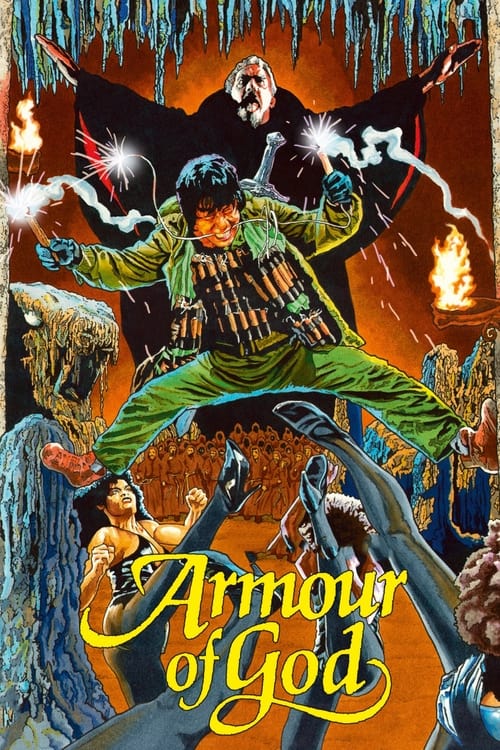
Armour
of God
IMDb Rating
22K
IMDb Votes
Near Fatal
Skull Fracture
$35M
Box Office HK
Synopsis & Review
Armour of God (1986) follows Jackie (Jackie Chan) — a globe-trotting rock star turned adventurer who goes by the nickname Asian Hawk — a mercenary antiquities dealer with a talent for extracting priceless relics from dangerous situations. When his childhood friend Alan (Alan Tam) contacts him with devastating news — their mutual friend Lorelei (Rosamund Kwan) has been kidnapped by a secretive Black Order cult — Asian Hawk is forced back into the field. The cult holds Lorelei hostage in exchange for the three remaining pieces of the Armour of God, a set of legendary medieval Christian artefacts that, when assembled, are believed to grant their possessor extraordinary power. Hawk tracks the pieces across Europe — from auction houses in Monaco to a fortified Yugoslavian castle — assembling his own team and outwitting the cult at every turn, culminating in a stunning cave battle featuring four martial-arts-trained female assassins and an improbable hot-air balloon escape.
Written and directed by Jackie Chan with co-writer Edward Tang, Armour of God is Chan's most overtly Hollywood-influenced film — a direct, unabashed attempt to create Hong Kong's answer to Raiders of the Lost Ark (1981), with Chan's Asian Hawk character designed as a direct parallel to Indiana Jones: the roguish, resourceful adventurer who operates at the intersection of archaeology, danger, and dark comedy. The film is significant not only for its globe-spanning ambition and genuinely impressive European production locations, but for the near-fatal accident that occurred during filming: Chan misjudged a seemingly simple jump from a castle wall onto a tree, the branch broke, and he fell approximately fifteen feet onto rocky ground, fracturing his skull and driving a piece of bone into his brain. Emergency surgery in a Yugoslav hospital saved his life. The accident is marked in the film's credit sequence, and a small hole remains in Chan's skull to this day. That the finished film is so energetic and inventive is remarkable given the circumstances of its production. The sequel, Armour of God II: Operation Condor (1991), is considered by many to surpass the original.
Why Watch This Movie?
The Most Dangerous Film Jackie Chan Ever Made
Chan has broken dozens of bones across his career — his nose multiple times, his ankle, his cheekbone, his sternum, both shoulders, his spine — but the Armour of God accident is the one that nearly killed him. A jump from a castle wall that should have been routine went wrong when the branch he was landing on snapped, sending him straight down onto rocks. The resulting skull fracture required emergency brain surgery in Yugoslavia. Chan spent days in intensive care. A titanium plate and a permanent opening in his skull are the permanent reminders. That the production continued and produced a film this entertaining is a testament to the dedication of everyone involved — and to the stubborn, arguably reckless creative vision that defines Chan's best work.
Hong Kong Action on a European Canvas
Most Hong Kong action films of the 1980s were shot entirely in the city — streets, warehouses, markets. Armour of God is something different: a genuine international co-production shot on location across Yugoslavia (now Croatia), France, and Spain, with a production scale that matched or exceeded contemporary Hollywood adventure films. The locations — particularly the dramatic Dalmatian coast castle and the European auction house sequences — give the film a visual sweep that sets it apart from Chan's other work of the period. Watching it is a reminder of how genuinely ambitious Hong Kong cinema was at its peak.
The Cave Finale Is a Masterclass in Choreographic Invention
The final sequence — set in a vast underground cave system beneath the Black Order's fortress — pits Asian Hawk against four highly trained female martial artists and then the cult's enormous male enforcer, all while navigating a crumbling environment full of fire, collapsing floors, and improvised weapons. Chan choreographed every moment himself, and the fight has an escalating, improvisational energy that keeps it unpredictable throughout. It is the film's creative peak and one of the best cave-set action sequences in cinema — claustrophobic, inventive, and genuinely exciting right up to the absurdist hot-air balloon escape that ends it.
Cast & Crew
Director
Jackie Chan
Screenplay
Jackie Chan & Edward Tang
Producer
Leonard Ho / Golden Harvest
Asian Hawk (Jackie)
Jackie Chan
Alan
Alan Tam
Lorelei
Rosamund Kwan
Laura
Lola Forner
Filming Location
Yugoslavia / France / Spain
Action Design
Jackie Chan Stunt Team
Official Trailer
© Golden Harvest / Media Asia. Trailer embedded via YouTube.
Frequently Asked Questions
What exactly happened during the near-fatal accident on Armour of God?
The accident occurred during filming in Yugoslavia in 1985. The scene required Chan to jump from a castle wall onto a tree growing alongside it — a simple, low-risk stunt by the standards of what Chan routinely performed. On the first take, the branch he was supposed to land on broke under his weight, and he fell approximately fifteen feet, landing head-first on rocks below. The impact fractured his skull on the right side and drove a fragment of bone into his cerebral cortex. Chan was rushed to a local hospital where emergency surgery was performed to remove the bone fragment and relieve pressure on the brain. He remained hospitalised for several days. The surgery left a small permanent hole in his skull, which Chan has mentioned in interviews and which is partially visible in certain angles. He considers it the most serious injury of his career and the closest he has come to death on a film set.
Is Armour of God II: Operation Condor worth watching?
Absolutely — and many fans consider it the superior film. Released in 1991, Operation Condor sends Asian Hawk to the Sahara Desert in search of a lost Nazi gold cache, with a larger budget, a more confident comic tone, and some of Chan's most inventive action set-pieces of the 1990s. The wind-tunnel finale is particularly spectacular. The film was shot across Spain, Morocco, and Hong Kong and benefits from Chan's maturing confidence as a filmmaker. When Miramax released it in North America in 1997, they released it as simply Operation Condor — before the original Armour of God, which they retitled Operation Condor 2: The Armour of the Gods, creating a confusing reversal. Watch the original first, then the sequel — in production order, not Miramax's release order.
Why is Jackie Chan's character called "Asian Hawk"?
The nickname "Asian Hawk" is a deliberate echo of Indiana Jones — a similarly evocative, slightly exotic adventurer's alias that signals the character's genre positioning immediately. Chan and co-writer Edward Tang built the character as a self-aware riff on the Hollywood adventure hero: rootless, mercenary, charming, and deeply competent in situations that would paralyse anyone else. The name also reflects a Hong Kong cinematic tradition of giving action heroes punchy English-language nicknames for international marketing purposes. Within the film, the name functions as both a brand — Asian Hawk is recognisable in European antiquities circles as a reliable, if expensive, retrieval specialist — and a joke: the character is introduced performing a rock concert before pivoting effortlessly to relic smuggling.
Where exactly was Armour of God filmed?
Principal photography took place across three countries. The castle sequences — including the location of Chan's near-fatal accident — were filmed in Yugoslavia, specifically at a medieval fortress on the Dalmatian coast in what is now Croatia. The European city scenes, auction house sequences, and street chases were filmed in France and Spain, with Paris providing some of the establishing location work. The cave finale was filmed on a constructed set built in Hong Kong after the production returned from Europe. The combination of genuine European architecture and Hong Kong-constructed interiors gives the film its distinctive visual texture — the exteriors feel authentically expansive while the fight sequences have the controlled precision that only a Hong Kong production unit can achieve.
More Jackie Chan Movies
More films starring Jackie Chan you should watch next.