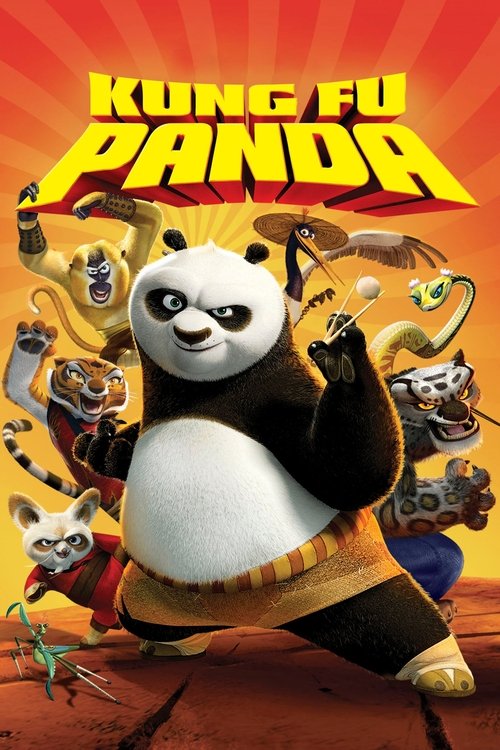
Kung Fu
Panda
IMDb Rating
600K
IMDb Votes
87%
Rotten Tomatoes
$632M
Box Office
Synopsis & Review
Directed by Mark Osborne and John Stevenson and released in 2008, Kung Fu Panda is a film of considerable surprise — a work that arrives looking like a high-concept comedy premise (clumsy giant panda accidentally becomes kung fu master) and reveals itself, with quiet confidence, to be a genuinely wise meditation on self-acceptance, the nature of potential, and the difference between the story you tell yourself about who you are and the story that might actually be true. Po (Jack Black) is a rotund, exuberant panda who works in his father's noodle shop in the Valley of Peace but whose heart is entirely given over to a passionate, encyclopaedic love of kung fu and the Furious Five — the legendary warriors who protect the valley under the guidance of the wise red panda Master Shifu (Dustin Hoffman). When the villainous snow leopard Tai Lung (Ian McShane) escapes from prison and threatens to destroy everything, the ancient tortoise Master Oogway (Randall Duk Kim) selects the Dragon Warrior — the hero prophesied to possess the ultimate power of the Dragon Scroll — and to everyone's astonishment, the chosen warrior is Po. What follows is an underdog story of genuine charm and unexpected philosophical depth, as Shifu struggles to find a way to train an apparently hopeless student, and Po slowly discovers that becoming who you are supposed to be is not a matter of changing yourself but of finding the version of yourself that was already capable.
What elevates Kung Fu Panda above its premise is the seriousness with which it takes its own central idea. The film's culminating revelation — that the Dragon Scroll, the secret of ultimate power, contains nothing at all, because there is no secret ingredient — is a genuinely elegant philosophical statement about the self-fulfilling nature of confidence and self-belief, delivered with perfect comic timing and real emotional weight. The visual design of the film, which draws on Chinese ink painting, classical Chinese architecture, and the visual vocabulary of Chinese martial arts cinema, is stunning — DreamWorks brought in production designer Raymond Zibach and art director Tang Heng to create a version of ancient China that feels both stylized and authentic. The action sequences, choreographed with reference to actual kung fu forms and filmed with the kind of kinetic spatial intelligence usually reserved for live-action martial arts cinema, are the most genuinely exciting in any animated film of the period. Hans Zimmer and John Powell's score blends Western orchestral music with traditional Chinese instruments in a way that serves both the comedy and the genuine emotional beats with equal precision. The film grossed $632 million worldwide and launched a franchise that has grown into one of DreamWorks' most beloved and critically praised animated series, with the third film in particular — and especially the fourth, Kung Fu Panda 4 (2024) — continuing to expand the world with real creative ambition.
Why Watch This Movie?
Master Oogway — The Wisest Character in Animation History
In a relatively small amount of screen time, Master Oogway delivers some of the most genuinely wise lines in animated cinema — including "Yesterday is history, tomorrow is a mystery, but today is a gift — that is why it is called the present" and the revelation about the Dragon Scroll. None of these feel like fortune cookie wisdom precisely because the film has earned them through story — they land as genuine insight rather than decoration. Oogway is one of the great supporting characters in the history of animated film.
The Most Beautiful Visual Design in DreamWorks History
The film's visual design — which draws on Chinese ink painting, Tang Dynasty architecture, and classical Chinese martial arts cinema — is the most fully realized and artistically coherent of any DreamWorks animated production. Every frame is composed with the precision of a painting, and the action sequences achieve a spatial intelligence and kinetic clarity that rivals the best live-action martial arts cinema. The opening animated prologue, rendered in a flat, stylized 2D inspired by Chinese shadow puppetry, is one of the finest pieces of animated design of the decade.
The "There Is No Secret Ingredient" Lesson — Philosophy for All Ages
The Dragon Scroll reveal is one of the most elegantly constructed philosophical payoffs in the history of animated film — and it works simultaneously as a joke and as a genuinely profound statement about self-belief. The film argues, with comic precision, that the difference between a hero and an ordinary person is not some magical external quality but the internal decision to believe that you are capable. This idea is delivered to children through comedy and action, and lands for adults as a serious and beautiful truth.
Cast & Crew
Directors
Mark Osborne & John Stevenson
Screenplay
Jonathan Aibel & Glenn Berger
Producer
Melissa Cobb
Po (voice)
Jack Black
Master Shifu (voice)
Dustin Hoffman
Tigress (voice)
Angelina Jolie
Tai Lung (voice)
Ian McShane
Original Score
Hans Zimmer & John Powell
Studio
DreamWorks Animation
Official Trailer
© DreamWorks Animation / Paramount Pictures. Trailer embedded via YouTube.
Frequently Asked Questions
What is the meaning of the Dragon Scroll in Kung Fu Panda?
The Dragon Scroll — the legendary document said to contain the secret of limitless power — turns out to be blank, or more precisely, reflective: its surface is a mirror, and when Po opens it, he sees only his own reflection. The meaning is delivered through Po's realization that his father's "secret ingredient" noodle soup contains no secret ingredient at all — the secret is that there is no secret, and the noodle soup is special only because people believe it is. Transferred to Po's situation, the revelation is that the Dragon Warrior's power comes from Po believing in himself — that he has always been capable, that the exceptionalism he sought in an external scroll was already present in him. The film is drawing on a long philosophical and psychological tradition: the idea that self-belief is itself the source of capability, rather than a consequence of it. In Buddhist and Taoist philosophical traditions, which the film draws on throughout its aesthetic and storytelling, this idea takes the form of the concept that the obstacle is the path — that the thing you are looking for is always already where you are standing.
How did DreamWorks research Chinese culture for the film?
The production team made multiple research trips to China, visiting the Chengdu Research Base of Giant Panda Breeding in Sichuan province, the Zhangjiajie National Forest Park (which inspired the film's dramatic mountain scenery), and various sites of Tang Dynasty architecture and classical Chinese art. Art director Tang Heng, who was born in China and had deep personal knowledge of classical Chinese visual culture, was instrumental in ensuring the film's aesthetic authenticity. The team studied classical Chinese ink painting, Song Dynasty landscape painting, the visual grammar of traditional Chinese opera and shadow puppetry, and the choreography of various kung fu styles — including wing chun, mantis style, and snake style — to develop both the character designs and the action sequences. The filmmakers were also aware of the cultural responsibility involved in using Chinese cultural material as the primary aesthetic framework for a Hollywood animated film and worked extensively with cultural consultants throughout the production to avoid stereotyping or misrepresentation.
How many Kung Fu Panda films are there?
As of 2024, there are four main Kung Fu Panda feature films: the original (2008), Kung Fu Panda 2 (2011), Kung Fu Panda 3 (2016), and Kung Fu Panda 4 (2024). The franchise also includes several short films and the television series Kung Fu Panda: The Dragon Knight on Netflix. The critical reception has remained remarkably consistent across the franchise: the original and the third film are most acclaimed, with Kung Fu Panda 3 particularly praised for its emotional depth and visual ambition. Kung Fu Panda 2 — directed by Jennifer Yuh Nelson, who became the first solo female director to helm a major Hollywood animated sequel — is also highly regarded, especially for its exploration of Po's origins and the backstory of Lord Shen. The franchise has grossed over $2 billion globally across its four films.
More 3D Films Like This
If you loved Kung Fu Panda, these animated adventures will delight you just as much.