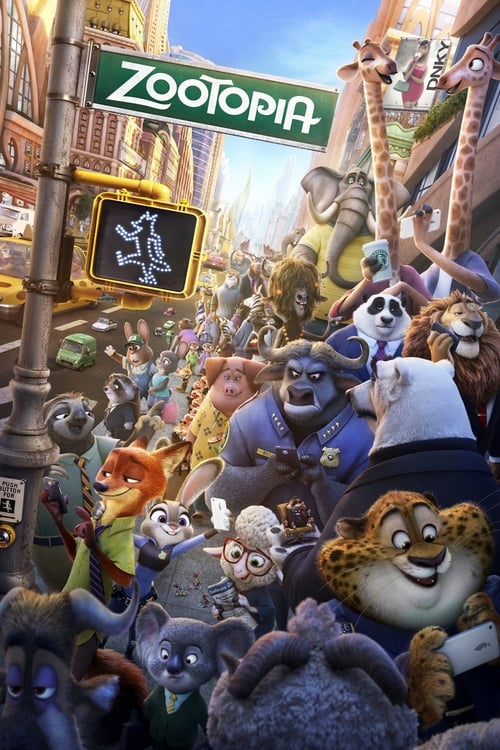
Zootopia
IMDb Rating
700K
IMDb Votes
98%
Rotten Tomatoes
$1.02B
Box Office
Synopsis & Review
Directed by Byron Howard and Rich Moore and released in 2016, Zootopia is one of the most politically intelligent animated films ever made by a major Hollywood studio — a work that uses the conventions of the buddy-cop procedural thriller to deliver a genuinely sophisticated exploration of systemic bias, implicit prejudice, and the way that good intentions and unconscious assumptions can coexist in the same person simultaneously. The film is set in the titular city of Zootopia, a modern metropolis of anthropomorphic animals where predators and prey have evolved past their natural enmities and live together in civilized society — a world that is, the film makes clear from the opening moments, an optimistic ideal rather than an achieved reality. Judy Hopps (Ginnifer Goodwin) is an idealistic young rabbit from rural Bunnyburrow who dreams of becoming the first bunny police officer in Zootopia's history. After graduating top of her class at the academy, she arrives in the city to discover that her police chief, Chief Bogo (Idris Elba), a water buffalo with impeccable institutional instincts, considers her too small and too inexperienced for real casework and assigns her to parking duty. When Judy bets her career on solving a missing mammal case that the department has deprioritized, she is forced into an uneasy partnership with Nick Wilde (Jason Bateman), a charming, world-weary red fox and career con artist whose cynicism about Zootopia's social ideals is, as the film will reveal, far better grounded in personal experience than Judy's optimism.
What makes Zootopia genuinely remarkable is the specificity and care with which it maps its animal allegory onto the real dynamics of racial and social bias. The film does not merely present prejudice as a simple moral failure of bad individuals — it shows it operating at the level of systems and institutions, in the unconscious assumptions of good people, and in the way that members of stigmatized groups internalize the expectations placed on them. Nick Wilde's backstory — a child who wanted to be a scout and was humiliated for aspiring above his species — is the film's most powerful emotional sequence, and the way it shapes his adult cynicism and his instinctive distrust of Judy's optimism gives the buddy-cop dynamic a genuine psychological depth. The film's twist — which reveals that the apparent villain is not who the audience expects, and that the narrative logic of prejudice has led both the characters and the viewer to false conclusions — is one of the most elegantly constructed plot reversals in recent animated cinema. Michael Giacchino's score and the integration of Shakira's original song "Try Everything" created a film whose musical landscape matched the scope of its ambition. Zootopia won the Academy Award for Best Animated Feature, grossed over $1 billion worldwide — making it the seventh highest-grossing animated film of all time at the time of its release — and generated one of the largest and most enthusiastic fan communities in the history of animated cinema.
Why Watch This Movie?
The Smartest Allegory About Prejudice in Any Mainstream Film
What separates Zootopia from other animated films that address racism and bias is that it refuses simple answers. The film shows prejudice operating not just in obvious villains but in good-hearted protagonists — Judy genuinely holds unconscious biases about predator animals that she is not even aware of until they cause real harm. The film's argument, delivered to children through comedy and adventure, is that fighting prejudice requires more than good intentions: it requires constant self-examination, which is a significantly more honest and demanding position than most films for any audience are willing to take.
Nick Wilde — The Most Complex Character in Disney Animation Since Gaston
Jason Bateman's Nick Wilde is a masterwork of voice acting and character writing — a man whose surface cynicism is a precisely calibrated defense against a world that has consistently confirmed his lowest expectations, and whose journey toward trust and vulnerability is the film's emotional spine. Nick is not a reformed villain or an obvious hero in waiting; he is a person who has been shaped by experience into someone whose worldview has been genuinely earned, and whose change of heart feels earned rather than convenient. His backstory sequence — with the childhood scout troop and the muzzle — is devastating.
A World Built With Extraordinary Detail and Comic Invention
The world of Zootopia — a city designed to accommodate every ecosystem, from the tropical Rainforest District to the frozen Tundratown to the tiny Rodentia neighborhood where everything is scaled for small animals — is one of the most inventively designed environments in Disney animation history. The film uses its world-building as a source of both comedy and character, and it rewards multiple viewings with background details, jokes, and observations that are invisible on a first watch. The DMV sequence — in which every employee is a sloth moving at geological speed — is one of the finest single comic sequences in any animated film of the decade.
Cast & Crew
Directors
Byron Howard & Rich Moore
Screenplay
Jared Bush & Phil Johnston
Producer
Clark Spencer
Judy Hopps (voice)
Ginnifer Goodwin
Nick Wilde (voice)
Jason Bateman
Chief Bogo (voice)
Idris Elba
Mr. Big (voice)
Maurice LaMarche
Original Score
Michael Giacchino
Studio
Walt Disney Animation
Official Trailer
© Walt Disney Animation Studios. Trailer embedded via YouTube.
Frequently Asked Questions
What real-world issues is Zootopia actually about?
The film's animal allegory maps onto several real-world social dynamics simultaneously, which is part of its richness. The predator/prey distinction primarily functions as a metaphor for racial and ethnic prejudice — the way that historical associations between certain groups and perceived danger persist long after the conditions that generated them have changed. Nick Wilde's experience as a fox — constantly presumed to be untrustworthy regardless of his actual behavior, and having eventually internalized the expectation that the world will always see him as a con artist — maps closely onto the experiences of racial minorities who face systemic bias even in nominally meritocratic institutions. The film also engages with questions of implicit bias (Judy's well-intentioned but harmful assumptions about predators), institutional racism (the police department's differential treatment of different species), and the way prejudice is perpetuated through fear rather than hatred. The directors have confirmed in interviews that they consulted with sociologists and civil rights scholars during the film's development to ensure the allegory was handled with genuine accuracy and nuance.
How long did it take to design the world of Zootopia?
The world-building for Zootopia took approximately three years of pre-production research and design. The filmmakers made research trips to study real animals at wildlife reserves in Africa and the United States, consulting with zoologists and behavioral researchers to understand how different species move, communicate, and interact. The challenge of designing a city that could realistically accommodate animals of radically different sizes — from elephants to mice — required entirely new thinking about urban planning, architecture, and infrastructure. The film's production designers created detailed lore for each of Zootopia's twelve distinct ecosystems-within-the-city, many of which appear only briefly or in the background. The Rainforest District, for example, was designed as a self-sustaining weather system with its own rainfall cycle. Each district's architectural vocabulary drew on a different visual tradition — the Sahara Square section echoes Middle Eastern architecture, while Tundratown has Slavic decorative influences. Only a fraction of this material made it into the final film, but the detail of the world-building is what gives every background and establishing shot its sense of genuine depth.
Is Zootopia 2 coming?
Yes — Zootopia 2 was officially announced by Disney and is currently in production, with a planned theatrical release in November 2025. The sequel will reunite the principal creative team and cast, with Ginnifer Goodwin and Jason Bateman returning as Judy Hopps and Nick Wilde. Disney announced the sequel in 2024 alongside other animated sequels in their pipeline, citing the continued enormous popularity of the original film and its characters. Few additional plot details have been officially confirmed, but the announcement was accompanied by enthusiastic responses from both the original cast and the film's substantial fan community. The original Zootopia is among the highest-grossing animated films of all time and has maintained a large and active fandom since its release in 2016, making a sequel one of the most eagerly anticipated animated projects in Disney's upcoming slate.
More 3D Films Like This
If you loved Zootopia, these animated adventures will entertain and challenge you in equal measure.