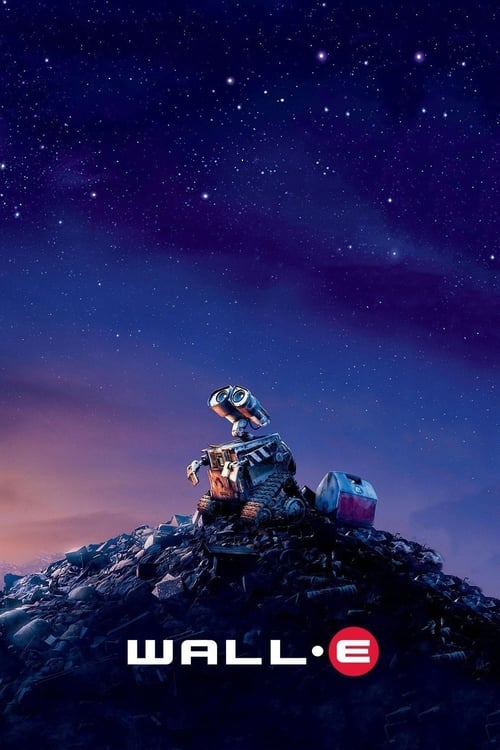
WALL·E
IMDb Rating
1.1M
IMDb Votes
95%
Rotten Tomatoes
$532M
Box Office
Synopsis & Review
Directed by Andrew Stanton and released in 2008, WALL·E is the most formally radical and artistically ambitious film Pixar has ever produced — a film that opens with approximately forty minutes of almost entirely wordless storytelling, that looks and moves more like a Buster Keaton silent film than a conventional animated feature, and that uses the physical comedy and emotional expressiveness of a small robot to deliver one of the most genuinely affecting love stories in the history of cinema. WALL·E (Waste Allocation Load Lifter: Earth-Class) is the last functioning robot on an abandoned Earth, seven hundred years after humanity fled to a luxury space cruise liner called the Axiom when the planet became buried under its own garbage. Every day, WALL·E compresses trash into cubes and stacks them into towering skyscrapers, accompanied only by a cockroach and a collection of human artifacts he has gathered from the waste — a Rubik's Cube, a rubber duck, a Hello, Dolly! VHS tape that he watches repeatedly, dreaming of the kind of human connection it depicts. When a sleek, advanced probe robot named EVE (Extraterrestrial Vegetation Evaluator) arrives on a search mission, WALL·E falls immediately and completely in love with her — and when EVE is retrieved by the Axiom after discovering the one living plant that WALL·E has been nurturing, WALL·E follows her into space, setting in motion a chain of events that will determine the future of the human race.
What makes WALL·E extraordinary — genuinely extraordinary, not merely very good — is the completeness with which it integrates its formal ambition, its political argument, and its emotional story. The film is simultaneously a Charlie Chaplin-influenced silent comedy, a blistering environmental and consumerist satire, a science fiction adventure, and a love story of genuine depth and delicacy — and it manages all four registers simultaneously without sacrificing any of them. The political argument — that unchecked consumerism and corporate convenience will destroy both the planet and human physical, intellectual, and social capacity — is delivered not through dialogue or exposition but through visual imagery of extraordinary specificity and wit: the morbidly obese humans floating on hovering chairs, incapable of walking, talking to screens, having their every need anticipated before they can form the desire to want it. Ben Burtt's sound design for WALL·E and EVE is one of the great achievements in the history of film sound — the robots communicate entirely through electronic sounds, chirps, and beeps, yet their inner lives, emotional states, and developing relationship are completely legible in every moment. Thomas Newman's score and the use of songs from Hello, Dolly! as WALL·E's emotional touchstone create a film whose musical landscape is as unusual and as perfectly calibrated as every other element. The film won the Academy Award for Best Animated Feature, was nominated for Best Original Screenplay — the first animated film to receive that nomination in fifteen years — and is consistently ranked among the greatest films ever made, animated or otherwise.
Why Watch This Movie?
The Greatest Silent Film Since the Silent Era
The first forty minutes of WALL·E contain almost no dialogue. The entire emotional and narrative world of the film — WALL·E's loneliness, his curiosity, his capacity for love, the desolation of an abandoned Earth, and the extraordinary specificity of his inner life — is conveyed entirely through movement, sound design, and visual storytelling. It is the most sustained demonstration of pure cinematic technique in any animated film, and it proves that the most fundamental tools of cinema — image and movement — can achieve things that words cannot.
A Love Story Told With More Emotion Than Most Human Romance Films
The relationship between WALL·E and EVE — a battered, rusting, lonely little robot and a sleek, advanced, initially unresponsive probe — is one of cinema's great love stories. What makes it remarkable is that it is built entirely from gesture, sound, and the quality of attention each character pays the other. WALL·E's love is expressed through the careful preservation of EVE's dormant body during a rainstorm, through the small gifts he tries to give her, through the absolute wholeness of his devotion. It is more emotionally convincing than most films with human actors and full dialogue.
The Most Prescient Environmental Warning in Popular Cinema
Released in 2008, WALL·E's vision of Earth buried under centuries of accumulated garbage, and of humanity transformed by convenience culture and corporate comfort into passive, screen-addicted consumers incapable of physical or intellectual activity, has only grown more pointed with time. The film makes its environmental and social argument not through lectures or moralizing but through visual imagery of extraordinary satirical precision — and it does so in a film aimed primarily at children, trusting its audience with a seriousness of purpose that most adult cinema does not attempt.
Cast & Crew
Director
Andrew Stanton
Screenplay
Andrew Stanton & Jim Reardon
Producer
Jim Morris
WALL·E (voice/sound)
Ben Burtt
EVE (voice/sound)
Elissa Knight
Captain (voice)
Jeff Garlin
Sound Design
Ben Burtt
Original Score
Thomas Newman
Studio
Pixar / Walt Disney
Official Trailer
© Pixar Animation Studios / Walt Disney Pictures. Trailer embedded via YouTube.
Frequently Asked Questions
How did Pixar make WALL·E and EVE so expressive without dialogue?
The expressiveness of WALL·E and EVE was achieved through a combination of extraordinary sound design, character movement, and the specific design of their physical appearance — particularly their eyes. Ben Burtt, who had previously created the sound design for R2-D2 in Star Wars, created WALL·E's entire sonic vocabulary from scratch, using modified recordings of real electronic equipment, motors, and industrial sounds to build a sonic language that audiences could read emotionally with complete precision. WALL·E's eyes — wide, yellowed binocular lenses that can tilt, compress, and widen — were specifically designed to replicate the ocular expressiveness of human eyes in ways that audiences could instinctively read. Director Andrew Stanton studied Buster Keaton and Charlie Chaplin extensively, focusing on how silent comedians expressed inner states through body language alone, and the animation team spent months developing WALL·E's movement vocabulary — the way he holds his arms, the speed and quality of his gestures — to communicate character as precisely as dialogue would. EVE, by contrast, was designed with a minimalist, smooth, Apple-product aesthetic that deliberately withheld expression, making her gradual warming to WALL·E all the more legible as it developed.
Was Disney nervous about a film with forty minutes of no dialogue?
Yes — significantly. Disney executives were deeply concerned about the commercial viability of an animated film aimed at children that contained approximately forty minutes of nearly wordless storytelling, no traditional songs, and a satirical portrait of humanity as morbidly obese, screen-addicted consumers. At various points during production, Disney pushed for changes that would have reduced the silent opening section or added more conventional animated film elements. Pixar chief creative officer John Lasseter backed Andrew Stanton's vision and protected the film from interference, but the internal discussions were apparently substantial. Andrew Stanton has described the film as the most difficult he has made because the studio trust required for such an unconventional project was enormous. The film's commercial success — $532 million worldwide on a $180 million budget — and its critical reception, which included being named one of the ten greatest animated films ever made by the American Film Institute, vindicated the decision completely.
Why does WALL·E use footage from Hello, Dolly!?
The 1969 musical Hello, Dolly! — specifically the songs "Put On Your Sunday Clothes" and "It Only Takes a Moment" — functions as WALL·E's emotional education and his articulation of what he wants from life. WALL·E has watched the film so many times that it has given him his understanding of love, romance, and the desire for human connection — all of which he has never actually experienced. The song "It Only Takes a Moment," in which a character sings about holding someone's hand, becomes WALL·E's clearest expression of what he yearns for, and the image of two people holding hands is the gesture that defines his relationship with EVE throughout the film. Andrew Stanton has said that the choice of Hello, Dolly! was deliberate: its optimistic, old-fashioned romanticism — its complete sincerity about the value of love and connection — felt like exactly the kind of emotional vocabulary that a lonely robot, having only human cultural artifacts to learn from, would absorb and internalize. The use of a real 1969 film also grounds WALL·E's world in recognizable human culture rather than invented film history, which makes his connection to humanity feel more genuine.
More 3D Films Like This
If you loved WALL·E, these films will take you somewhere equally extraordinary.