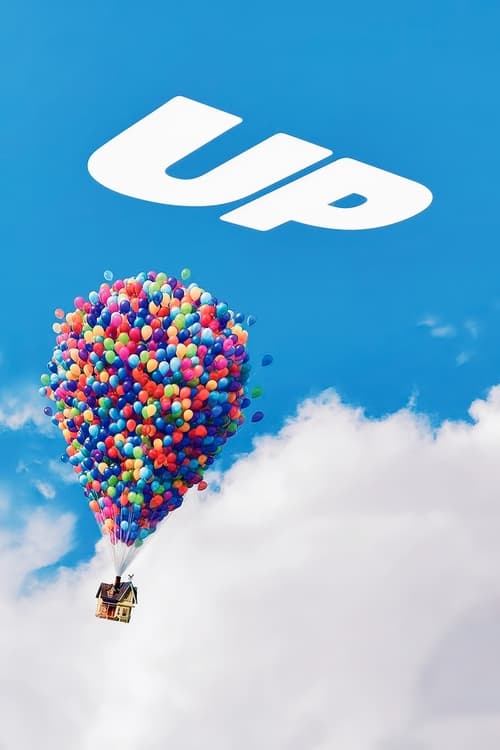
Up
IMDb Rating
1.1M
IMDb Votes
98%
Rotten Tomatoes
$735M
Box Office
Synopsis & Review
Directed by Pete Docter and released in 2009, Up is arguably the bravest film Pixar has ever made — a work that opens with a four-minute wordless montage depicting an entire human life, from young love through marriage, joy, loss, and old age, that has left audiences weeping in cinemas around the world for fifteen years and shows no signs of losing its power. Carl Fredricksen (Edward Asner) is a 78-year-old retired balloon salesman and widower whose beloved wife Ellie — the adventure-loving girl he met in childhood and married at the beginning of that devastating prologue — died before the two of them could fulfill their lifelong dream of traveling to Paradise Falls in South America. Facing eviction from the house where they built their life together, Carl makes a decision of breathtaking stubbornness: he ties ten thousand helium balloons to his chimney and simply flies away. What he does not realize until he is already airborne is that Russell (Jordan Nagai), an earnest, pudgy eight-year-old Wilderness Explorer scout, has accidentally stowed away on his front porch. Together, the mismatched pair — the grief-hardened old man and the cheerfully relentless child — navigate their flying house toward Paradise Falls, where they will discover that the boyhood hero Carl has idolized all his life, the explorer Charles Muntz (Christopher Plummer), has become something very different from the man of his childhood dreams.
What makes Up so extraordinary — beyond the technical marvel of its balloon-lifted house drifting across stunning South American landscapes in fully realized stereoscopic 3D — is the emotional honesty with which it treats grief, disappointment, and the difficulty of letting go. Carl is not a lovable eccentric; he is a genuinely difficult, closed-off, bitter old man whose sorrow has calcified into anger. The film's genius is in understanding that grief of that depth is not a character flaw but a measure of love — that Carl's inability to move past Ellie's death is inseparable from the magnitude of what they had together. His relationship with Russell, which moves from irritation to reluctant tolerance to something approaching the paternal love Carl never experienced, is the film's emotional spine — and the moment when Carl finally opens Ellie's adventure book and reads the final pages she filled in is among the most quietly devastating moments Pixar has ever created. Michael Giacchino's score — which won the Academy Award — is built around the simple, heartbreaking "Married Life" theme from the opening montage, recurring throughout in different emotional registers until its final, joyful reprise. Up was the first animated film and the first 3D film to open the Cannes Film Festival. It won two Academy Awards — Best Animated Feature and Best Original Score — and grossed $735 million worldwide.
Why Watch This Movie?
The Most Emotionally Devastating Four Minutes in Cinema History
The opening "Married Life" montage — which depicts Carl and Ellie's entire life together in four wordless minutes, including their discovery that they cannot have children and Ellie's eventual death — is simply one of the most extraordinary things ever put in a film. It was accomplished with no dialogue, no narration, and no conventional dramatic tools, relying entirely on image, music, and the audience's own emotional intelligence. Film students will study it for decades. Audiences simply weep.
A Film About Grief That Doesn't Lie to You
Most films about grief follow a trajectory of healing — the grieving character learns to let go, moves on, finds peace. Up is more honest than that. Carl does not heal; he simply finds that life, in the form of an eight-year-old boy who needs him, insists on continuing anyway. The film's argument is not that grief ends but that love — new love, unexpected love — can coexist with it. It is one of the most emotionally adult things a children's film has ever done.
3D Filmmaking Used With Genuine Artistic Purpose
Pixar designed Up to use stereoscopic 3D not as spectacle but as emotional metaphor — the vast, beautiful landscapes of Venezuela in three-dimensional depth create a sense of openness and possibility that contrasts directly with the claustrophobia of Carl's grief-sealed world. The visual contrast between the cramped, old-world interior of the floating house and the boundless sky around it is one of the most intelligent uses of 3D depth in the history of the medium.
Cast & Crew
Director
Pete Docter
Screenplay
Pete Docter & Bob Peterson
Producer
Jonas Rivera
Carl Fredricksen (voice)
Edward Asner
Russell (voice)
Jordan Nagai
Charles Muntz (voice)
Christopher Plummer
Dug (voice)
Bob Peterson
Original Score
Michael Giacchino
Studio
Pixar / Walt Disney
Official Trailer
© Pixar Animation Studios / Walt Disney Pictures. Trailer embedded via YouTube.
Frequently Asked Questions
How many balloons would it actually take to lift a house?
This question was answered definitively by a team of scientists at the University of Leicester, who published a paper calculating that a typical American house weighing approximately 100,000 pounds would require around 9.4 million latex balloons — each about 10 inches in diameter — to achieve liftoff. The film uses approximately 10,297 balloons as depicted, which the Pixar team knew was far short of the real number but judged to be the maximum visually coherent and aesthetically pleasing. Interestingly, the National Geographic Channel actually tested the premise in 2011, successfully lifting a small house 10 feet into the air using 300 weather balloons — each significantly larger than a standard party balloon. The physics of lighter-than-air lift work; the number in the film is simply a dramatic simplification.
Why was the opening montage so emotionally powerful — and how did Pixar create it?
The "Married Life" montage was conceived by director Pete Docter as a way to give the audience the emotional foundation for Carl's grief — to make them feel, rather than understand intellectually, what Carl has lost — in the shortest possible time. Docter has said that the decision to do it without dialogue was deliberate: the moment you give characters words, the audience starts processing language rather than emotion, and he needed a direct emotional channel. The sequence was storyboarded and revised over two years, with Michael Giacchino composing the "Married Life" theme early in the process so the images could be cut to the music. The montage deliberately uses visual shorthand — a series of iconic moments representing seasons of a life — rather than extended scenes, trusting the audience to fill in the emotional details themselves. Pixar tested the sequence repeatedly with audiences and consistently found that it produced crying in viewers within the first ninety seconds — an unprecedented response to animated content at that point in the medium's history.
Was Up really the first animated film to open the Cannes Film Festival?
Yes — Up made history on May 13, 2009, when it became the first animated film and the first 3D film ever to open the Cannes Film Festival, which is among the most prestigious film events in the world. The selection was significant because Cannes had historically been resistant to both animated films and Hollywood studio fare, preferring auteur cinema from around the world. The choice of Up as the opening film represented a formal acknowledgment by the Festival of Cannes that animated cinema had achieved a level of artistic seriousness that demanded to be recognized on the world's most prestigious stage. The film received a standing ovation at its Cannes premiere. It went on to win the Academy Award for Best Animated Feature and Best Original Score, and remains one of the highest-rated animated films on both IMDb and Rotten Tomatoes.
More 3D Films Like This
If you loved Up, these animated masterpieces will move you just as deeply.