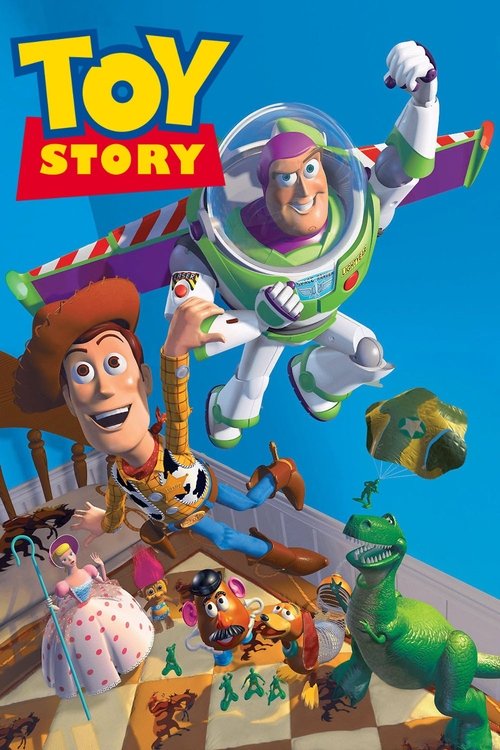
Toy Story
IMDb Rating
1.0M
IMDb Votes
100%
Rotten Tomatoes
$373M
Box Office
Synopsis & Review
Directed by John Lasseter and released in November 1995, Toy Story is not merely a great animated film — it is a seismic event in the history of cinema. The first feature-length film ever created entirely using computer-generated imagery, it represented a technological leap so total and so immediate that it rendered the previous decades of cel animation aesthetics instantly historical, opening a door through which every subsequent animated feature would walk. But what makes Toy Story genuinely extraordinary is not its technology, which could have been impressive and emotionally inert — it is the story. Woody (Tom Hanks) is a pull-string cowboy toy and the beloved leader of a young boy named Andy's toy collection. His world is upended when Andy receives a new birthday gift: Buzz Lightyear (Tim Allen), a sleek space ranger action figure who is convinced, with complete sincerity, that he is a real Space Ranger on a genuine interstellar mission. As Buzz supplants Woody as Andy's favorite, Woody's jealousy causes a series of events that strand both toys far from home — and forces the pair to find their way back together before Andy's family moves away. What unfolds is one of the most perfectly constructed buddy comedies ever made, built on a genuine philosophical premise: what does it mean to exist only in relation to someone else's love and attention?
What Pixar understood that no one else had quite grasped — and what Toy Story proved beyond argument — is that computer animation is not a gimmick or a style but a new medium with its own expressive possibilities. The film's writers, including Joss Whedon, Andrew Stanton, Joel Cohen, and Alec Sokolow, crafted a screenplay that works simultaneously as a children's adventure, a workplace comedy about status anxiety and obsolescence, and a genuinely moving meditation on identity and belonging. Tom Hanks's voice performance as Woody is one of the finest in the history of animation — warm, neurotic, funny, and ultimately heartbreaking — and Tim Allen's Buzz is his perfect comic opposite. Randy Newman's score and original songs capture the film's emotional register with extraordinary precision. Toy Story received three Academy Award nominations — including a Special Achievement Award for John Lasseter — and grossed $373 million on a $30 million budget. It spawned three sequels, two of which are widely considered equal to or greater than the original, and launched Pixar Animation Studios as the most consistently excellent filmmaking organization in the history of animated cinema. Nearly thirty years on, not a single frame has aged.
Why Watch This Movie?
The Film That Invented Modern Animation
Before Toy Story, computer-generated imagery was a visual effect used inside live-action films. After it, CGI animation was a feature film medium in its own right — and every major animation studio in the world immediately began transitioning away from hand-drawn cel animation. The film did not merely change how animated films looked; it changed what animated films were and what they could become. Its influence on the subsequent thirty years of cinema cannot be overstated.
A Perfect Screenplay That Works for Every Age
Children love Toy Story for its adventure, its comedy, and its toys. Adults love it for its exploration of jealousy, obsolescence, and the terror of being replaced in someone's affections. Elderly viewers love it for its meditations on loyalty and the passage of time. The film operates with perfect clarity on every emotional register simultaneously — which is the rarest and most difficult thing a screenplay can achieve, and which is why the film continues to work on every audience it encounters.
The Beginning of the Greatest Franchise in Animation History
Toy Story launched a franchise that includes three sequels — each of which was produced with the same creative seriousness as the original — and a universe of short films, specials, and spin-offs. Toy Story 3 (2010) is widely considered one of the greatest animated films ever made and reduced an entire generation of adults to tears. The original film is not merely a classic in itself; it is the foundation of one of the most beloved storytelling universes in cinema history.
Cast & Crew
Director
John Lasseter
Screenplay
Whedon · Stanton · Cohen · Sokolow
Producer
Ralph Guggenheimer
Woody (voice)
Tom Hanks
Buzz Lightyear (voice)
Tim Allen
Mr. Potato Head (voice)
Don Rickles
Original Score
Randy Newman
Animation Studio
Pixar Animation Studios
Distributor
Walt Disney Pictures
Official Trailer
© Pixar Animation Studios / Walt Disney Pictures. Trailer embedded via YouTube.
Frequently Asked Questions
Was Toy Story really the first fully computer-animated feature film?
Yes — Toy Story holds the distinction of being the first feature-length film created entirely through computer-generated imagery, without any hand-drawn animation. Prior to its release, CGI had been used in live-action films for specific effects sequences — the water creature in The Abyss (1989), the T-1000 in Terminator 2 (1991), the dinosaurs in Jurassic Park (1993) — but no studio had attempted to build an entire feature-length narrative world from the ground up in CGI. Pixar had spent the decade preceding Toy Story developing the RenderMan software and producing short films to test what was possible. The production required 800,000 machine hours of rendering time across a network of 117 Sun Microsystems workstations. At the time, the technology could not realistically render human skin or hair, which is why the story was set in a world of toys — objects with simpler, smoother surfaces that the available computing power could handle convincingly.
Why was the original script for Toy Story completely rewritten?
One of the most dramatic production crises in animation history occurred in November 1993, when Disney executives viewed an early cut of the film and hated what they saw. The original version, developed under pressure from Disney to create a film with more edge and adult appeal, had made Woody an aggressively sarcastic, mean-spirited character — entirely unlikeable and fundamentally inconsistent with what Pixar actually wanted the film to be. Disney shut down production after the screening and threatened to cancel the project entirely. Pixar was given one final chance. Andrew Stanton, Pete Docter, Joe Ranft, and John Lasseter completely rewrote the script over a frantic weekend, reverting Woody to the warmer, more recognizably human character he became in the finished film. The shutdown was eventually one of the most fortunate things to happen to the movie, as it forced the creative team back to the emotional core of their original vision.
How many Toy Story films are there, and which is the best?
There are four main Toy Story films: the original (1995), Toy Story 2 (1999), Toy Story 3 (2010), and Toy Story 4 (2019). All four hold rare 100% or near-perfect scores on Rotten Tomatoes, making the franchise arguably the most consistently excellent in the history of animated cinema. Critical and audience consensus generally places Toy Story 3 as the emotional pinnacle of the series — a film that deals with growing up, loss, and letting go with such devastating honesty that it reduced enormous numbers of adult viewers to tears in cinemas worldwide. It won the Academy Award for Best Animated Feature and is often cited as one of the greatest animated films ever made. Toy Story 2 is similarly acclaimed as a rare sequel that equals its predecessor, while Toy Story 4 — though widely praised — is considered by some fans as a less essential entry given the emotional completeness of Toy Story 3's ending.
More 3D Films Like This
If you loved Toy Story, these animated masterpieces belong on your watchlist.