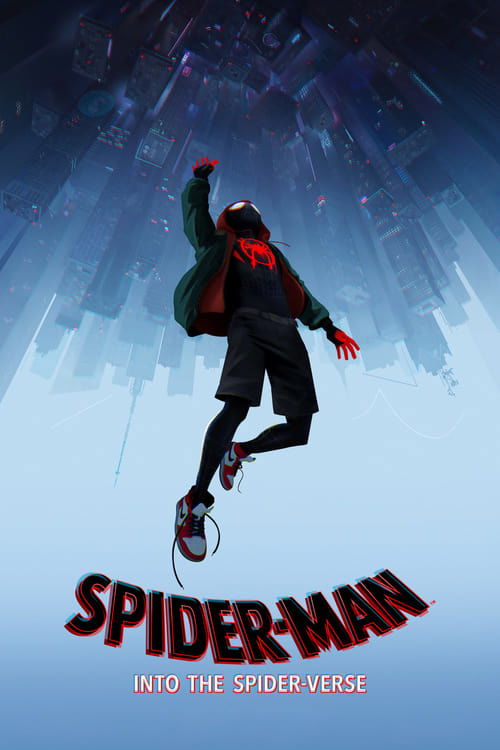
Spider-Man:
Into the Spider-Verse
IMDb Rating
680K
IMDb Votes
97%
Rotten Tomatoes
$384M
Box Office
Synopsis & Review
Directed by Bob Persichetti, Peter Ramsey, and Rodney Rothman and released in 2018, Spider-Man: Into the Spider-Verse is the most visually revolutionary animated film ever made — and one of the most emotionally resonant superhero stories ever told. Miles Morales (Shameik Moore) is a thirteen-year-old Afro-Latino teenager from Brooklyn who is bitten by a radioactive spider and discovers, with considerable alarm, that he is not the only Spider-Man in existence. When the villainous Kingpin (Liev Schreiber) activates a supercollider that rips open the barriers between parallel dimensions, a collection of Spider-People from across the multiverse are pulled into Miles's universe: Peter B. Parker (Jake Johnson), a middle-aged, schlubby version of the original Spider-Man in the early stages of a midlife crisis; Gwen Stacy / Spider-Woman (Hailee Steinfeld), a stylish, self-possessed version from a universe where it was Gwen rather than Peter who was bitten; Spider-Man Noir (Nicolas Cage), a black-and-white 1930s detective version; Peni Parker (Kimiko Glenn), a Japanese-American girl bonded with a spider-robot; and Spider-Ham (John Mulaney), a cartoon pig. Miles must learn to harness his powers and find his own identity as Spider-Man in time to help them all return to their home dimensions — before the collider destroys everything.
What makes Into the Spider-Verse so extraordinary — and what distinguishes it from every other animated film of the past decade — is the totality of its artistic ambition. The film was made using a completely new animation technique developed specifically for it by Sony Pictures Animation and a team of artists and engineers who spent years creating a visual language that replicates the look and feel of comic book panels in motion: halftone dots, Ben-Day dot patterns, misaligned color separations, visible outlines, motion blur expressed as multiple overlapping frames. Each Spider-Person was designed and animated in their own distinct style — Spider-Ham moves like a Looney Tunes character; Spider-Man Noir is rendered in near-monochrome; Miles's world is layered with graffiti art and Brooklyn texture — creating a film that feels simultaneously like reading six different comic books simultaneously and watching one of the most purely cinematic experiences of the decade. The screenplay by Phil Lord and Rodney Rothman is funny, emotionally precise, and structurally ingenious — and its central argument, that "anyone can wear the mask," is perhaps the most genuinely democratic statement any superhero film has ever made. The film won the Academy Award for Best Animated Feature, the Golden Globe for Best Animated Feature, the Annie Award for Best Animated Feature, and numerous critics' awards. On its release, Roger Ebert's site called it "the best Spider-Man film ever made." A decade on, that assessment has only grown more secure.
Why Watch This Movie?
The Most Visually Innovative Film of the 21st Century
The animation technique developed for Into the Spider-Verse is genuinely unprecedented in the history of the medium. By deliberately breaking the conventional rules of smooth, fluid animation — introducing visible frame offsets, comic-book printing artifacts, and distinct visual registers for each character — the film created a new visual language that has influenced virtually every major animated production made since. Watching it for the first time is a physical experience: the images move in ways you have never seen before and cannot quite believe are happening.
Miles Morales — The Most Important New Superhero in a Generation
Miles Morales is a genuinely new kind of superhero protagonist — a teenager who is not exceptional by birth, destiny, or privilege, but who must find his own way to become Spider-Man while navigating the very specific pressures of being a young Black and Latino man in contemporary America. His story is about identity, legacy, and the courage to define yourself on your own terms. The film makes his journey feel personal and universal simultaneously — a rare achievement in any medium.
The Greatest 3D Cinema Experience Ever Made
While most 3D films use the technology as a gimmick — objects flying at the camera, depth that feels like a diorama — Into the Spider-Verse was designed from the ground up to use 3D as an expressive tool. The depth of field, the layering of the comic-book visual elements, and the way different dimensional realities are rendered in overlapping spatial planes create a 3D experience unlike any other in cinema history. Seen in a properly calibrated 3D screening, it is breathtaking.
Cast & Crew
Directors
Persichetti · Ramsey · Rothman
Screenplay
Phil Lord & Rodney Rothman
Producer
Amy Pascal & Phil Lord
Miles Morales
Shameik Moore
Peter B. Parker
Jake Johnson
Gwen Stacy
Hailee Steinfeld
Kingpin
Liev Schreiber
Original Score
Daniel Pemberton
Studio
Sony Pictures Animation
Official Trailer
© Sony Pictures Animation. Trailer embedded via YouTube.
Frequently Asked Questions
How was the unique animation style of Into the Spider-Verse created?
The film's animation style was the result of years of research and development by Sony Pictures Animation's team, who deliberately set out to create something that had never been seen before. The core innovation was animating Miles Morales and his world at 24 frames per second — the standard film rate — but animating the Spider-People at 12 frames per second, deliberately introducing a stutter that replicates the feel of comic book action panels. This technique, called "animating on twos," was considered technically incorrect by conventional animation standards, but the directors insisted on it because it created the distinctive kinetic energy they wanted. The team also layered in visual elements directly borrowed from comic book printing: Ben-Day halftone dots, color separation misalignment (where the color appears slightly offset from the outlines), visible ink textures, and speech-bubble-style thought captions. Each alternate Spider-Person was given their own distinct visual register — Spider-Ham runs at an even lower frame rate to emphasize his cartoon origin; Spider-Man Noir is rendered in near-monochrome with sepia tones. The film required a custom rendering pipeline that took four years to develop and produced some of the most complex individual frames in the history of digital animation.
Who is Miles Morales and where does the character come from?
Miles Morales was created by writer Brian Michael Bendis and artist Sara Pichelli and first appeared in Marvel Comics in August 2011, initially as the Spider-Man of the Ultimate Marvel universe — an alternate continuity separate from the main Marvel comics line. Miles is an Afro-Latino teenager from Brooklyn whose father is African-American and whose mother is Puerto Rican, making him one of the first major superheroes of color in mainstream American comics. His creation was partly inspired by the casting of Donald Glover as a background character in the live-action Spider-Man films, which had sparked a fan campaign for Glover to play Peter Parker. Bendis has said the character was also inspired by President Barack Obama — a figure who represented, for many people, the idea that anyone could aspire to the highest position regardless of background. Miles was so popular that he eventually replaced Peter Parker as the primary Spider-Man in the Ultimate universe and later crossed over into the main Marvel continuity, where he continues to appear alongside the original Peter Parker.
Is Into the Spider-Verse connected to the live-action Spider-Man films?
No — Spider-Man: Into the Spider-Verse exists in its own separate animated universe, entirely independent from the MCU's Tom Holland Spider-Man films, the Sam Raimi trilogy with Tobey Maguire, or the Marc Webb films with Andrew Garfield. Sony Pictures Animation and Sony Pictures Entertainment maintain separate creative divisions for their animated and live-action Spider-Man properties. The film is the first entry in what has become its own animated universe, followed by Across the Spider-Verse (2023), and with Beyond the Spider-Verse planned as its conclusion. While characters from the Raimi and Webb films did appear in the live-action Spider-Man: No Way Home (2021), that was an entirely separate crossover event within the MCU, and none of those live-action characters appear in the animated Spider-Verse series. The animated universe has its own internal continuity and multiverse logic independent of any other Spider-Man property.
More 3D Films Like This
If you loved Into the Spider-Verse, these spectacular 3D experiences belong on your watchlist.