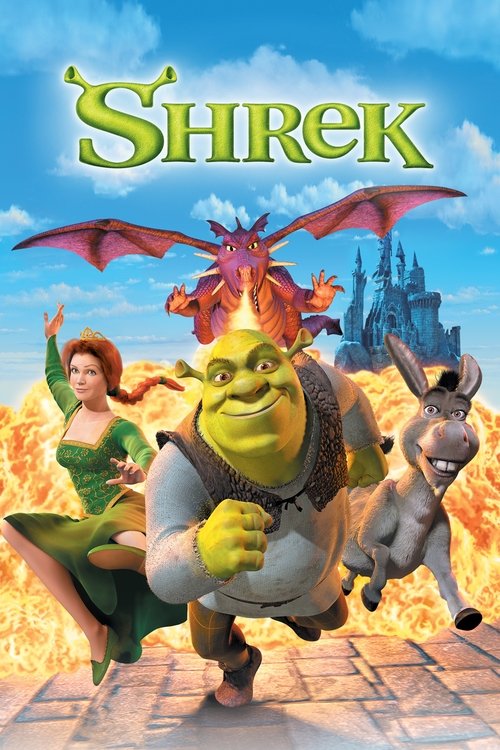
Shrek
IMDb Rating
650K
IMDb Votes
88%
Rotten Tomatoes
$484M
Box Office
Synopsis & Review
Directed by Andrew Adamson and Vicky Jenson and released in 2001, Shrek arrived as one of the most deliberately subversive mainstream animated films ever produced — a film that set out, with cheerful aggression, to dismantle every cliché of the fairy tale genre that Disney had spent sixty years perfecting, and to replace them with something looser, funnier, more cynical, and — paradoxically — more genuinely romantic. Shrek (Mike Myers) is a large, green, solitary ogre who lives happily in his swamp, frightening away the occasional villager and enjoying his own company. When the vain, diminutive Lord Farquaad (John Lithgow) exiles all the fairy tale creatures of the land to Shrek's swamp — including Pinocchio, the Three Little Pigs, the Gingerbread Man, and an irrepressibly talkative Donkey (Eddie Murphy) — Shrek strikes a deal: he will travel to the dragon-guarded castle of Princess Fiona (Cameron Diaz) and retrieve her for Farquaad to marry, in exchange for the return of his swamp. What he does not expect is that Fiona — properly trained in the conventions of fairy tale romance — will not fit neatly into the role he has been sent to fill, and that the journey to deliver her will reveal things about both of them that neither was prepared to discover.
What makes Shrek a genuine classic rather than merely a clever parody is the warmth that operates beneath its irony. The film's central argument — that conventional beauty is an arbitrary standard that tells you nothing about a person's worth — is delivered through a story that genuinely earns its conclusion rather than simply asserting it. Shrek and Fiona are fully realized characters whose relationship develops with real emotional logic, and the film's willingness to let its hero be genuinely ugly, bad-tempered, and socially unappealing — and to argue that these qualities do not disqualify him from love — was a genuinely radical position for a mainstream animated film to take in 2001. Eddie Murphy's Donkey is one of the great comic creations in the history of animated cinema — a character of unstoppable, slightly deranged good cheer whose total indifference to social boundaries somehow becomes the film's moral compass. The animation, while primitive by current standards, was the most sophisticated CGI character work that had been achieved at the time of release, particularly in the rendering of Shrek's skin and hair. The film won the first-ever Academy Award for Best Animated Feature Film, grossed $484 million worldwide on a $60 million budget, and launched a franchise that has generated over $3.5 billion globally. It also inspired the most pervasive internet meme culture of any animated film in history — a measure, in its own strange way, of how completely the character has embedded himself in popular consciousness.
Why Watch This Movie?
Eddie Murphy's Donkey — The Greatest Comedic Voice Performance Ever
Eddie Murphy's Donkey is a genuine tour de force of improvisational energy, comic timing, and character consistency that has rarely been matched in animation. Murphy reportedly improvised enormous portions of his dialogue, and the filmmakers built the character around his energy rather than constraining his performance to fit a pre-written character. The result is something that feels completely alive — a being of pure, joyful, unfiltered enthusiasm who is simultaneously the film's funniest and most emotionally honest character.
The Film That Beat Disney at Its Own Game
When Shrek won the first-ever Academy Award for Best Animated Feature in 2002, beating Disney/Pixar's Monsters, Inc., it was a genuinely shocking result — not least because the film spent much of its runtime satirizing the Disney fairy tale formula with pointed, specific mockery. The victory was a watershed moment that announced DreamWorks Animation as a genuine creative competitor to Pixar, and demonstrated that irreverence and subversion could be just as valuable in animated storytelling as sincerity and sentiment.
A Love Story That Actually Believes Its Own Message
Most films that argue "beauty is on the inside" resolve that argument by making the ugly protagonist beautiful. Shrek resolves it by making the beautiful character choose to become what the world would consider ugly — and then presenting this as the happy ending, without irony or qualification. It is a genuinely unusual moral position for a mainstream film, and the fact that it lands emotionally rather than feeling like a lecture is a testament to the film's real warmth beneath its surface irreverence.
Cast & Crew
Directors
Andrew Adamson & Vicky Jenson
Screenplay
Ted Elliott & Terry Rossio
Based On
Book by William Steig
Shrek (voice)
Mike Myers
Donkey (voice)
Eddie Murphy
Princess Fiona (voice)
Cameron Diaz
Lord Farquaad (voice)
John Lithgow
Original Score
Harry Gregson-Williams & John Powell
Studio
DreamWorks Animation
Official Trailer
© DreamWorks Animation. Trailer embedded via YouTube.
Frequently Asked Questions
Why did Chris Farley originally voice Shrek, and what happened?
Comedian Chris Farley was originally cast as the voice of Shrek and had recorded approximately 80 to 90 percent of his dialogue for the role before his death from a drug overdose in December 1997, at the age of 33. Farley's version of the character was significantly different from Mike Myers's final portrayal — reportedly more enthusiastic, childlike, and emotionally open, with less of the sardonic grumpiness that Myers eventually brought to the role. After Farley's death, the filmmakers considered using his recordings but ultimately decided it would be inappropriate and potentially distressing, and recast the role with Mike Myers. Myers initially recorded his performance in his natural voice before requesting the opportunity to re-record everything in a Scottish accent, which added significantly to the production's cost but produced the distinctive Shrek voice that became iconic. Some of Farley's original recordings have been heard by those who worked on the production, though they have never been publicly released.
Is Shrek satirizing Disney specifically?
Yes — and quite deliberately. DreamWorks Animation was founded in part by Jeffrey Katzenberg, who had a famously acrimonious departure from Disney in 1994 after being passed over for promotion by Michael Eisner. Shrek was widely understood at the time of its release as a pointed personal and institutional critique of Disney, and the film's mockery of the fairy tale formula, its visual design of Duloc (Lord Farquaad's kingdom) as an obvious parody of Disneyland, and the character of Farquaad himself — widely believed to be a caricature of either Katzenberg's nemesis Michael Eisner or Disney's founder Walt Disney — were all part of a deliberate counter-programming strategy. The filmmakers have never officially confirmed that Farquaad was based on a specific individual, but the short stature of the character (Lithgow described him as "Napoleon with a castle") and the Disneyland parody were acknowledged as satirical. The fact that Shrek then won the first Academy Award for Best Animated Feature over Disney/Pixar's Monsters, Inc. was widely seen in Hollywood as a satisfying coda to the Katzenberg-Eisner feud.
How many Shrek films are there and which is the best?
The main Shrek franchise consists of four feature films: Shrek (2001), Shrek 2 (2004), Shrek the Third (2007), and Shrek Forever After (2010), plus the spin-off Puss in Boots (2011) and its sequel Puss in Boots: The Last Wish (2022). Critical and audience consensus generally places Shrek 2 as equal to or slightly superior to the original — it has a slightly higher IMDb rating and is often cited as one of the rare sequels that expands and deepens the original's world without diminishing it. Puss in Boots: The Last Wish (2022) has been widely acclaimed as the best film in the entire franchise, praised for its extraordinary animation style, mature themes about mortality and self-acceptance, and the remarkable performance of Antonio Banderas. A fifth Shrek film was announced for release in 2026, reuniting the original cast.
More 3D Films Like This
If you loved Shrek, these animated films will delight you just as much.