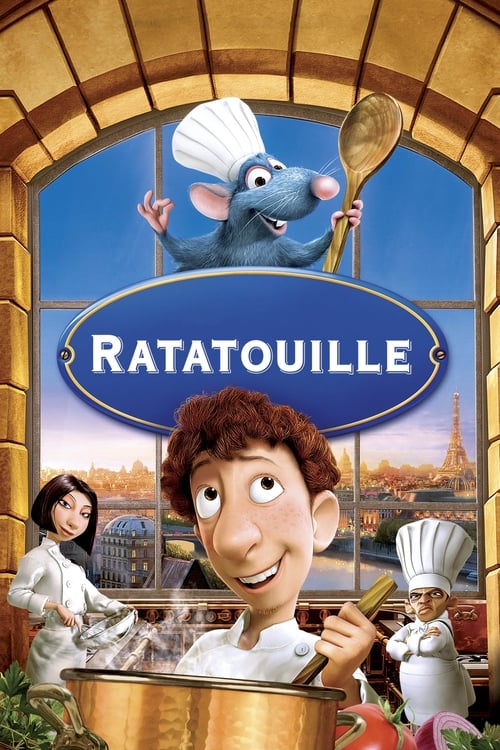
Ratatouille
IMDb Rating
800K
IMDb Votes
96%
Rotten Tomatoes
$623M
Box Office
Synopsis & Review
Written and directed by Brad Bird — returning to Pixar after The Incredibles — and released in 2007, Ratatouille is one of the most unlikely and one of the most perfectly realized films Pixar has ever made: a work about a rat who wants to cook in a Parisian restaurant that manages, through sheer formal intelligence and genuine warmth, to become a meditation on the nature of creativity, the relationship between artist and audience, the legitimacy of desire, and the specific courage required to pursue excellence in the face of a world that has decided in advance what you are capable of. Remy (Patton Oswalt) is a rat with an extraordinarily refined sense of smell and taste — a gift that makes him alien among his own kind, for whom food is merely sustenance, and that gives him an uncontrollable love for the cuisine of the legendary chef Auguste Gusteau (Brad Garrett), whose Paris restaurant was the finest in the world until the devastating review of the feared critic Anton Ego (Peter O'Toole) cost it its fifth Michelin star and broke its creator's heart. Separated from his family by a flood, Remy ends up in the kitchens of Gusteau's restaurant, now run by the scheming sous-chef Skinner (Ian Holm), and discovers that the kitchen staff includes Linguini (Lou Romano) — a young, talentless young man who has just gotten a job as a garbage boy. When Linguini accidentally ruins a soup and Remy instinctively corrects it, the two form an unusual partnership: Remy hides under Linguini's chef's hat and controls his movements by pulling his hair, turning the incompetent Linguini into a culinary genius.
What makes Ratatouille so genuinely extraordinary — and what gives it a place in the very highest tier of animated cinema — is not its premise, which is delightful but modest, but the seriousness and the depth with which it takes its own thematic material. The film is, at its heart, a film about art: about what it costs to make something genuinely good, about the courage required to pursue an authentic vision in a world that has assigned you to a different role, and about the relationship between the creator, the work, and the audience. Gusteau's motto — "Anyone can cook" — is the film's organizing principle, but the film understands this more subtly than it first appears: not that everyone is capable of greatness, but that greatness can come from anywhere, including places the world would never think to look. The film's cinematography — shot by Sharon Calahan and Robert Anderson — renders Paris at night with a painterly warmth and luminosity that is unlike anything else in Pixar's catalog. Michael Giacchino's score is his finest work for Pixar, a perfectly calibrated blend of French café jazz and classical romanticism that captures the emotional texture of the film with extraordinary precision. But the film's true pinnacle is the final monologue delivered by Anton Ego — one of the greatest pieces of writing in Pixar's history, a meditation on the role of criticism and the relationship between the critic and the art they judge that stands as one of the finest minutes in any animated film. Ratatouille won the Academy Award for Best Animated Feature and grossed $623 million worldwide.
Why Watch This Movie?
Anton Ego's Final Monologue — The Greatest Writing in Pixar History
The speech Anton Ego delivers at the end of the film — in which he reflects on the nature of criticism, on the arrogance of the critic's position, and on the revelatory experience of encountering art that exceeds your expectations — is the finest piece of writing in Pixar's history and one of the finest in any animated film. Peter O'Toole delivers it with a quiet grandeur that makes it feel genuinely earned. It is the moment the film transforms from a very good animated comedy into something that deserves to be considered great cinema.
A Pixar Film That Takes Artistic Excellence Seriously
Most family films that address the theme of artistic aspiration resolve it by vindicating the underdog through popular success. Ratatouille is more demanding than that. The film argues that genuine excellence — the kind that comes from following your authentic vision rather than the audience's expectations — is its own justification, even when it costs you everything. Remy's cooking is not celebrated because it becomes popular; it is presented as valuable because it is genuinely, irreducibly excellent. This is a quietly radical position for a film aimed at families.
Paris Rendered More Beautifully Than in Any Other Animated Film
The production team made multiple research trips to Paris, photographing streets, restaurants, markets, and rooftops at different times of day and in different seasons, and the resulting film is the most cinematically beautiful portrait of the city in any animated production. The views of Paris at night from the rooftops of Montmartre — rain-slicked streets, warm restaurant windows, the Eiffel Tower in the distance — are among the most stunning images Pixar has ever created. The kitchen sequences, with their heat, steam, and organized chaos, have a kinetic energy that rivals any live-action culinary film.
Cast & Crew
Director
Brad Bird
Screenplay
Brad Bird
Producer
Brad Lewis
Remy (voice)
Patton Oswalt
Anton Ego (voice)
Peter O'Toole
Skinner (voice)
Ian Holm
Linguini (voice)
Lou Romano
Original Score
Michael Giacchino
Studio
Pixar / Walt Disney
Official Trailer
© Pixar Animation Studios / Walt Disney Pictures. Trailer embedded via YouTube.
Frequently Asked Questions
What is the meaning of Anton Ego's final speech?
Anton Ego's closing monologue is widely regarded as one of the finest pieces of writing in Pixar's history and one of the most honest meditations on the nature of criticism in any film. The speech makes several interconnected arguments. First, it acknowledges the essential arrogance of the critic's position: the act of judging art requires placing yourself above the thing you are judging, a posture that is comfortable and self-flattering but which carries a fundamental dishonesty. Second, it argues that new creative work — work that challenges existing standards or comes from unexpected sources — is inherently at a disadvantage when judged by critics whose frameworks and preferences were formed by the past. Third, and most importantly, it argues that the least-celebrated position in art — that of the audience member who finds, in something new and unexpected, a genuine experience of beauty or truth — is also the most valuable. Ego's transformation across the film is from a man who derives pleasure from exercising power over art to a man who can be moved by it. His willingness to write honestly about Remy's cooking, at significant personal and professional cost, is the film's moral climax — the moment when self-serving judgment is replaced by genuine critical engagement.
Is the "Anyone can cook" motto meant literally?
The film explicitly addresses this question in Ego's closing narration, where he explains that Gusteau's motto is "not everyone can become a great artist, but a great artist can come from anywhere." This is a crucial distinction that the film builds toward from its opening — and it is a more demanding and more honest position than the simpler democratic reading of the motto. The film is not arguing that all people are equally capable of artistic excellence; it is arguing that the gatekeeping systems that decide in advance who is capable of excellence — who deserves access to training, resources, recognition — are wrong. Greatness is not predictable from social position, species, background, or expectation. This argument is what gives the film its emotional and intellectual backbone, and it is what elevates it from a pleasant comedy about a cooking rat into something genuinely concerned with how art and excellence work in a world that prefers comfortable hierarchies to inconvenient talent.
Why is the Ratatouille dish itself so significant?
The climactic scene in which Remy serves Anton Ego a version of the humble Provençal vegetable dish ratatouille — and Ego's experience of tasting it triggers an involuntary memory of his mother's cooking that sends him back to a moment of childhood innocence — is one of the most cinematically precise sequences in Pixar's history. The dish itself is significant on multiple levels. Ratatouille is a peasant dish — a simple, rustic preparation of garden vegetables that originated among the working class of Nice and Provence, about as far from haute cuisine as you can get. By serving this dish to the most feared restaurant critic in Paris, Remy makes an argument about the nature of greatness: that the finest cooking is not about expensive ingredients or complex technique but about the quality of attention and care brought to any preparation, however simple. The visual technique used to render Ego's memory — a brief, instantaneous cut to a child version of Ego at his mother's table, rendered in a looser, warmer visual style than the rest of the film — is borrowed from the language of live-action cinema and was genuinely unprecedented in Pixar's work at that point. It is the most emotionally precise moment in the film.
More 3D Films Like This
If you loved Ratatouille, these animated masterpieces deserve a place on your watchlist.
🎬 Top 15 3D Films — Complete!
You've explored all 15 entries in CineVault's definitive Top 3D Films ranking — from Spider-Verse to Ratatouille. Every great animated and 3D cinematic experience, all in one place.