Finding
Nemo
IMDb Rating
1.1M
IMDb Votes
99%
Rotten Tomatoes
$940M
Box Office
Synopsis & Review
Directed by Andrew Stanton and released in 2003, Finding Nemo is Pixar's most visually beautiful film and one of the studio's most emotionally generous — a work that uses the vast, luminous world of the ocean as a canvas for an adventure story about the nature of love, the terror and necessity of letting go, and the way that fear, when it calcifies into obsession, can become indistinguishable from the thing it is trying to prevent. Marlin (Albert Brooks) is a clownfish living on the Great Barrier Reef, a widower whose entire emotional life has contracted around his single surviving son, Nemo (Alexander Gould). Nemo, born with a partially developed fin that Marlin treats as a permanent disability requiring permanent protection, is every inch the independent-minded child of an overprotective parent — desperate for autonomy, convinced of his own competence, and resentful of the bubble in which his father tries to keep him. When Nemo, in an act of defiance on his first day of school, swims too close to a boat and is scooped up by a scuba diver and transported to a fish tank in a dentist's office in Sydney, Marlin sets out across the entire ocean to find him — accompanied only by Dory (Ellen DeGeneres), a regal blue tang with a severe short-term memory disorder who is, in her chaotic, forgetful, endlessly cheerful way, exactly the companion Marlin needs.
What separates Finding Nemo from the large majority of animated adventure films is the completeness and honesty of its emotional argument. The film understands that Marlin's overprotectiveness is not merely a character flaw to be overcome but the entirely comprehensible response of a man who has experienced catastrophic loss — and that the path between traumatized hypervigilance and genuine trust in the people you love is neither short nor easy. His journey across the ocean is also a journey toward understanding that protection and control are not the same thing, and that love expressed as restriction is a kind of diminishment of the beloved. Dory, meanwhile, is one of the most genuinely funny and emotionally resonant characters Pixar has ever created — a being whose disability forces her to live entirely in the present moment, and whose philosophical relationship with memory and continuity models, without didacticism, the kind of openness to experience that Marlin is slowly learning. Thomas Newman's score is warm, curious, and oceanic — one of the finest he has ever written — and the animation, which required Pixar to develop entirely new rendering software capable of creating convincing underwater light and caustics, remains breathtaking more than two decades later. The film won the Academy Award for Best Animated Feature, grossed $940 million worldwide on a $94 million budget, and was re-released in 3D in 2012, where the underwater world it depicted — with all its depth and dimensionality — translated into stereoscopic format with extraordinary naturalness.
Why Watch This Movie?
The Most Beautiful Animation Ever Made
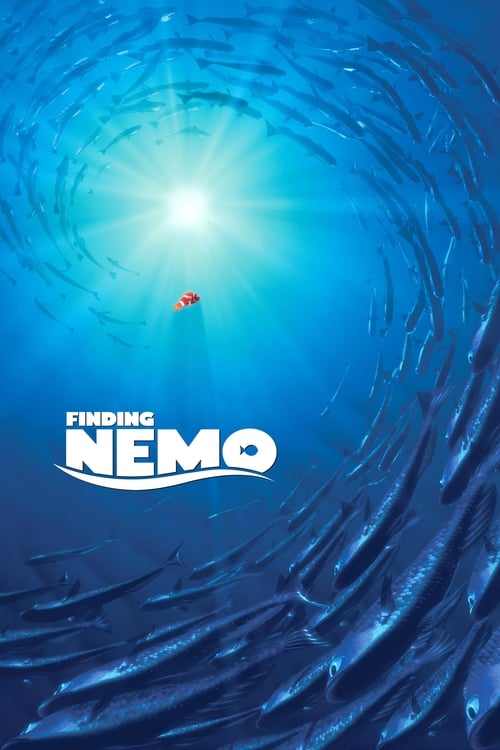
Pixar built entirely new rendering technology to create the underwater light — the caustic patterns on the seabed, the way sunlight fractures through water, the luminescence of deep-sea creatures — that fills every frame of Finding Nemo. The result is a film of such sustained visual beauty that even scenes without narrative tension are simply pleasurable to watch. When it was re-released in 3D in 2012, the depth and dimensionality of the underwater world translated into stereoscopic format so naturally that it felt as though the film had always been designed for it.
Ellen DeGeneres's Dory — Comedy and Pathos in Perfect Balance
Dory is one of the most difficult characters to write: a figure whose disability is the source of both her comedy and her emotional depth, without ever being exploited or condescended to. DeGeneres's performance is a masterwork of comic timing and genuine warmth — she makes Dory's short-term memory loss feel like a superpower rather than a limitation, and the scene in which she speaks to Marlin in his own language, addressing his deepest fear about letting Nemo go, is among the most quietly devastating moments in Pixar history.
A Parent–Child Story That Speaks to Both Sides
Children watching Finding Nemo see Nemo's story — the frustration of overprotective love, the desperate need for autonomy, the discovery that the world beyond the reef is both more dangerous and more wondrous than your parent told you. Adults see Marlin's — the terror of loving someone you cannot always protect, and the slow understanding that love expressed as control is a kind of cage. The film holds both perspectives with complete honesty and equal compassion, which is why it works for every age simultaneously.
Cast & Crew
Director
Andrew Stanton
Screenplay
Andrew Stanton & Bob Peterson
Producer
Graham Walters
Marlin (voice)
Albert Brooks
Dory (voice)
Ellen DeGeneres
Nemo (voice)
Alexander Gould
Gill (voice)
Willem Dafoe
Original Score
Thomas Newman
Studio
Pixar / Walt Disney
Official Trailer
© Pixar Animation Studios / Walt Disney Pictures. Trailer embedded via YouTube.
Frequently Asked Questions
Is the marine biology in Finding Nemo accurate?
The film is reasonably accurate in many respects but takes deliberate creative liberties where realism would conflict with storytelling. Clownfish do live in symbiosis with sea anemones on the Great Barrier Reef, and male clownfish are indeed the primary caregivers for eggs in the nest. However, one significant biological fact the film inverts: clownfish are sequential hermaphrodites, meaning they are all born male, and the dominant fish in any group can change sex to become female. This means that when Coral (Marlin's mate) dies in the film's opening, Marlin — as the dominant remaining fish — would in reality have changed sex and become female. The film sensibly chose not to incorporate this detail. The depiction of the East Australian Current as a sort of oceanic highway used by sea turtles is based on real behavior; green sea turtles do use the EAC for long-distance migration. The film's team consulted extensively with marine biologists and aquarists during production to ensure the visual depiction of reef life, deep-sea creatures, and open-ocean environments was as accurate as possible.
What inspired Andrew Stanton to make Finding Nemo?
Andrew Stanton has said that the film's central idea came from a personal moment of recognition. He was walking with his young son one day and realized he had spent the entire walk worrying about his son's safety — holding his hand too tight, steering him away from imagined dangers — and had not actually been present with his son or enjoyed the time they were spending together. The gap between the love he felt and the expression of that love struck him as both very funny and genuinely sad. The film grew from that observation: what does it look like when love becomes fear, and what does it cost the person you love? Stanton has also said that the ocean setting came from the same fundamental impulse — he wanted to set the film in the most hostile, dangerous, alien environment imaginable, to make Marlin's overprotectiveness feel both understandable and absurd at the same time.
How was the underwater lighting in Finding Nemo created?
Creating believable underwater light was the single greatest technical challenge of the production, and it required Pixar to develop entirely new rendering software. The specific phenomenon the team needed to replicate was "caustics" — the rippling, shifting patterns of light created when sunlight passes through the moving surface of water and refracts onto objects below. Pixar's existing RenderMan software could not simulate this effect convincingly, so the technical team spent months developing new algorithms capable of calculating the complex physics of light scattering through water in real time. The team also studied extensive underwater photography and footage, and consulted with oceanographers and marine photographers to understand how different depths, water clarity, and currents affect the quality and color of underwater light. The resulting visual system was so successful that many viewers, upon first seeing the film, wondered whether the backgrounds were actually filmed using real underwater photography with animated characters placed on top — which the filmmakers took as the highest possible compliment.
More 3D Films Like This
If you loved Finding Nemo, these animated adventures deserve a spot on your watchlist.