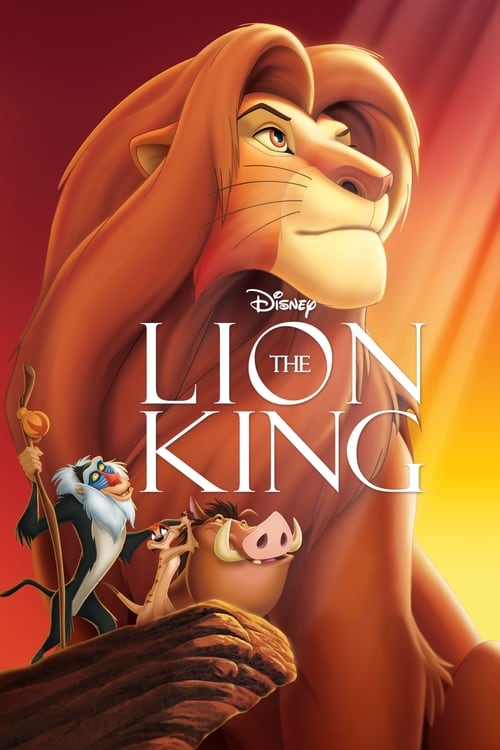
The Lion
King
IMDb Rating
1.0M
IMDb Votes
93%
Rotten Tomatoes
$968M
Box Office
Synopsis & Review
Directed by Roger Allers and Rob Minkoff and released in 1994, The Lion King is the pinnacle of the Disney Renaissance — the extraordinary creative period from 1989 to 1999 during which Walt Disney Animation Studios produced a succession of beloved classics that redefined what animated features could be. It is also the highest-grossing traditionally animated film in the history of cinema, a Broadway phenomenon, and one of the most culturally influential animated works ever made. The story, loosely inspired by Shakespeare's Hamlet, follows young Simba (voiced as an adult by Matthew Broderick), the heir to the Pride Lands, who witnesses the murder of his father King Mufasa (James Earl Jones) at the hands of his villainous uncle Scar (Jeremy Irons) — who then manipulates Simba into believing he was responsible for the death and convinces him to flee into exile. Growing up in the jungle with the carefree meerkat Timon (Nathan Lane) and warthog Pumbaa (Ernie Sabella) under the philosophy of "Hakuna Matata," Simba tries to forget his past — until a encounter with his childhood friend Nala (Moira Kelly) and a vision of his dead father force him to confront his identity, his grief, and his responsibility to his kingdom and his people.
What makes The Lion King so enduringly powerful is the fearlessness with which it commits to genuine tragedy at the center of what is ostensibly a children's film. The death of Mufasa — depicted on screen in full, without cutaway — is one of the most emotionally devastating sequences in the history of animation, and the film's willingness to show a child witnessing the death of his parent, and then to depict years of guilt, grief, and avoidance in their aftermath, gives it an emotional weight that most adult dramas fail to achieve. James Earl Jones's voice performance as Mufasa — warm, commanding, and unmistakably loving — makes his absence felt across the entire second half of the film. Jeremy Irons's Scar is one of Disney's greatest villains: theatrically camp, genuinely menacing, and wickedly funny in equal measure. Hans Zimmer's score and Elton John and Tim Rice's songs — including "Circle of Life," "Can You Feel the Love Tonight," and "Be Prepared" — are among the finest ever written for an animated film. The film was re-released in 3D in 2011, and the three-dimensional conversion of the Pride Rock sequences and the wildebeest stampede was among the most effective 3D conversions ever applied to an existing animated film, demonstrating the visual depth that was already inherent in the original cinematography. It won two Academy Awards — Best Original Score and Best Original Song — and grossed $968 million on a $45 million budget.
Why Watch This Movie?
The Greatest Villain in Disney History
Jeremy Irons's Scar is a masterwork of animated villainy — a character who is simultaneously hilarious and genuinely frightening, whose theatrical self-awareness only makes him more dangerous. His "Be Prepared" sequence is among the most cinematically ambitious things Disney has ever put in a children's film: a full-scale Nuremberg rally parody rendered in angular expressionist animation that deliberately evokes Nazi imagery. It is bold, visually stunning, and completely committed to its own darkness.
Hand-Drawn Animation at Its Absolute Zenith
The wildebeest stampede sequence — in which thousands of animals pour through a gorge in a scene that took three years and the studio's first CGI department to produce — remains one of the most technically staggering achievements in the history of hand-drawn animation. The combination of traditionally animated characters with computer-generated crowd movement was genuinely revolutionary in 1994 and has never been surpassed for sheer physical impact within the classical animation tradition.
A Soundtrack That Defined a Generation
The combination of Elton John and Tim Rice's pop songs and Hans Zimmer's orchestral score creates a musical landscape of extraordinary range and emotional depth. "Circle of Life" opens the film with one of the most iconic sequences in animation history; "Hakuna Matata" is a perfectly constructed comic relief number; "Can You Feel the Love Tonight" is a genuinely beautiful ballad. Together they form a soundtrack that an entire generation grew up with and that has lost nothing of its power over thirty years.
Cast & Crew
Directors
Roger Allers & Rob Minkoff
Screenplay
Irene Mecchi & Jonathan Roberts
Songs
Elton John & Tim Rice
Simba (adult, voice)
Matthew Broderick
Mufasa (voice)
James Earl Jones
Scar (voice)
Jeremy Irons
Timon (voice)
Nathan Lane
Original Score
Hans Zimmer
Studio
Walt Disney Animation
Official Trailer
© Walt Disney Pictures. Trailer embedded via YouTube.
Frequently Asked Questions
Is The Lion King really based on Shakespeare's Hamlet?
The structural parallels between The Lion King and Hamlet are undeniable and have been widely acknowledged by the filmmakers, though Disney has always maintained that the film was independently developed rather than directly adapted from Shakespeare. Both feature a young prince whose father is murdered by a treacherous uncle who then takes the throne; both involve the ghost of the dead father appearing to the hero; both explore the prince's flight from responsibility and eventual return to claim his birthright. The Disney screenwriters have said they were not consciously working from Hamlet but were drawing from similar archetypal storytelling traditions — the hero's journey, the exile and return, the usurpation narrative — that Shakespeare himself was drawing from when he wrote Hamlet. The film also draws on elements of the Biblical story of Joseph and the Egyptian myth of Osiris. The Hamlet connection is real but the relationship is one of structural kinship rather than direct adaptation.
How was the wildebeest stampede sequence created?
The wildebeest stampede is one of the most technically complex sequences in the history of traditional animation, and it required Disney to establish its first dedicated CGI department specifically to produce it. The sequence took approximately three years to complete. A team of computer scientists and animators created a custom software program called CAPS (Computer Animation Production System) and a specific crowd simulation tool that could generate the movement of thousands of individual wildebeest simultaneously, each with slightly different movement cycles to avoid a robotic, uniform look. The CGI-generated herd was then composited with hand-drawn foreground characters — Simba, Mufasa, and Scar — using traditional cel animation techniques. The result was a seamless integration of computer-generated crowd movement and classical hand-drawn character animation that was entirely unprecedented in 1994 and that established the technical foundation for the hybrid animation approaches that all major studios would adopt over the following decade.
Why was the 2019 live-action remake controversial?
Jon Favreau's 2019 photorealistic CGI remake of The Lion King was one of the most commercially successful films of that year — grossing over $1.6 billion worldwide — but it divided critics and audiences on a fundamental aesthetic question. The remake rendered all of its animal characters with photorealistic accuracy, which meant they looked and moved exactly like real lions, meerkats, and warthogs. Critics argued that this photorealism came at a severe emotional cost: real animals do not have expressive faces, and the characters that had been so vivid and emotionally legible in the 1994 original — Simba's grief, Scar's theatrical menace, Timon and Pumbaa's comic mugging — were flattened into the blank, naturalistic expressions of actual wildlife. The film demonstrated, unexpectedly, that the stylization and expressiveness of traditional animation were not limitations to be overcome by technology, but essential expressive tools that the original filmmakers had used with extraordinary skill. Many critics argued that the remake proved that the original was irreplaceable precisely because of its artificiality.
More 3D Films Like This
If you loved The Lion King, these animated classics deserve a place on your watchlist.