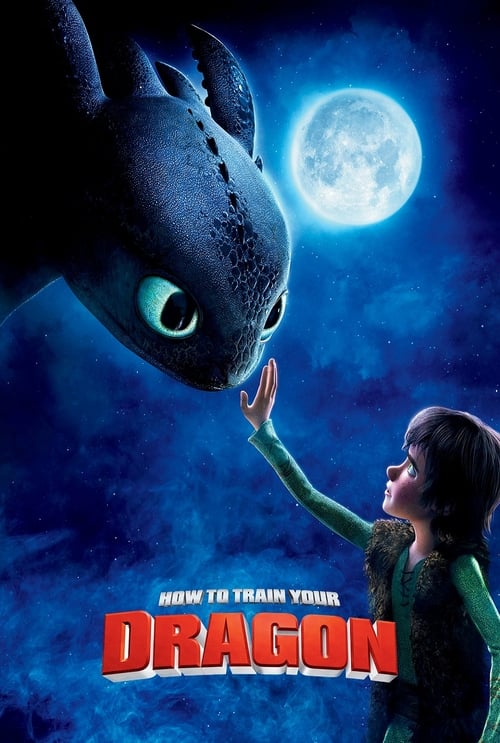
How to Train
Your Dragon
IMDb Rating
650K
IMDb Votes
99%
Rotten Tomatoes
$495M
Box Office
Synopsis & Review
Directed by Dean DeBlois and Chris Sanders and released in 2010, How to Train Your Dragon is the film that announced DreamWorks Animation's arrival as a studio capable of genuine emotional and artistic ambition — not merely a commercially reliable factory of comedy sequels, but a place where someone could make something that aspired to the same heights as the best Pixar had produced. Set in a mythical Viking island called Berk, the film follows Hiccup (Jay Baruchel), a gangly, inventive teenager who is the son of the village chief Stoick (Gerard Butler) but entirely unable to live up to the warrior ideal his community demands. When Hiccup shoots down and secretly befriends a Toothless — a rare, feared species of dragon called a Night Fury — he discovers that everything his village believes about dragons is wrong. Rather than ferocious predators to be destroyed, dragons are intelligent, emotionally complex creatures who attack only because they themselves are enslaved by a greater threat. As Hiccup trains Toothless and builds a prosthetic tail fin that allows the dragon to fly again, the two form one of the most genuinely moving friendships in the history of animated cinema — and Hiccup must find a way to bridge the war between his people and creatures they have never tried to understand.
What makes How to Train Your Dragon transcend its adventure premise is the emotional intelligence it brings to questions of prejudice, disability, and the courage required to see through your own culture's inherited assumptions. Hiccup is not a conventional hero — he is physically slight, socially awkward, and constitutionally incapable of the violence his world demands — and the film never asks him to become one. Instead, it argues that the qualities that make him an outcast in his community — curiosity, empathy, ingenuity, the refusal to destroy what he doesn't understand — are precisely the qualities that will save everyone. John Powell's Oscar-nominated score is a soaring, Celtic-influenced masterwork that reaches its emotional peak in the film's extended flying sequences — sequences that remain, over fifteen years on, among the most purely joyful things ever put in an animated film. Shot in stereoscopic 3D with extraordinary attention to the spatial possibilities of aerial flight, the sequences in which Hiccup and Toothless ride through clouds and dive over the ocean are the most fully realized argument for what 3D cinema can be when it is used as an expressive tool rather than a gimmick. The film received two Academy Award nominations — Best Animated Feature and Best Original Score — and grossed $495 million worldwide. It spawned two sequels, a television series, and a live-action remake in 2025.
Why Watch This Movie?
The Greatest Flying Sequences in Animation History
The scenes in which Hiccup and Toothless take flight together are a genuine argument for what cinema can do at its best — pure kinetic joy rendered with technical perfection and emotional truth. Designed specifically to exploit the spatial depth of stereoscopic 3D, they place the audience inside the sensation of flight in a way that no other film has managed before or since. The sequence set to John Powell's "Test Drive" is one of the finest three minutes in the history of animated cinema.
Toothless — The Greatest Animated Animal Character Ever
Toothless does not speak a word. He communicates entirely through body language, expression, and movement — and yet he is one of the most vivid, fully realised, and emotionally expressive characters in the history of animated film. The animators studied cats, dogs, and various other animals to develop his movement vocabulary, and the result is a creature whose inner life feels completely real and completely legible. The scene where he first tentatively allows Hiccup to touch him is genuinely one of the most moving moments in any animated film.
A Story About Disability, Empathy, and Inherited Prejudice
Both Hiccup and Toothless end the film permanently disabled — Hiccup loses his left foot, Toothless loses part of his tail fin — and neither is "fixed" or magically restored. The film argues, with quiet dignity, that disability does not require a cure but an accommodation, and that the bond between beings who understand each other's limitations is one of the purest forms of love. It is one of the most thoughtful treatments of disability in mainstream cinema, animated or otherwise.
Cast & Crew
Directors
Dean DeBlois & Chris Sanders
Screenplay
Will Davies & DeBlois & Sanders
Based On
Novel by Cressida Cowell
Hiccup (voice)
Jay Baruchel
Stoick (voice)
Gerard Butler
Astrid (voice)
America Ferrera
Gobber (voice)
Craig Ferguson
Original Score
John Powell
Studio
DreamWorks Animation
Official Trailer
© DreamWorks Animation / Paramount Pictures. Trailer embedded via YouTube.
Frequently Asked Questions
How faithful is the film to the original book series?
The film takes considerable creative liberties with Cressida Cowell's beloved children's book series, which began in 2003. In the books, Hiccup is a small, red-haired Viking boy who trains a Common Garden Dragon named Toothless — a tiny, toothless, orange dragon who is far from the sleek, powerful Night Fury of the film. The books are also much more comedic and irreverent in tone. The filmmakers essentially used the core premise — a boy who befriends a dragon in a Viking world that hates dragons — and the character names, and built an entirely new story around them. Cressida Cowell has spoken warmly about the adaptation, noting that she considers the film and the books to be separate entities that can coexist happily. The film's Toothless, in particular, is one of the most significant creative departures from the source material — and one of the most successful, as he became the defining visual icon of the entire franchise.
Why did How to Train Your Dragon lose the Best Animated Feature Oscar?
At the 83rd Academy Awards in 2011, How to Train Your Dragon lost the Best Animated Feature award to Pixar's Toy Story 3 — a decision that is difficult to argue with, given that Toy Story 3 is widely considered one of the greatest animated films ever made and the emotional conclusion of one of cinema's most beloved franchises. However, the loss was painful for many fans of the DreamWorks film, who felt that How to Train Your Dragon represented a genuine artistic breakthrough for the studio and deserved recognition for its technical and emotional achievements. The film also lost the Best Original Score award to Trent Reznor and Atticus Ross's score for The Social Network — a decision that remains controversial, as John Powell's score is among the finest ever written for an animated film and was central to the film's emotional impact.
Is there a live-action remake of How to Train Your Dragon?
Yes — Universal Pictures released a live-action adaptation of How to Train Your Dragon in 2025, directed by Dean DeBlois, who directed the original animated trilogy. The film stars Mason Thames as Hiccup and Gerard Butler reprising his role as Stoick, with a CGI-rendered Toothless alongside live-action actors. The live-action remake follows the same story as the 2010 animated original, using the technological advances of the 2020s to render the dragons and the world of Berk in photorealistic CGI integrated with practical sets and locations. DeBlois has said that he agreed to direct only because the technology had finally reached a point where he felt Toothless could be rendered with the same expressiveness and emotional depth that the animation team had achieved fifteen years earlier.
More 3D Films Like This
If you loved How to Train Your Dragon, these spectacular films belong on your watchlist.