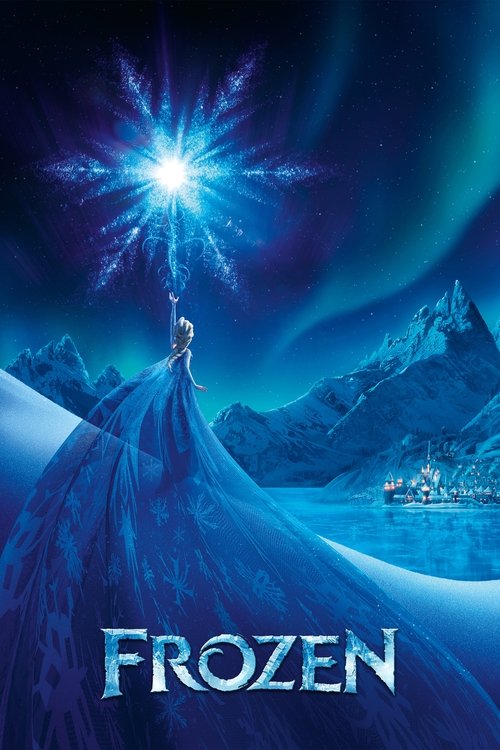
Frozen
IMDb Rating
680K
IMDb Votes
90%
Rotten Tomatoes
$1.28B
Box Office
Synopsis & Review
Directed by Chris Buck and Jennifer Lee and released in 2013, Frozen is the most commercially successful traditionally structured Disney animated feature since The Lion King — a film that arrived at precisely the right cultural moment to become a genuine global phenomenon, and whose legacy is complicated by the tension between its genuine creative ambitions and the tidal wave of marketing saturation that followed its extraordinary success. Loosely inspired by Hans Christian Andersen's fairy tale "The Snow Queen," the film follows Princess Anna (Kristen Bell) of the Nordic kingdom of Arendelle, who sets off on a quest to find her elder sister Queen Elsa (Idina Menzel) — a woman who has hidden her magical ice powers in shame her entire life, accidentally unleashed them in public during her coronation ceremony, and fled to the mountains to build an ice palace where she can finally be herself. Accompanying Anna on her quest are Kristoff (Jonathan Groff), an ice harvester, his loyal reindeer Sven, and Olaf (Josh Gad), a warm-hearted snowman brought to life by Elsa's magic who dreams, with complete innocence, of experiencing summer for the first time. The story builds toward a climax that deliberately subverts the conventional fairy tale resolution — replacing the romantic true love's kiss with a demonstration of sisterly love — in a narrative decision that was both genuinely surprising for 2013 and entirely consistent with the film's central argument.
What makes Frozen a genuine artistic achievement — rather than merely the marketing phenomenon it became — is the seriousness and emotional honesty of its central relationship. The dynamic between Elsa and Anna is the film's beating heart: two sisters separated by shame and fear, each convinced that distance is protection, each wrong in ways that cost both of them enormously. Elsa's arc — from a woman paralyzed by the belief that her authentic self is a danger to those she loves, to one who learns that love does not require concealment — was widely read, with good reason, as a powerful metaphor for LGBTQ experience, particularly for the experience of growing up closeted in a world that teaches you your true nature is shameful. Whether or not this reading was intentional, it gave the film a genuine emotional resonance with millions of viewers that purely narrative analysis cannot fully explain. Christophe Beck's score and the songs by Robert Lopez and Kristen Anderson-Lopez — particularly "Let It Go," which became one of the best-selling singles of the decade — are the most fully realized original musical compositions in a Disney film since Alan Menken's work in the 1990s. The film won two Academy Awards — Best Animated Feature and Best Original Song — grossed $1.28 billion worldwide (making it the fifth highest-grossing animated film in history at the time of its release), and generated merchandise revenue that has been estimated at over $10 billion globally.
Why Watch This Movie?
The Animation of Ice and Snow — A Technical Marvel
Disney's technical team developed entirely new simulation software called "Matterhorn" specifically to render the behavior of snow and ice convincingly — a challenge so complex that the team described it as one of the most difficult rendering problems they had ever attempted. The result is a film in which every snowflake, ice crystal, and frozen surface behaves with genuine physical accuracy. In 3D, the depth of ice palace sequences — with light fracturing through thousands of crystalline surfaces — is among the most visually spectacular things a stereoscopic animated film has achieved.
"Let It Go" — One of the Greatest Animated Musical Moments
Whatever one thinks of the film's broader cultural footprint, the sequence in which Elsa builds her ice palace while singing "Let It Go" is a genuine achievement of animated musical filmmaking. Idina Menzel's vocal performance, the choreography of Elsa's movement, and the visual design of the palace construction are perfectly integrated into a single four-minute sequence that functions simultaneously as character revelation, production design showcase, and genuinely moving musical performance. It is one of the finest sequences in the Disney animated canon.
A Disney Film That Finally Subverts "True Love's Kiss"
For eighty years, Disney animated films resolved their central conflicts through romantic love — the prince's kiss, the hero's devotion, the heterosexual union as the structural happy ending. Frozen was the first major Disney animated feature to explicitly subvert this convention, resolving its climax through sisterly love rather than romance. This was a genuinely significant creative decision that marked a real shift in Disney's approach to animated storytelling, and one that continues to reverberate through the studio's subsequent work.
Cast & Crew
Directors
Chris Buck & Jennifer Lee
Screenplay
Jennifer Lee
Songs by
Robert & Kristen Anderson-Lopez
Elsa (voice)
Idina Menzel
Anna (voice)
Kristen Bell
Kristoff (voice)
Jonathan Groff
Olaf (voice)
Josh Gad
Original Score
Christophe Beck
Studio
Walt Disney Animation
Official Trailer
© Walt Disney Animation Studios. Trailer embedded via YouTube.
Frequently Asked Questions
How faithful is Frozen to Hans Christian Andersen's "The Snow Queen"?
The film is very loosely based on Andersen's 1845 fairy tale and shares relatively little with its source material beyond the basic premise of a Snow Queen with magical ice powers. In Andersen's original, the Snow Queen is not a sympathetic protagonist but a powerful, ambiguous, somewhat menacing figure who abducts a boy named Kai by embedding shards of an enchanted mirror in his heart and eye, and the story follows a girl named Gerda who travels to rescue him. The Snow Queen herself is never humanized or given a redemptive arc — she is a force of nature rather than a character with psychology. The filmmakers, who worked on the project for nearly a decade through multiple development phases, made the transformative creative decision to reframe the Snow Queen as a sympathetic protagonist with an internal conflict, and to center the story on two sisters rather than the boy-girl friendship of the original. The setting — an Scandinavian-inspired Nordic kingdom — and the basic concept of an ice-powered queen were retained; virtually everything else was invented specifically for the film.
Why did "Let It Go" become such a global phenomenon?
The extraordinary reach of "Let It Go" — which was performed in forty-two languages for international releases of the film, topped charts in dozens of countries, and became one of the best-selling digital singles of the decade — can be attributed to several factors working simultaneously. Structurally, the song is an exceptionally well-constructed power ballad: it has a clear dramatic arc, a chorus that functions as both emotional release and narrative statement, and a melody simple enough to be memorable after a single hearing. Idina Menzel's vocal performance is one of the most technically demanding and emotionally committed in the Disney musical canon. But beyond its craft, the song resonated because its core message — "I'm done hiding who I am and I don't care what you think anymore" — spoke to an enormous range of listeners who found in it an anthem for their own experiences of shame, concealment, and the liberation of self-acceptance. This universality of emotional application, rather than any single specific reading, is what elevated it from a successful animated film song to a genuine cultural touchstone.
Is Frozen II worth watching after the original?
Frozen II (2019) is a sequel of genuine ambition that is both more visually spectacular and significantly more narratively complex than the original — qualities that make it a more interesting film for adults but a somewhat harder watch for the very young children who formed the original's core audience. The sequel expands the world of Arendelle into the mythology of the Enchanted Forest, explores the origin of Elsa's powers, and gives both sisters more emotionally complex arcs than the original. The songs, again by Robert Lopez and Kristen Anderson-Lopez, include "Into the Unknown" — another major set piece for Elsa — and "Show Yourself," which many consider the emotional superior of "Let It Go." The film grossed $1.45 billion worldwide, surpassing the original, and is widely seen as the rare sequel that respects and deepens its source material rather than simply capitalizing on it. Whether you find it better or worse than the original depends largely on whether you preferred the first film's emotional simplicity or would welcome greater narrative and thematic complexity.
More 3D Films Like This
If you loved Frozen, these animated adventures will warm your heart just as much.