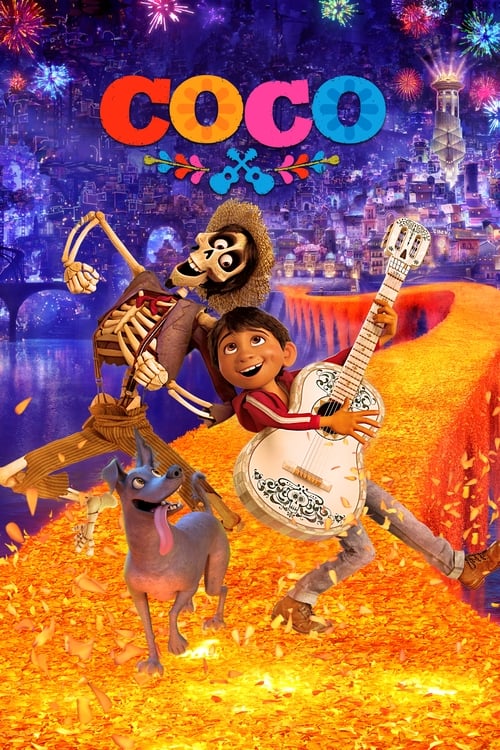
Coco
IMDb Rating
800K
IMDb Votes
97%
Rotten Tomatoes
$807M
Box Office
Synopsis & Review
Directed by Lee Unkrich and Adrian Molina and released in 2017, Coco is Pixar's most visually audacious film and one of its most emotionally complete — a work that builds its world with extraordinary attention to cultural specificity and then uses that world to deliver an emotional payoff of devastating beauty. Miguel (Anthony Gonzalez) is a twelve-year-old boy in the Mexican village of Santa Cecília who dreams of becoming a musician despite his family's absolute prohibition on music — a ban that stretches back generations to when Miguel's great-great-grandfather abandoned his family to pursue his musical career. On Día de Muertos (the Day of the Dead), Miguel accidentally crosses over into the Land of the Dead, where the spirits of his ancestors — a vivid, bickering, deeply loving extended family — are gathered for the holiday. To return to the living world before sunrise, Miguel must get the blessing of a family member, but every blessing comes with the condition that he give up music. Convinced that his great-great-grandfather was the legendary singer Ernesto de la Cruz (Benjamin Bratt) — whose guitar he played before crossing over — Miguel sets off across the Land of the Dead with the hapless but warm-hearted Héctor (Gael García Bernal) to find him, not realizing that the truth about his family's past is both stranger and more important than the story he believes.
What makes Coco so remarkable is the discipline with which it connects its spectacular world-building to its emotional argument. The Land of the Dead — a towering, luminous, staggeringly colorful city built on the concept of the marigold bridge — is one of the most fully realized and visually inventive environments in the history of animated film. The production team made extensive research trips to the Oaxaca region of Mexico, consulting with cultural experts, artists, and community members to ensure that the film's depiction of Día de Muertos, Mexican family culture, and the visual vocabulary of the Land of the Dead was both authentic and respectful. The result is a film that feels genuinely rooted in a specific cultural tradition rather than appropriating its surface aesthetics — a distinction that matters and that audiences and critics from that tradition recognized and celebrated. The film's central theme — that the dead truly die only when they are forgotten, and that to remember someone is to keep them alive — is the most beautiful argument for the importance of family memory and cultural continuity that any mainstream animated film has ever made. The final sequence, in which Miguel sings "Remember Me" to the elderly, dementia-affected Coco, is among the most devastating emotional climaxes in Pixar's extraordinary catalog. The film won two Academy Awards — Best Animated Feature and Best Original Song — and grossed $807 million worldwide. In Mexico, it broke box office records and became the highest-grossing film of all time in that country at the time of its release.
Why Watch This Movie?
The Most Visually Spectacular World in Pixar History
The Land of the Dead is a genuinely staggering achievement of animated world-building — a city of towering, marigold-lit towers where millions of skeletal spirits live, work, and gather for the holiday, rendered with a density of detail and a richness of color that makes every frame worth pausing to examine. In 3D, the depth of this world — with marigold bridges stretching into the distance, layers of city rising into the sky — is the most visually immersive experience in any Pixar film. The film's marigold orange and cobalt blue color palette is one of the most distinctive and beautiful in the history of animated cinema.
The Final Scene — The Most Devastating Moment in Pixar History
The scene in which Miguel returns from the Land of the Dead and sings "Remember Me" to his elderly great-great-grandmother Coco — who has been lost to dementia throughout the film but recognizes the song her father used to sing to her — is one of the most emotionally overwhelming finales in the history of animated cinema. It is a scene about memory, love, dementia, and the way music can reach through the fog of cognitive decline to touch something that clinical language cannot access. It consistently reduces adult audiences to tears and has been described by many parents as one of the most unexpectedly devastating cinema experiences of their lives.
A Celebration of Mexican Culture Done With Genuine Respect
Pixar spent six years in pre-production, making multiple research trips to Mexico and consulting extensively with Mexican-American scholars, artists, and cultural consultants to ensure the film's depiction of Día de Muertos, Mexican family dynamics, music, food, and visual culture was authentic rather than stereotypical. The result is a film that Mexican audiences embraced with enormous warmth — it became the highest-grossing film in Mexican box office history at the time of its release — and that is widely regarded as one of the most respectful and successful depictions of a specific non-Anglo cultural tradition in mainstream American animated film.
Cast & Crew
Directors
Lee Unkrich & Adrian Molina
Screenplay
Adrian Molina & Matthew Aldrich
Producer
Darla K. Anderson
Miguel (voice)
Anthony Gonzalez
Héctor (voice)
Gael García Bernal
Ernesto de la Cruz (voice)
Benjamin Bratt
Imelda (voice)
Alanna Ubach
Original Score
Michael Giacchino
Studio
Pixar / Walt Disney
Official Trailer
© Pixar Animation Studios / Walt Disney Pictures. Trailer embedded via YouTube.
Frequently Asked Questions
What is Día de Muertos and how accurately does Coco portray it?
Día de Muertos, or Day of the Dead, is a Mexican holiday celebrated on November 1st and 2nd that honors deceased family members. Contrary to the common misconception that it is a mournful occasion, it is traditionally a joyful celebration — families build elaborate altars (ofrendas) decorated with marigold flowers, the favorite foods and possessions of the deceased, and photographs, and gather at cemeteries to eat, drink, tell stories, and commune with the spirits of those who have passed. The underlying spiritual belief, which the film depicts with remarkable accuracy, is that the dead can return to visit the living during this holiday as long as their photos remain on an ofrenda — without a photo, a spirit cannot cross back. The film's cultural consultants, who included Mexican-American scholars, artists, and Pixar employees, confirmed that the film depicts the holiday with genuine accuracy and respect. Mexican audiences embraced the film enthusiastically, and it is widely regarded in Mexico as one of the most authentic and honoring depictions of Mexican culture in mainstream Hollywood cinema.
What is the concept of the "final death" in Coco?
One of the most moving and philosophically original ideas in Coco is the concept of the "final death" — the second, permanent death that a spirit in the Land of the Dead experiences when the last living person who remembers them forgets them or dies. In the film's cosmology, a spirit exists in the Land of the Dead for as long as someone in the Land of the Living remembers them and keeps their photo on an ofrenda. When the last memory of them fades, they dissolve entirely — a true and final end. This concept is not drawn directly from traditional Día de Muertos belief but is an original invention of the filmmakers that grows organically from the holiday's underlying logic: that remembering the dead keeps them alive in a meaningful sense. The idea gives the film its most emotionally devastating stakes — Héctor's desperation is not merely about being forgotten but about ceasing to exist entirely — and makes the final scene, in which Coco's memory of her father is preserved just in time, a genuinely harrowing emotional climax about the relationship between love, memory, and existence.
How did Pixar build the Land of the Dead?
The Land of the Dead required Pixar to develop entirely new rendering and simulation tools to achieve the density, scale, and luminosity the filmmakers envisioned. The city contains millions of individual structures, lights, and spirits — a complexity of scale that exceeded anything the studio had attempted before. The marigold glow that permeates the entire world required new lighting algorithms capable of rendering the way bioluminescent orange light scatters through an urban environment at enormous scale. The marigold bridge — the translucent, petal-strewn pathway between the Land of the Living and the Land of the Dead — required new simulation software for the physics of millions of individual flower petals in motion. The production team drew their architectural inspiration from the cliff-side cities of Guanajuato in Mexico, the terraced housing of Oaxaca, and pre-Columbian Mesoamerican architecture, layering these references into a city that feels both fantastical and culturally grounded. The film contains more unique character designs than any previous Pixar production — the background crowds of the Land of the Dead include hundreds of individually designed skeleton characters, each with their own distinct personality and visual style.
More 3D Films Like This
If you loved Coco, these animated masterpieces will move you just as deeply.