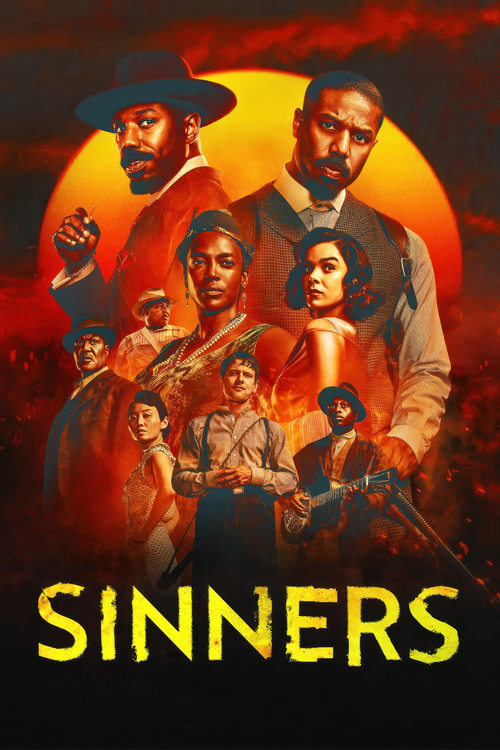
SINNERS
IMDb Rating
148K+
IMDb Votes
96%
Rotten Tomatoes
$445M
Box Office
Synopsis & Review
The Mississippi Delta, 1932. Twin brothers Smoke and Stack (both played by Michael B. Jordan) return to their Louisiana hometown after years of running with Al Capone's outfit in Chicago — carrying enough money, confidence, and hard-earned pragmatism to do something they have always wanted: open a juke joint. A place for Black people to drink, dance, listen to blues, and exist for a few hours beyond the reach of the Jim Crow world outside. They lease a building from a local white landowner, recruit musicians and workers from the community, and prepare to open on a single magical night. Among those who answer the call is Sammie Moore (Miles Caton), their young cousin — a boy who plays guitar with a gift so extraordinary that it seems less like talent than like something that chose him. The evening begins with joy, with music, with the specific electricity of a community gathering in defiance of everything that wants to diminish it. And then, drawn by the sound of the blues from somewhere older than the Delta itself, something arrives at the door and asks to be let in.
Ryan Coogler wrote Sinners — his first original screenplay — as a deliberate break from the franchise filmmaking that occupied the decade between Fruitvale Station and this film. The result is the most fully realised work of his career: a film that uses the grammar of vampire horror to explore the specific terror of a community that has already survived centuries of violence, and that finds in that community's music not merely entertainment but a form of spiritual resistance. The decision to shoot on film — genuine 35mm and large-format analogue stock — gives Sinners a warmth and a grain that digital cannot replicate, and cinematographer Autumn Durald Arkapaw uses the Delta's specific quality of light — low, golden, laden with heat and history — to create images of extraordinary beauty and unease simultaneously. Jordan's dual performance is extraordinary: Smoke and Stack are visually identical and temperamentally distinct in ways that go far beyond surface characterisation, and Jordan manages them simultaneously with a physical specificity that makes them feel like genuinely different people sharing a face. The film earned a 96% on Rotten Tomatoes and has been discussed widely as the best horror film of the past decade and as a serious Awards contender. It is absolutely both.
Why Watch This Movie?
Horror That Actually Means Something
The horror genre at its most ambitious uses the supernatural to illuminate something true about the real world — and Sinners does this with greater intelligence and deeper conviction than any American horror film since Jordan Peele's Get Out. The vampires in Coogler's film are not merely monsters; they are a manifestation of a specific threat that Black communities in 1930s Mississippi understood viscerally. What they offer — belonging, safety, the end of suffering — is exactly what a Jim Crow society denied. That the price of accepting their offer is your soul and your community's independence is not metaphor. It is history wearing a different face.
The Music Is the Soul of the Film
Ludwig Göransson composed a score for Sinners that is simultaneously an original film score and a historical document — drawing on the specific musical traditions of the 1930s Delta blues while creating something that could only exist in a film. The live musical performances in the juke joint sequences are extraordinary: the film uses extended takes of actual musical performance rather than cutting around them, which means that when the blues reaches its peak in the film's centrepiece sequence, you feel what the characters feel. Sammie Moore's guitar playing — performed by Miles Caton, a genuine blues prodigy discovered through Coogler's casting search — is the most electrifying musical performance in any 2025 film.
An Entirely Original Vision Shot on Film
In a year dominated by sequels, remakes, and franchise entries, Sinners is a $90 million original genre film from a major studio — shot on analogue film stock rather than digitally, featuring no prior IP, and trusting its audience to follow a director's specific vision without the safety net of pre-existing recognition. That this gamble resulted in one of the year's biggest critical successes and a commercially profitable release is as important as the film itself: it is a proof of concept for original cinema at the highest level of studio investment, and Coogler's achievement here makes a compelling argument for what that cinema can accomplish.
Cast & Crew
Director / Writer
Ryan Coogler
Studio
Warner Bros. / Proximity
Original Score
Ludwig Göransson
Smoke / Stack
Michael B. Jordan
Mary
Hailee Steinfeld
Sammie Moore
Miles Caton
Delta Slim
Delroy Lindo
Remmick
Jack O'Connell
Cinematography
Autumn Durald Arkapaw
Official Trailer
© Warner Bros. Pictures / Proximity Media. Trailer embedded via YouTube.
Frequently Asked Questions
Is Sinners a pure horror film or something more?
Sinners defies easy genre categorisation, which is partly why it generated such passionate critical response. It is a horror film in its mechanics — there are genuine scares, sustained dread, and a climactic siege sequence that ranks among the most expertly constructed in the genre — but it is equally a period drama about Black community and survival in the Jim Crow South, a film about the origins and power of the blues, and a character study of two brothers carrying the weight of everything they have done to survive. The horror elements are never decorative; they are organically integrated into the historical and emotional context in a way that makes the supernatural elements feel like a natural extension of the world rather than an imposition on it. If you enjoy smart, ambitious genre filmmaking in the tradition of John Carpenter's The Thing or Jordan Peele's work, Sinners is essential viewing.
Why did Ryan Coogler shoot on film rather than digitally?
Coogler and cinematographer Autumn Durald Arkapaw have cited several interconnected reasons for choosing analogue film stock. Practically, the grain structure of 35mm and large-format film creates a visual texture that is indistinguishable from actual 1930s photographic material in certain conditions, giving the film a period authenticity that no digital colour grade can fully replicate. Philosophically, Coogler has spoken about film stock as itself a historical medium — the same technology that would have been used to document the world of the film, if anyone had been documenting it. And aesthetically, the way analogue film renders skin tones, particularly in low and firelight conditions, was essential to Coogler's vision for the juke joint sequences. The film was shot across multiple formats — 35mm, VistaVision, and Techniscope — each deployed for specific emotional purposes within the narrative.
How graphic is the violence in Sinners?
The film is rated R and the rating is earned — Sinners does not pull its punches in its horror sequences. The violence is purposeful rather than gratuitous; Coogler uses it to ensure that the threat the vampires represent is genuinely felt rather than abstractly understood. The film's most intense sequences are not gratuitously gory but are genuinely frightening and disturbing in a way that requires the audience to sit with discomfort. Viewers who are sensitive to horror violence should be aware that the film's third act in particular is sustained and intense. The film is not appropriate for children or viewers who find horror genre violence distressing, but for audiences comfortable with the genre it is expertly calibrated — terrifying rather than exploitative.
What is the significance of the blues in the film's mythology?
The blues occupies a central and theologically significant role in the film's supernatural mythology — one that the film gradually reveals rather than explains upfront, and which is best discovered in the watching. Coogler draws on actual folkloric traditions surrounding blues music in the Mississippi Delta, including the mythology of the "crossroads deal" most famously associated with Robert Johnson, and extends these traditions into something original and specific to the film's world. The supernatural entities in Sinners are drawn to the blues for reasons that the film treats as cosmologically meaningful rather than incidental — the music functions as a kind of signal, or summons, or key, whose implications the film unpacks across its second and third acts. The music is not incidental to the horror. It is the origin of it.
More Movies Like This
If you loved Sinners, these films belong on your watchlist.