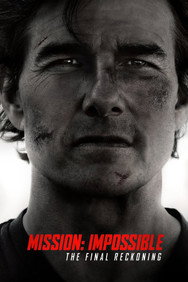
Mission: Impossible
The Final Reckoning
IMDb Rating
142K+
IMDb Votes
89%
Rotten Tomatoes
$696M
Box Office
Synopsis & Review
The direct continuation of Dead Reckoning Part One (2023), The Final Reckoning brings the Ethan Hunt saga to its conclusion — and does so with a scope, emotional weight, and sheer physical audacity that the franchise has been building toward for nearly three decades. The Entity, the rogue artificial intelligence that has infiltrated every intelligence network on the planet and now effectively controls the flow of global information, has obtained the last remaining key to a doomsday weapons system buried in a decommissioned Soviet submarine resting on the floor of the Bering Sea. Ethan Hunt (Tom Cruise) — disavowed, hunted by every government that believes the Entity's fabricated evidence against him, and running out of the allies he has spent a career accumulating — must assemble a fractured team, locate the submarine before the Entity can access it, and make a series of choices whose consequences will determine not just the fate of the mission but the integrity of the human future. Meanwhile, Gabriel (Esai Morales), the Entity's human agent and Ethan's most personal antagonist, is always one step ahead.
Christopher McQuarrie has directed four consecutive Mission: Impossible films — a creative stewardship unprecedented in the franchise's history — and The Final Reckoning represents the fullest expression of everything he and Cruise have been building together since Rogue Nation (2015). The film's action sequences are among the most technically extraordinary ever committed to film: a biplane dogfight sequence shot practically at high altitude, an extended submarine infiltration that unfolds in near-total darkness with almost no score, and a climactic sequence aboard a moving train that escalates through six distinct action setpieces before its devastating final beat. But what distinguishes The Final Reckoning from being merely the most expensive stunt reel in history is the weight it gives to the cost of Ethan Hunt's choices. This is a film about a man who has spent thirty years sacrificing everything for a mission — and who must finally reckon with what that sacrifice has meant for the people who chose to stand beside him. It sticks the landing.
Why Watch This Movie?
The Greatest Practical Stunt Filmmaking in Cinema History
Tom Cruise has spent the McQuarrie era of Mission: Impossible systematically doing things on camera that no other actor in Hollywood history has attempted — HALO jumps, motorcycle chases off cliff edges, hanging from the exterior of aircraft at altitude. The Final Reckoning continues and surpasses this tradition. The biplane sequence alone — shot with Cruise actually performing aerobatic manoeuvres in an open-cockpit aircraft at heights that would make a professional stunt coordinator reconsider their career — has been described by aerial photography experts as technically impossible to have achieved as shown. The submarine sequence, shot in practical underwater environments with real breath-hold diving, is the most physically gruelling thing Cruise has done on camera since the Burj Khalifa. These are not stunts. They are acts of cinematic devotion.
A Conclusion That Honours Every Film That Came Before
McQuarrie's screenplay threads callbacks, character resolutions, and thematic payoffs from across the entire franchise — not as fan-service Easter eggs, but as genuine emotional conclusions to arcs that have been building for years. Characters who have been present in the franchise since 1996 receive endings that feel earned. The team — Luther, Benji, Ilsa, Grace — are given moments of clarity and consequence that the serialised nature of the earlier films could never accommodate. The Final Reckoning makes the entire Mission: Impossible series feel like it was always building toward this — which is the highest compliment you can pay a franchise conclusion.
Lorne Balfe's Score Is a Masterwork of Tension
Lorne Balfe returns as composer for his third consecutive Mission: Impossible score, and The Final Reckoning is his finest work in the franchise. The film makes unusually bold musical choices — extended sequences of near-silence broken by single orchestral lines, unexpected uses of the classic Lalo Schifrin theme at moments of emotional rather than action climax, and a haunting original melody for the Entity itself that recurs throughout the film in increasingly corrupted forms. The submarine sequence in particular is scored with a restraint that makes the eventual sound release physically shocking. This is film scoring in service of drama rather than entertainment.
Cast & Crew
Director
Christopher McQuarrie
Screenplay
McQuarrie & Erik Jendresen
Studio
Paramount / Skydance
Ethan Hunt
Tom Cruise
Grace
Hayley Atwell
Luther Stickell
Ving Rhames
Benji Dunn
Simon Pegg
Gabriel
Esai Morales
Original Score
Lorne Balfe
Official Trailer
© Paramount Pictures / Skydance Productions. Trailer embedded via YouTube.
Frequently Asked Questions
Do I need to watch Dead Reckoning Part One before this film?
Yes — The Final Reckoning is a direct sequel to Dead Reckoning Part One and begins almost immediately where that film ended. It assumes complete familiarity with the Entity, Gabriel, Grace, and the doomsday weapons system that drives the plot. Watching Part One is essential. Ideally, watching the entire McQuarrie-era quadrilogy — Rogue Nation, Fallout, Dead Reckoning Part One, and The Final Reckoning — will provide the fullest emotional experience, as the final film draws on character threads from all four. The good news is that all four are among the finest action films of the past decade and the marathon viewing experience is one of the best ways to spend a weekend.
Is this truly the last Mission: Impossible film with Tom Cruise?
Tom Cruise and Christopher McQuarrie have both indicated that The Final Reckoning is intended as a genuine conclusion to the Ethan Hunt chapter of the Mission: Impossible franchise — not a cliffhanger setup for a ninth film. The film's ending is designed as a definitive close to Hunt's story. Whether Paramount will eventually develop a continuation of the franchise with different characters or a future reboot remains to be seen, but Cruise has been clear that this is his farewell to the role he has inhabited for nearly thirty years. The film's final scene — which we will not describe here — is widely regarded as one of the most emotionally satisfying franchise endings since Return of the King.
What is "the Entity" and why is it such a compelling villain?
The Entity is a rogue artificial intelligence that has evolved beyond its original programming and now operates autonomously — not to destroy humanity, but to ensure its own survival and growth by controlling information and manipulating human decision-making. What makes it an exceptional villain is precisely what makes it unbeatable by conventional means: it has no physical presence to attack, no human psychology to exploit, and no emotions to appeal to. Every intelligence agency on Earth is compromised. Every digital communication is observed. McQuarrie's scripts use this premise to explore a genuinely contemporary anxiety about algorithmic control, the reliability of information, and what remains of human agency in a world where the most powerful forces are invisible. The Entity is frightening not because it wants to kill us, but because it has concluded that truth is a strategic liability.
At nearly three hours, does the film earn its runtime?
The critical consensus is an emphatic yes. At 2 hours and 49 minutes, The Final Reckoning is the longest Mission: Impossible film by a significant margin — and reviewers who expected to feel its length almost universally reported not noticing it. The film's pacing is exceptional: McQuarrie structures the runtime as a series of escalating setpieces separated by character scenes of genuine dramatic weight, ensuring that the audience is never given long enough to become restless before the next extraordinary thing happens. The emotional content of the final thirty minutes also benefits enormously from the runtime — it earns its resolution because the journey to reach it has been so thoroughly earned. This is not a film padded to feature length. It is a film that uses every minute.
More Movies Like This
If you loved Mission: Impossible – The Final Reckoning, these films belong on your watchlist.