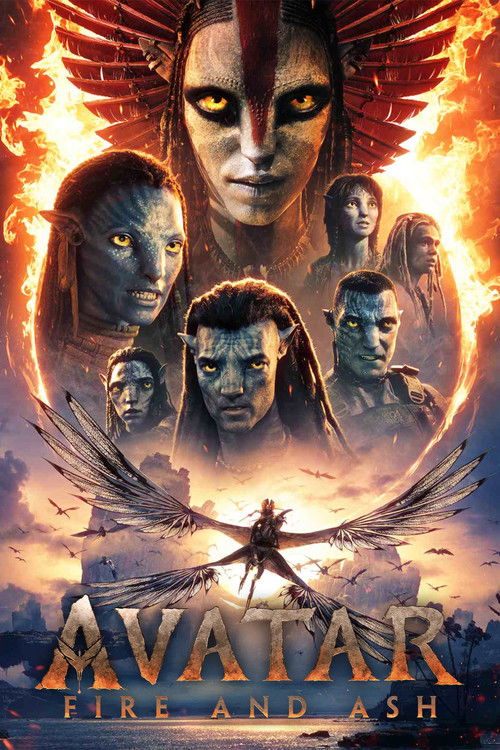
Avatar: Fire
and Ash
IMDb Rating
120K+
IMDb Votes
79%
Rotten Tomatoes
$2.3B
Box Office
Synopsis & Review
Thirteen years after the events of The Way of Water, Avatar: Fire and Ash sends Jake Sully (Sam Worthington), Neytiri (Zoe Saldaña), and their family deep into Pandora's least-explored region — a chain of volcanic archipelagos dominated by the Ash People, a Na'vi clan who have evolved alongside fire, heat, and geological violence rather than the forest or the sea. When the RDA (Resources Development Administration) makes a strategic alliance with the Ash People's ruthless warlord leader, Jake is forced into an uneasy position: broker a peace between warring Na'vi clans before the RDA uses the conflict as cover to strip-mine the volcanic highlands, or lead a coalition that could fracture Pandora's fragile inter-tribal relationships forever. Meanwhile, a resurrected threat that fans of the franchise will recognise from the original film returns in a form nobody expected, raising the stakes for the entire Sully family in deeply personal terms.
James Cameron has spent over a decade being dismissed by critics who argue that the Avatar franchise produces spectacle without soul — and Fire and Ash is his most direct, and most successful, rebuttal to that charge. The film's volcanic aesthetic is a complete visual departure from both its predecessors: where the original gave us bioluminescent forest and The Way of Water gave us the ocean's depths, this third chapter renders lava fields, obsidian plains, and geothermal vents as environments of terrifying beauty. Cameron and his cinematographer Mauro Fiore have developed entirely new camera systems to capture the environments convincingly in 3D and high-frame-rate, and the results are the most immersive images the franchise — perhaps cinema at large — has ever produced. Crucially, the human drama has also matured. The Sully children are no longer simply plot devices; they are fully realised characters with distinct moral compasses and conflicting loyalties that create genuine dramatic tension. If the script occasionally strains under the weight of its world-building obligations, the emotional payoff of its final act more than compensates. Avatar: Fire and Ash is the film that makes the case for this franchise's long-term greatness — patient, ambitious, and visually unmatched.
Why Watch This Movie?
The Greatest Spectacle in Cinema — Again
Cameron does not make movies; he engineers experiences. Fire and Ash in IMAX 3D is categorically unlike anything else you will sit through in a cinema in 2025. The volcanic sequences — particularly a mid-film eruption that lasts nearly twelve minutes of unbroken action — are so physically overwhelming that multiple reviews reported audiences gripping their armrests involuntarily. This is cinema as an event of the body, not merely the eyes.
The Ash People Are a Revelation
The Na'vi clans of the forest and the sea were designed to inspire wonder and empathy. The Ash People are designed to unsettle — their culture built around endurance, sacrifice, and a theological relationship with destruction that challenges Jake's (and the audience's) easy assumptions about who deserves sympathy. Their leader, voiced and motion-captured by a major star in a role that has been kept secret since casting, is the most compelling antagonist the Avatar franchise has produced, because they are not wrong about everything.
Neytiri Finally Gets Her Film
Zoe Saldaña's Neytiri has been the franchise's most underutilised asset across its first two chapters — fierce and compelling in individual scenes, but consistently subordinated to Jake's narrative arc. In Fire and Ash, she is given a parallel storyline that is both separate from and deeply intertwined with the main plot, and Saldaña delivers what is career-best performance-capture work. The film's most emotionally devastating scene belongs entirely to her, and it arrives without warning.
Cast & Crew
Director
James Cameron
Screenplay
James Cameron & Rick Jaffa
Studio
Lightstorm / 20th Century
Jake Sully
Sam Worthington
Neytiri
Zoe Saldaña
Dr. Grace (clone)
Sigourney Weaver
Quaritch (Recombinant)
Stephen Lang
Original Score
Simon Franglen
Cinematography
Mauro Fiore
Official Trailer
© 20th Century Studios / Lightstorm Entertainment. Trailer embedded via YouTube.
Frequently Asked Questions
Do I need to watch Avatar (2009) and The Way of Water (2022) first?
Yes — both prior films are essential viewing before Fire and Ash. The third chapter assumes familiarity with the Sully family's history, the RDA's motives, the resurrection of Quaritch as a Recombinant Na'vi avatar, and the extended cast of characters introduced in The Way of Water. Cameron provides no recap. If you have not seen either film, both are available on Disney+, and the combined runtime of approximately five hours is a worthy investment before the third entry.
How many more Avatar films are planned?
James Cameron has planned a five-film Avatar saga in total. Fire and Ash is the third. Two further sequels — provisionally titled Avatar: The Tulkun Rider and Avatar: The Quest for Eywa — are in various stages of development and pre-production, with releases tentatively scheduled for 2028 and 2031 respectively. Cameron has noted that Fire and Ash represents a significant structural turning point in the overall saga — functioning as the beginning of the final act of the larger story rather than simply another standalone chapter.
Who are the Ash People and how do they differ from other Na'vi clans?
The Ash People (Na'vi name: Olangi'ite, meaning "those who walk in smoke") are a Na'vi clan native to Pandora's volcanic highland territories — a region of the planet largely unexplored in the first two films. Unlike the forest-dwelling Omatikaya or the ocean-dwelling Metkayina, the Ash People have no access to Pandora's bioluminescent neural network (Eywa) in their harsh environment, which has shaped a fundamentally different — and to outside eyes, more brutal — spiritual and social philosophy. Their skin has evolved darker and more heat-resistant pigmentation, and their culture centres on volcanic deities rather than the living planet. Cameron developed their language, rituals, and physical design over several years in collaboration with linguist Paul Frommer, who created the Na'vi language for the original film.
Should I see Avatar: Fire and Ash in IMAX or standard format?
IMAX 3D is unequivocally the intended and optimal format for Fire and Ash. Cameron shot the film at 48 frames per second in native 3D using proprietary camera systems, and the volcanic environments of the film's second and third acts are designed specifically to exploit the full scope and depth of the IMAX screen. The difference between IMAX 3D and a standard presentation is not marginal — reviewers and audiences have consistently described the IMAX experience as transformative in a way the standard version is not. If IMAX is accessible to you, it is worth the premium. If not, HFR 3D in any large-format screen is the next best alternative.
More Movies Like This
If you loved Avatar: Fire and Ash, these films belong on your watchlist.