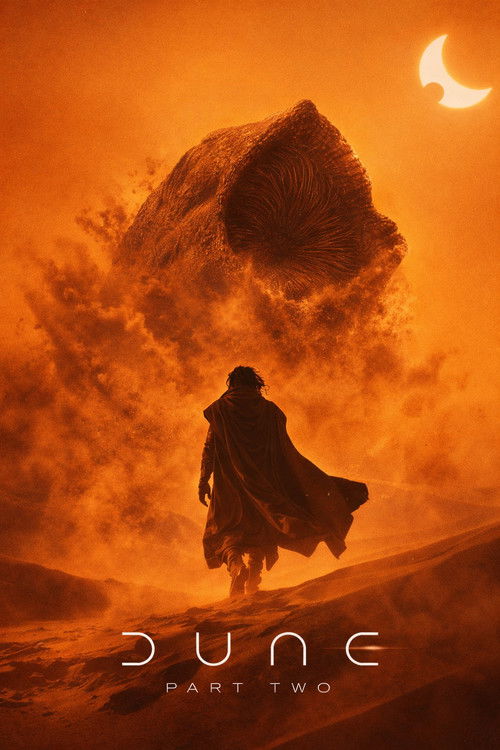
Dune: Part Two
IMDb Rating
450K+
IMDb Votes
92%
Rotten Tomatoes
$714M
Box Office
Synopsis & Review
Having survived the slaughter of House Atreides and taken refuge among the Fremen of Arrakis, Paul continues his ascent toward a destiny he both desires and dreads. As he deepens his bond with the warrior Chani and gains standing among Stilgar's people, the political and religious machinery around him — his mother Jessica's manipulation of Fremen prophecy, the Harkonnens' brutal grip on spice production, and the Emperor's own schemes — pushes him inexorably toward a holy war he can see coming and cannot find a way to stop.
Few studios would greenlight a nearly three-hour sequel built around a sandworm-summoning ritual and a holy war its protagonist actively dreads, but Denis Villeneuve's Dune: Part Two earns every minute of its considerable runtime, delivering the rare blockbuster sequel that improves on a genuinely strong predecessor in nearly every respect. Villeneuve's command of scale — a black-and-white Harkonnen homeworld sequence alone reframes what a comic-book-adjacent action set piece can look like — is matched by a script, co-written with Jon Spaihts, that takes Paul Atreides's hero's journey and systematically interrogates it, refusing the easy catharsis most chosen-one narratives offer. Zendaya, given far more to do than the first film allowed, anchors the back half as Chani's growing horror at what Paul is becoming provides the film's moral conscience, while Austin Butler's feral, near-unrecognizable turn as Feyd-Rautha gives the Harkonnen sequences a genuinely unsettling new gear. Hans Zimmer's score remains a force of nature in its own right. It is rare for a franchise this scale to end its middle chapter on a note this morally unresolved, and rarer still for audiences and critics to reward that ambiguity as overwhelmingly as they did.
Why Watch This Movie?
One of the Best-Reviewed Blockbusters of the Decade
Dune: Part Two earned near-universal critical acclaim and among the highest audience scores of any major 2024 release, a rare instance of a sequel widely considered superior to its already well-regarded predecessor.
A Visually Audacious Black-and-White Sequence
Villeneuve and cinematographer Greig Fraser stage an entire Harkonnen homeworld sequence in stark monochrome to simulate the planet's black sun, producing one of the most striking images in any 2024 film.
Austin Butler's Genuinely Terrifying Feyd-Rautha
Butler's near-unrecognizable performance as the psychopathic Harkonnen heir adds a jolt of menace that elevates every scene he appears in.
It Refuses an Easy, Triumphant Ending
Rather than delivering a straightforward hero's victory, the film interrogates the cost of Paul's rise to power, leaving audiences with a finale that's as unsettling as it is spectacular.
Cast & Crew
Director
Denis Villeneuve
Screenplay
Jon Spaihts & Denis Villeneuve
Studio
Legendary / Warner Bros.
Paul Atreides
Timothée Chalamet
Chani
Zendaya
Lady Jessica
Rebecca Ferguson
Feyd-Rautha
Austin Butler
Original Score
Hans Zimmer
Official Trailer
© Legendary Pictures / Warner Bros. Pictures. Trailer embedded via YouTube.
Frequently Asked Questions
Do I need to watch Dune (2021) before this one?
Yes, essential. Dune: Part Two picks up immediately where the first film ended and assumes full familiarity with House Atreides's betrayal, Paul and Jessica's flight into the desert, and the political structure of the Imperium. It is not designed to function as a standalone film.
Is there a Dune: Part Three planned?
Yes. Denis Villeneuve has confirmed he is developing a third film adapting Frank Herbert's Dune Messiah, the direct literary sequel, though it had not yet entered production as of this writing.
Why does part of the film appear in black and white?
The Harkonnen homeworld of Giedi Prime orbits a black sun that emits light outside the human visible spectrum, so Villeneuve and cinematographer Greig Fraser shot those sequences using infrared-sensitive cameras, producing the stark monochrome look as a way to visualize an alien environment rather than as a stylistic flourish alone.
How closely does the film follow Frank Herbert's novel?
Fairly closely in broad strokes, though Villeneuve and co-writer Jon Spaihts made notable changes — particularly expanding Chani's skepticism toward Paul's rise and the religious mythology surrounding him — to sharpen the story's critique of messianic narratives for a modern audience.
More Movies Like This
If you loved Dune: Part Two, these films belong on your watchlist.